JondaX standardises lab results and at-home medical device data from any source, any format, any language into clean, harmonised records matching whatever standard your research pipeline requires.
The harmonisation burden
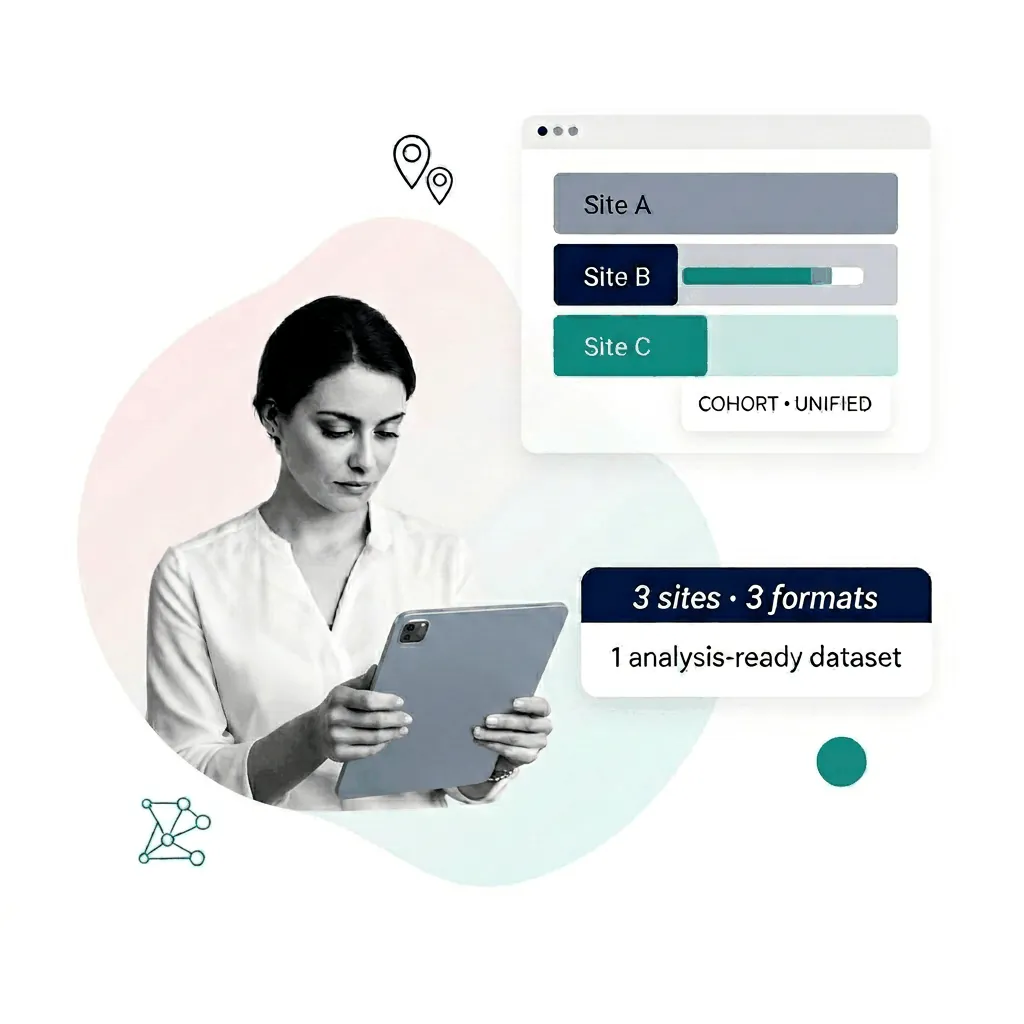
Multi-site studies, cross-regional cohorts, and longitudinal datasets all have the same invisible cost: the months before analysis begins, spent reconciling lab formats, at-home device readings, unit systems, terminology, and coding inconsistencies. JondaX moves that cost out of your research cycle entirely.
Lab A reports fasting blood glucose in mmol/L as "Fasting blood glucose." Lab B reports it in mg/dL as "FBG." Lab C assigns its own internal code with a unit string that doesn't match either. Your team writes reconciliation logic every time a new site joins the study.
Before you can run a single cohort query, you are parsing PDFs from one site, HL7 feeds from another, and CSV exports from a third, writing cleaning scripts, and resolving terminology mismatches. Weeks of preparation for hours of insight.
Ad hoc data cleaning scripts are hard to audit and harder to replicate. When reviewers ask how you normalised across sites, the answer needs to be documented, not reconstructed.
Multi-site lab data is challenging. Patient-recorded diary data and at-home device readings (blood pressure, glucose, weight, symptom logs) are harder still. Every patient records differently, in different units, sometimes in different languages. Photo-captured readings solve evidence, but the images then need harmonising alongside the lab data.
THE SOLUTION
JondaX accepts lab data and at-home medical device data from any site, in any format, in any language, and returns clean, harmonised records standardised to your research pipeline's specification, without any preprocessing.
Accepts any source, as-is. Lab results, at-home medical device data, PDFs, HL7, FHIR, images, CSV, from any source.
Codes applied to your ontology. Whatever ontology your research pipeline requires, including LOINC. SNOMED on the roadmap.
Units harmonised, end to end. Across all measurement systems, using internationally recognised conversions.
10+ languages processed natively. English, Bahasa Indonesia, Spanish, French, and more, no preprocessing required.
Output in the format your pipeline expects. FHIR XML, FHIR JSON, JSON, HL7, CSV, pipeline-ready, every time.
Reproducible by design. Every transformation logged with full provenance. Same input, same output, always.
Photo-captured device readings, harmonised. At-home device images harmonised alongside lab data in the same pipeline.
Research-grade capabilities
Configurable coding, unit harmonisation, reproducible transforms, and full provenance as a standard, not a bolt-on.
Codes applied to whatever ontology your research pipeline requires, including LOINC. Consistent terminology across all sites, all languages, all input formats. SNOMED is on the roadmap.
mmol/L, mg/dL, umol/L, every unit harmonised to your target measurement system using internationally recognised conversions. No manual conversion logic required.
Lab data from Singapore, Indonesia, Spain, France, and beyond. 10+ languages processed natively including English, Bahasa Indonesia, Spanish, and French, no translation preprocessing required.
Every transformation logged: input text, output value, mapping applied, confidence score, timestamp, transformation ID. Reviewers get documented answers, not reconstructed ones.
FBC, U&E, LFTs, and other safety lab results from multi-site trials processed automatically. Manual harmonisation cannot keep up with 24-hour safety reporting requirements.
Low-quality scans and photos processed via OCR with human-in-the-loop verification for clinical accuracy. Critical for sites where digital lab reports are not always available.
Research teams typically manually enter lab data from heterogeneous formats into research databases. In GCP-governed studies, that manual entry requires 100% verification by a second person. JondaX structures source lab data automatically.
Patient-recorded diary data and at-home device readings (blood pressure, glucose, weight, symptom logs) harmonised into your research pipeline alongside lab biomarkers. Photo-captured readings provide audit-grade evidence manual entries cannot.
Straight answers to the questions that come up when evaluating JondaX.
Yes. JondaX is designed for multi-source ingestion. You can send data from any number of labs or clinical sites in a single pipeline. Each record is harmonised to your target coding system and unit standard, regardless of the source format or language. The result is a cohort-ready dataset where every biomarker is directly comparable across sites. This means your analysis can start on day one of database lock instead of waiting for site-by-site reconciliation work to finish.
Every transformation is logged with full provenance: input text, output value, mapping applied, confidence score, timestamp, and transformation ID. The same input always produces the same output. When reviewers ask how you harmonised across sites, the answer is documented and reproducible. This means your study passes audit on the data-handling layer without your team reconstructing cleaning decisions from memory or old scripts.
JondaX maps to whatever coding system your research pipeline requires, including LOINC (lab and clinical observations). SNOMED is on the roadmap. Unmapped or low-confidence data is sent for review, with a two-person independent review process in place. This means your research data conforms to whatever standard your study protocol specifies, not a tool-imposed default.
Yes, via Pathology Pro. The OCR-capable module handles low-quality scans, photographs of lab reports, and printed documents. For clinical research requiring high accuracy, Pathology Pro includes a two-step independent review by our in-house team for low-confidence extractions. This means you can include data from sites without digital lab reporting in your primary cohort, not just in a separate "paper sites" secondary analysis.
JondaX de-identifies data on ingestion within your selected residency region (Singapore, EU, or US). Additional residency regions are available on enterprise plans. Data is retained for 30 days for error resolution, then purged. JondaX is ISO 27001 certified and designed to comply with HIPAA, GDPR, and PDPA. DPA and BAA are executed automatically on signup. This means your IRB/ethics submission, your data-protection impact assessment, and your sponsor governance review all have documented answers without bespoke negotiations.
Yes. JondaX supports the data structuring and harmonisation workflows needed in GCP-governed research. The platform captures traceable processing, controlled transformations, and an audit-oriented architecture that aligns with GCP data-integrity principles. Full GCP compliance depends on the complete study process (SOPs, system validation, user controls, sponsor and site procedures) beyond any single tool's scope. This means JondaX fits into your validated GCP environment as a data layer without becoming the compliance bottleneck.
Patient-recorded diary data and at-home medical device readings (blood pressure, glucose, weight, symptom logs) are harmonised into your research pipeline alongside lab biomarker data. Photo-captured readings provide audit-grade evidence that manual text entries cannot. The same harmonisation pipeline applies: configurable coding, unit harmonisation, full provenance logging. This means your longitudinal or decentralised study designs have a single ingestion layer for lab and at-home data, not parallel workflows that have to be reconciled later.
Medidata, Veeva Vault, and similar platforms focus on electronic data capture (EDC), case report forms, and study management workflows. JondaX focuses on harmonising the heterogeneous source data that flows into those platforms: multi-site lab outputs, scanned reports, at-home device readings, patient-recorded data. JondaX runs alongside your existing EDC, not as a replacement. This means you can solve the data harmonisation problem without replacing the platforms your study is already built on.
30 free transformations across pathology and medical devices. No credit card required.
No credit card. No sales call. 30 free transformations across pathology and medical devices included so you can evaluate JondaX with your own data.
Create free account →Upload real files. See the output quality. Test with your own lab reports or device photos. No commitment required.
View API docs →Ready to integrate? Purchase a subscription and get your production API key. Most teams are live within around two weeks.
See pricing →