JondaX Pathology is a lab report API. Transform lab results from any specimen type, any format, any language into clean, coded, system-ready output. Core for digital files. Pro for scans, photos, and complex documents with OCR and human-in-the-loop verification.
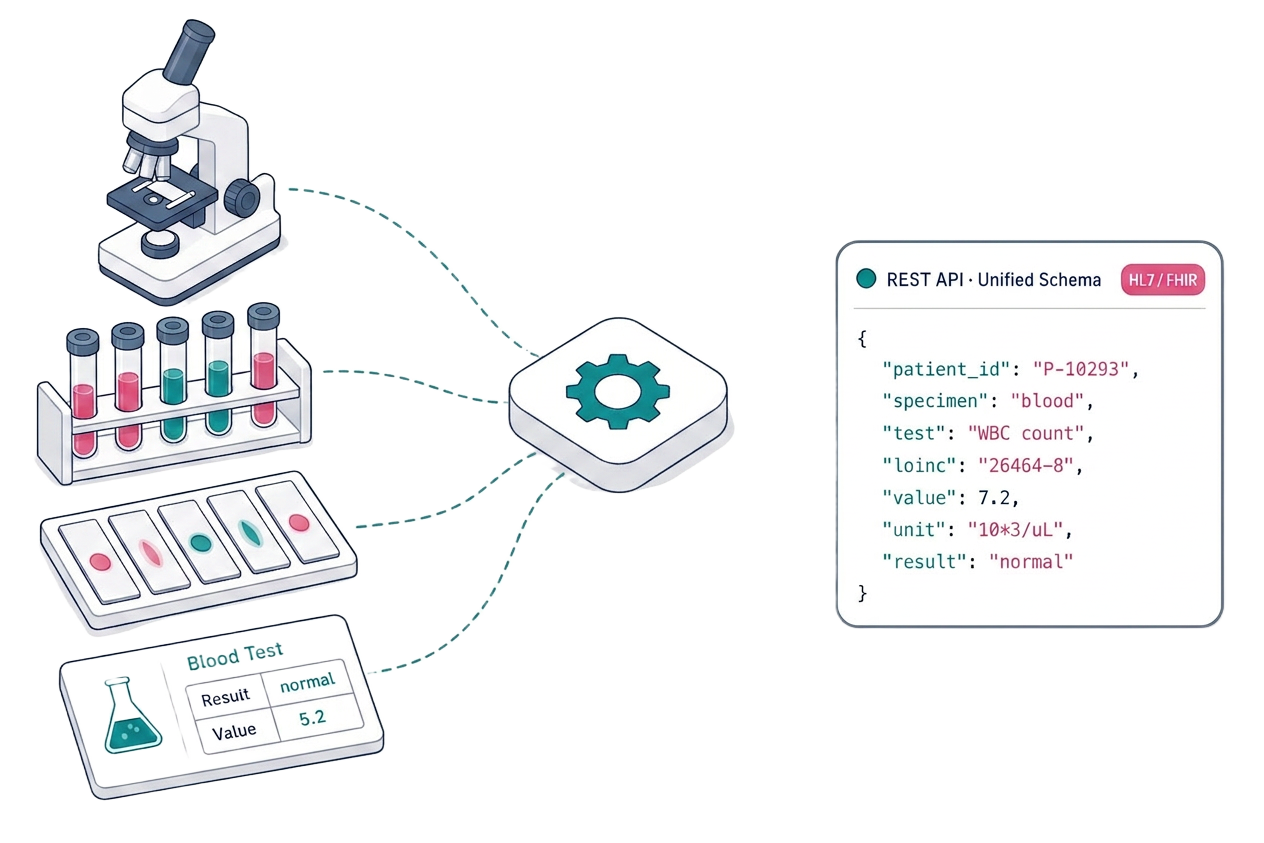
Lab reports arrive as PDFs, scans, HL7 messages, and photos. Every lab uses different terminology, different units, different coding conventions.
Getting each new lab into your pipeline means writing extraction logic, building harmonisation rules, validating edge cases, and maintaining all of it when templates change. Months of engineering work per lab, before a single result reaches your product.
Choose based on your input quality. Mix and match across your pipeline.
For digitally-generated files
For scans, photos, low-quality and non-digital inputs
JondaX Pathology handles the full range of clinical laboratory specimens, not just standard blood panels.
From full blood count, metabolic, lipid, liver, and kidney panels to hormones, vitamins, tumour markers, inflammatory markers, cardiovascular markers, and less common blood-based biomarkers.
Urinalysis, urine culture, spot and 24-hour collections, dipstick results, microscopy findings, and quantitative urine measurements.
Faecal occult blood, stool culture, parasitology, calprotectin, H. pylori antigen, and other gastrointestinal markers reported in lab results.
CSF cell count, protein, glucose, culture, and other specialist markers reported in structured or semi-structured laboratory reports.
Sputum cultures, respiratory pathogen panels, AFB smears, microbiology findings, and related laboratory results from respiratory specimens.
Blood cultures, wound swabs, sensitivity results, antibiogram data, organism identification, and culture results from different specimen sources.
JondaX can support additional pathology report types depending on format, structure, language, terminology, and output requirements.
Most biomarkers in a lab report need no human input at all. Those come back near-instantly, in the format you configured, ready for your system to use.
Anything flagged for review goes to our in-house team and arrives in a second batch once resolved. Your pipeline starts moving on the bulk of the report while the remainder is verified properly.
Where nothing is flagged, the whole report arrives in one batch.
Pathology Core handles digitally-generated files: HL7 v2, FHIR, and JSON. Pathology Pro handles everything else: scanned documents, photographs of lab reports, low-quality PDFs, and complex multi-page reports. Pro includes OCR, robust layout handling across lab templates, and anomaly and inconsistency detection. Both tiers include human-in-the-loop verification via two-step independent review by our in-house team for low-confidence data. Choose based on your input quality. You can mix and match across your pipeline.
Blood and haematology (full blood count, metabolic, lipid, liver, kidney panels, hormones, vitamins, tumour markers, inflammatory and cardiovascular markers), urine analysis, stool and faecal samples, CSF and specialist fluids, sputum and respiratory specimens, and microbiology and culture. JondaX can also support additional pathology report types depending on format, structure, language, terminology, and output requirements. Contact us if your specimen type is not listed.
JondaX processes lab reports in 10+ languages natively, including English, Bahasa Indonesia, Spanish, French, German, Italian, Polish, and Turkish. The source language is auto-detected. Biomarker names, values, units, and reference ranges are identified in the source language, harmonised, and returned as structured output coded to your standard. The source language and source text are preserved in the output for traceability.
JondaX maps to your chosen coding standard. LOINC is live. SNOMED CT is on the roadmap. You can also bring your own ontology, whether that is a customised internal vocabulary or a different standard your systems already run on. JondaX maps source terminology into it, so output arrives in the vocabulary your stack already speaks, not a tool-imposed default.
Yes, on a paid plan. Upload a template of your own test names and units, and JondaX matches incoming lab data against it. The same applies to terminology: if your systems run on a customised internal vocabulary, or on a standard other than the ones JondaX ships with, JondaX maps source terminology into your ontology. Output comes back in the names and vocabulary your stack already uses.
FHIR JSON, FHIR XML, HL7 v2, JSON, or CSV. You configure your default output format on the JondaX platform. Output format can also be specified per API call for clients who need different formats for different downstream systems.
Results are returned as soon as they are ready. Biomarkers that pass validation are delivered near-instantly in a first batch, so your system can act on them straight away. Any biomarker flagged for review is handled separately by our in-house team, then delivered in a second batch once resolved. Where nothing is flagged, you receive a single complete batch.
Our reviewers are an in-house team, not sub-processors. They work with the de-identified version of your data only. Every review is verified by a second reviewer before the record is returned. This two-step independent review process is how we maintain accuracy across diverse lab formats, languages, and templates.
Pathology Pro accepts BMP, HEIC, JPG, JPEG, GIF, and WEBP image formats, as well as scanned PDFs, low-quality PDFs, and multi-format documents. OCR handles text extraction from these inputs, with layout detection for diverse lab report templates.
30 free transformations across pathology and medical devices. No credit card required.