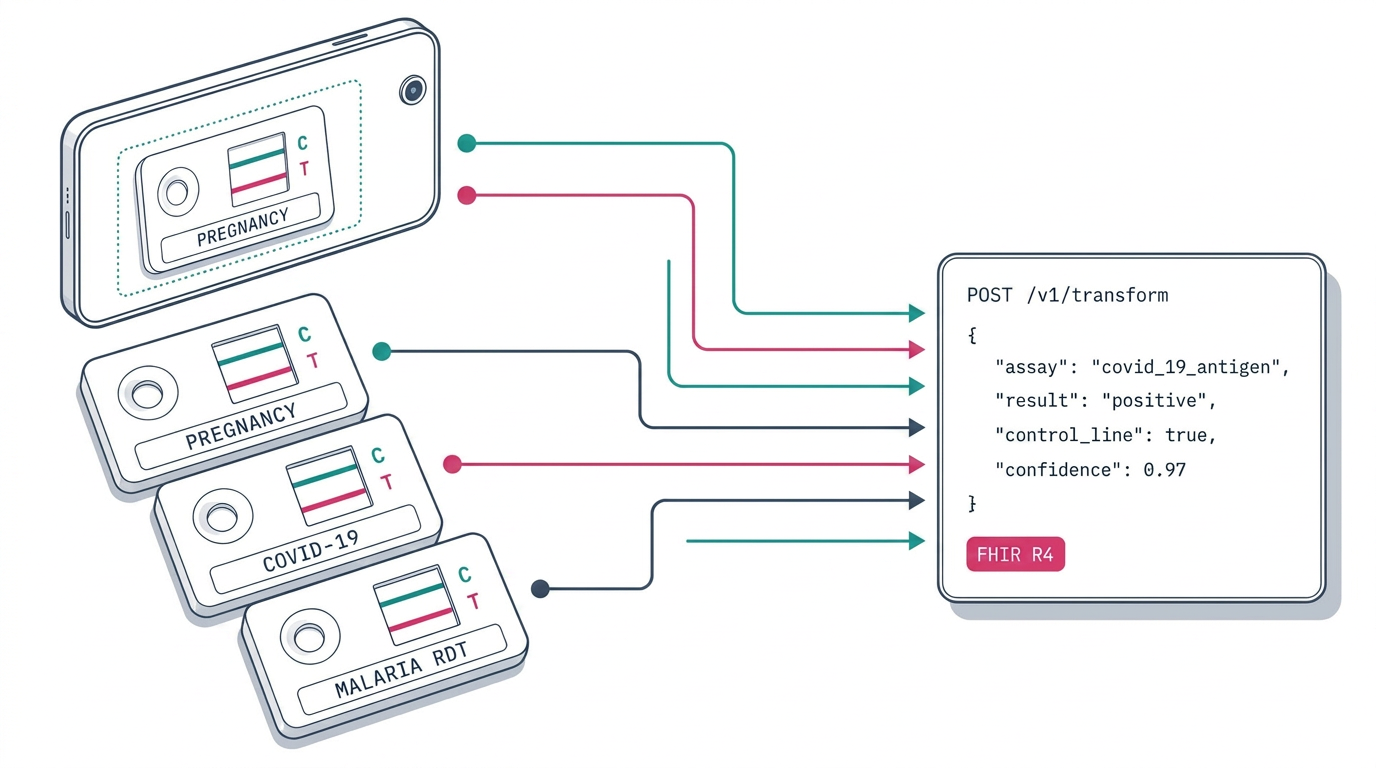
Photo of any lateral flow assay. Structured result back. Pregnancy, rapid antigen tests (COVID, flu, RSV), malaria RDTs, drug screens, fertility. Any brand, any assay type.
The problem
Lateral flow assays produce results in minutes, but capturing those results reliably is still manual. Reading strips, validating results, checking image quality, and entering data may work for one test. It does not scale across thousands.
Different users may read the same test differently, especially when lines are faint, lighting is poor, or the result is close to the threshold of visibility.
A photo may show that a test was performed, but it does not automatically tell your system whether the result was positive, negative, invalid, or uncertain.
Angle, lighting, blur, shadows, reflections, and poor focus can all affect whether a result can be read confidently.
Pregnancy tests, COVID tests, flu tests, RSV tests, malaria RDTs, fertility tests, and drug screens can all use lateral flow formats. But cassette design, line position, labels, timing windows, sample type, and interpretation rules can vary across brands and assays.
When results have to be typed, checked, corrected, and reconciled manually, point-of-care testing becomes harder to scale.
How it works
Any lateral flow strip. Any brand. Smartphone camera. JondaX handles the rest.
Image pre-processing corrects for angle, lighting, and blur. The AI engine reads the control and test lines and determines the result.
Positive, negative, or invalid. Confidence scored. Quality flagged. Ready for your system in JSON, FHIR, HL7 v2, or CSV.
Supported tests
If it has a control line and a test line, JondaX can read it.
Standard hCG lateral flow pregnancy tests. Clear positive/negative/invalid result with confidence score.
COVID-19, influenza A and B, RSV, Strep A, and other respiratory pathogen rapid antigen tests. Handles multi-analyte strips with multiple test lines.
Rapid diagnostic tests for P. falciparum, P. vivax, and pan-malaria antigen detection. Particularly relevant for Southeast Asia and tropical markets.
Multi-panel urine drug test strips. Reads individual panel lines for each substance and returns a structured result per analyte.
Ovulation prediction (LH surge) and fertility tracking strips. Reads line intensity for semi-quantitative LH level estimation.
Any test with a control and test line configuration. Contact us if your specific assay type is not listed. We expand coverage continuously.
Quality and reliability
Strips photographed at home, in clinics, and in the field. JondaX handles the variation.
Handles over-exposed, under-exposed, and shadow-affected images before reading the strip.
Blurry images flagged automatically. Clear re-capture prompt rather than unreliable data.
Photos taken at an angle are geometrically corrected before strip reading begins.
Every result includes a confidence score. Low-confidence results flagged for review.
Strips with invalid control lines detected and flagged, not silently passed as negative.
Source image reference, extraction timestamp, model version, and confidence score in every response.
What you get back
// Input: photo of COVID-19 rapid antigen test
{
  "test_type": "rapid_antigen",
  "analyte": "SARS-CoV-2",
  "result": "negative",
  "control_line": "present",
  "test_line": "absent",
  "confidence": 0.97,
  "quality_flag": "pass"
}
Any lateral flow assay with a control line and test line configuration. This includes pregnancy tests, rapid antigen tests (COVID-19, influenza, RSV, Strep A), malaria RDTs, multi-panel drug screens, fertility tests (LH surge), and other lateral flow formats. Any brand. If your specific assay type is not listed, contact us. We expand coverage continuously.
Your user photographs the test strip with a smartphone camera. JondaX pre-processes the image (corrects for angle, lighting, and blur), reads the control and test lines, and determines the result. The structured output includes the result (positive, negative, or invalid), confidence score, quality flag, test type, and analyte identification. Ready for your system in JSON, FHIR, HL7 v2, or CSV.
Every result includes a confidence score. When lines are faint, lighting is poor, or the result is close to the threshold of visibility, the confidence score reflects that uncertainty. Low-confidence results are flagged rather than silently passed through. Your system decides what threshold to accept for automatic processing and what to route for manual review.
Yes. Multi-analyte strips with multiple test lines (such as multi-panel drug screens) are read per-panel. Each substance returns a separate structured result within the same response. Individual panel lines are identified and reported independently.
Expired strips, missing control lines, and ambiguous results are detected and flagged before reaching your system. Blurry or low-quality photos trigger a re-capture prompt rather than returning unreliable data.
Point-of-Care is now in beta. Join the waitlist for access and to be notified when the module becomes generally available. Pricing will be announced at launch.
The free trial currently covers pathology and medical devices (30 free transformations, no credit card required). Point-of-Care will have its own evaluation path when it launches. Join the waitlist to be among the first to test it.
Point-of-Care is in beta. Join the waitlist to get access and be first to know when it becomes generally available.