A medical device data API. Extract and structure medical device readings for seamless system integration. Photo of a glucometer, BP monitor, pulse oximeter, scale, or thermometer in, structured data out. REST API. No hardware integration.
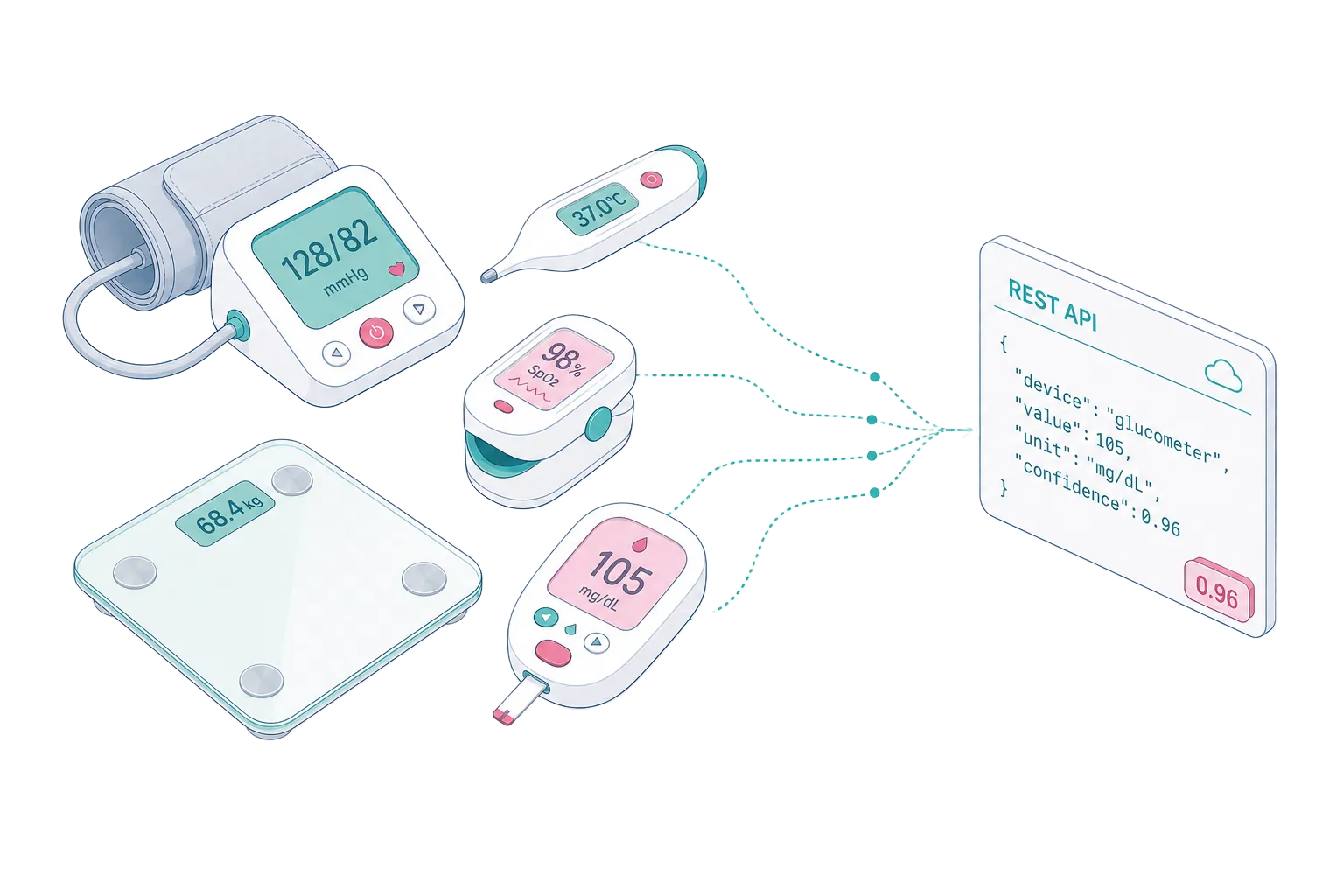
At-home medical devices don't always share APIs, auth flows, or data schemas. By the time you've integrated with the first five, your users have bought three new brands you haven't, and most teams tell those users “tough luck”.
See how JondaX handles this →Three steps. REST API. No hardware integration project.
A photo of the device screen, a PDF export, or a JSON reading from an app. JondaX accepts all of them.
Image pre-processing, reading extraction, unit conversion, quality checks. Flags blurry images and invalid values automatically.
Structured, unit-normalised, confidence-scored data ready for your EHR, app, or analytics pipeline. JSON, FHIR, HL7 v2, or CSV.
If your user can photograph the screen, JondaX can read it.
Blood glucose readings from home glucometers and CGMs. Handles mg/dL and mmol/L with automatic unit conversion.
Systolic, diastolic, and pulse from any home BP cuff. Trend-ready output.
SpO2 and pulse rate from fingertip and wrist oximeters. Quality checks for low perfusion index readings.
Weight, BMI, and body composition. Kg and lbs handled automatically.
Body temperature from oral, ear, and forehead thermometers. Celsius and Fahrenheit handled automatically.
Peak expiratory flow rate (PEFR) from peak flow meters. Structured output for asthma and COPD management workflows.
It is impossible to connect to every medical device. That is why JondaX works with almost any device that has a readable screen. If there is a device you need supported that you can photograph, contact us.
Photos from patients are rarely perfect. JondaX handles the mess.
Handles over-exposed, under-exposed, and shadow-affected images. Normalises brightness before reading the device screen.
Blurry images flagged automatically. Low-quality captures rejected with a clear re-capture prompt rather than returning unreliable data.
Photos taken at an angle are geometrically corrected before extraction. Users do not need to photograph the device perfectly.
Every result includes a confidence score. Low-confidence results are flagged for review rather than silently passed through as if high-confidence.
Source image reference, extraction timestamp, model version, confidence score, and device brand where available, all included in every response for audit purposes.
Every reading is extracted, validated, and structured with harmonised units, confidence scoring, and full traceability.
Glucometers, blood pressure monitors, pulse oximeters, scales, thermometers, and peak flow meters. JondaX uses photo-based capture: your user photographs the device screen, and JondaX extracts and structures the reading. If there is a device with a readable screen that you need supported, contact us. We expand coverage continuously.
Three steps. Your user takes a photo of the device screen with a smartphone camera. JondaX pre-processes the image (corrects for angle, lighting, and blur), extracts the reading, converts units, and applies quality checks. The structured, confidence-scored result is returned via the API. No hardware integration, no Bluetooth pairing, no per-device SDK.
JondaX is built for real-world conditions. The quality and reliability system handles lighting correction (over-exposed, under-exposed, shadows), blur and focus detection, and angle and perspective correction. Low-quality captures are rejected with a clear re-capture prompt rather than returning unreliable data. Every result includes a confidence score.
A structured JSON response including the device type, reading type, value, unit, and confidence score. Output is available in JSON, FHIR, HL7 v2, or CSV. Units are harmonised automatically (mg/dL, mmol/L, kPa, etc.). Full traceability is included: source image reference, extraction timestamp, model version, confidence score, and device brand where available.
It is impossible to connect to every medical device. APIs, auth flows, and data schemas differ across brands and models. Photo-based capture works with almost any device that has a readable screen, regardless of brand, model, connectivity, or firmware version. This is a deliberate architectural choice, not a limitation.
No. JondaX extracts and structures the data. It does not flag hypertension, out-of-range values, or clinical abnormalities. Clinical interpretation is the responsibility of your downstream system. JondaX provides the clean, structured input your system needs to make those determinations.
Yes. Every new account gets 30 free transformations across pathology and medical devices. No credit card required. Upload your own device photos, see the output quality, and evaluate accuracy before committing to a paid plan.
30 free transformations across pathology and medical devices. No credit card required.