Bangladesh's Health ID and Shared Health Record: Getting Hospital Data Ready to Connect
Bangladesh has been building the pieces of a connected health system for more than a decade. Hospital automation began in 2012, and a Shared Health Record, built around a unique health ID for every person, now sits at the centre of the national plan.
In 2026 the pace picked up. The new government has set a target of e-health cards for all citizens by 2028, hospital automation is expanding, and a comprehensive data protection law has passed Parliament. Officials have also been clear that they want to move deliberately, with a secure framework in place first.
This guide sets out what is changing, how the health ID and shared record work, what the data protection law means, and what hospitals, diagnostic centres and partners can do now. It draws on our experience at Jonda Health, where our work is turning health records from many different sources into structured, standardised information that clinicians and systems can actually use.
What is changing
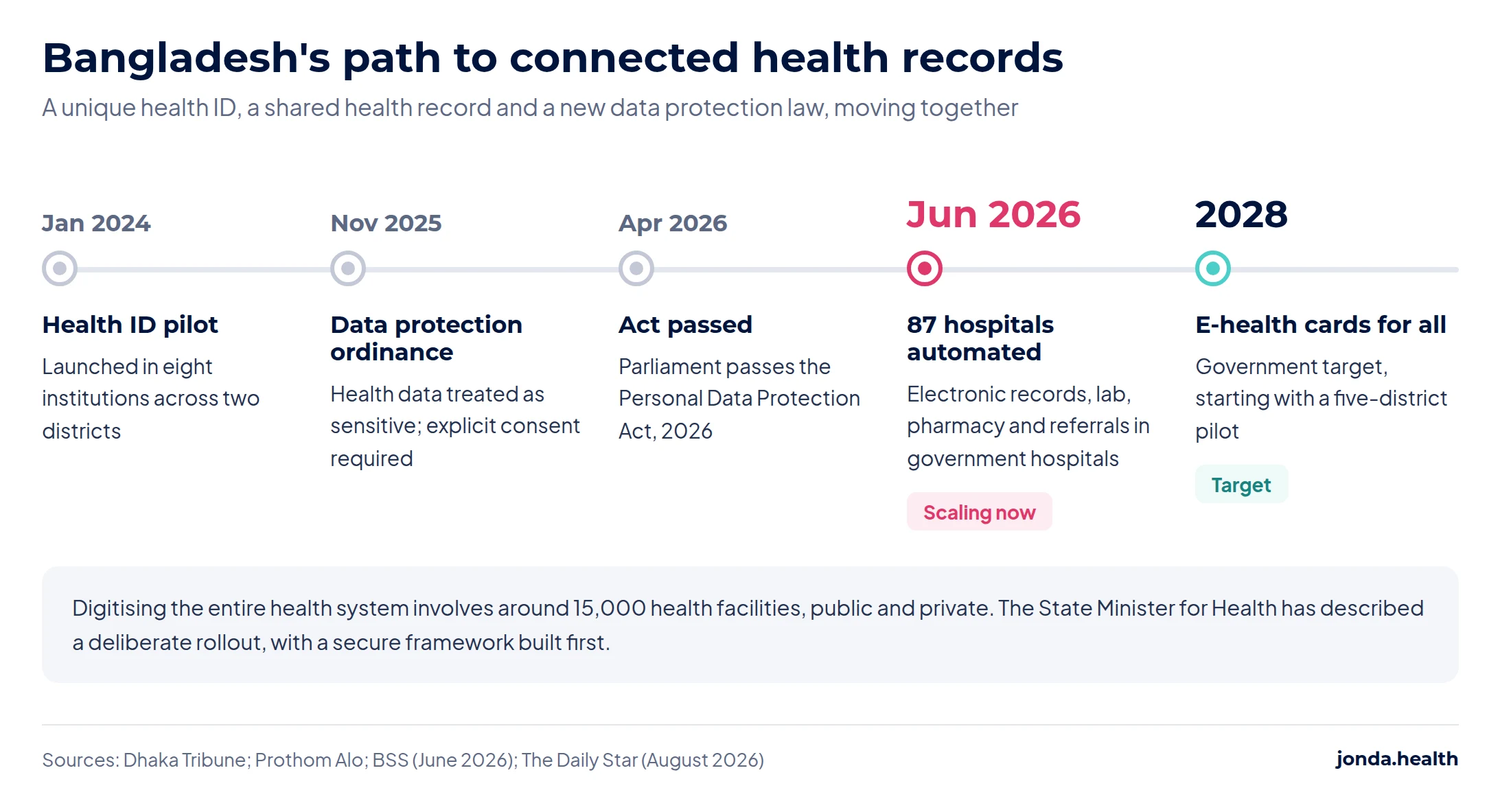
On 25 June 2026, Health and Family Welfare Minister Sardar Md. Sakhawat Husain told Parliament that automation systems were operational in 87 government hospitals: 61 Upazila Health Complexes, 14 district hospitals, 2 medical college hospitals and 10 national-level hospitals. The systems cover electronic medical records, laboratory test management, pharmacy distribution, user fees and referrals, and allow treatment records to move between facilities with patient consent. A larger development project awaits approval, and a pilot will introduce unique health IDs, e-health cards and integrated automation in five districts (BSS).
Earlier that month, the Minister said the government planned to provide e-health cards to all citizens by 2028, alongside AI-based national e-prescriptions and more public-private partnership (BSS). In August 2026, State Minister for Health MA Muhit noted that digitising the entire health system involves around 15,000 health facilities, and that the e-health card pilot, supported by the Asian Development Bank, would proceed carefully with data security in mind (The Daily Star).
The health ID and shared health record
The Shared Health Record is the Ministry of Health and Family Welfare's central system for identifying patients, retrieving their visit and service records from different care points, and building a personal health profile that can be shared with consent. It includes facility, provider, location and patient registries, and connects facilities through published interfaces (Shared Health Record).
Each person can obtain one health ID, issued after verifying their National ID or Birth Registration Number, which means children can be included too. A master client index links each health ID to demographic details so that the same person is identified consistently across facilities (Shared Health Record). The health ID pilot began in January 2024 in eight institutions across two districts, and private institutions are expected to register with the Directorate General of Health Services and connect their own software to the shared record (Dhaka Tribune).
That last point matters. Health experts have estimated that private providers deliver around two thirds of healthcare services in Bangladesh (The Business Standard). A shared record that only reflects public care would miss much of a patient's history.
The new data protection law
The Personal Data Protection Ordinance, 2025 was gazetted in November 2025, alongside a National Data Governance Ordinance. It recognises individuals as the owners of their personal data, requires explicit consent for collection and use, treats health, genetic and biometric data as sensitive, and provides for a national data management authority (Prothom Alo). On 9 April 2026, Parliament passed the Personal Data Protection Bill, 2026, retaining the ordinance (Dhaka Tribune).
The law classifies data into tiers, and legal commentators note that confidential and restricted personal data must be stored in Bangladesh, with transfers of sensitive data in significant volumes needing prior authorisation (Mahbub & Company). Many obligations are phased in, so organisations should check which provisions have commenced and how the classification rules apply to their records. Where records are reused beyond direct care, the right protections matter, which we explain in this guide.
The data work behind a shared record
A health ID solves one problem well: it gives each person a single identifier. The harder part is what arrives from each facility and how reliably it attaches to that identifier.
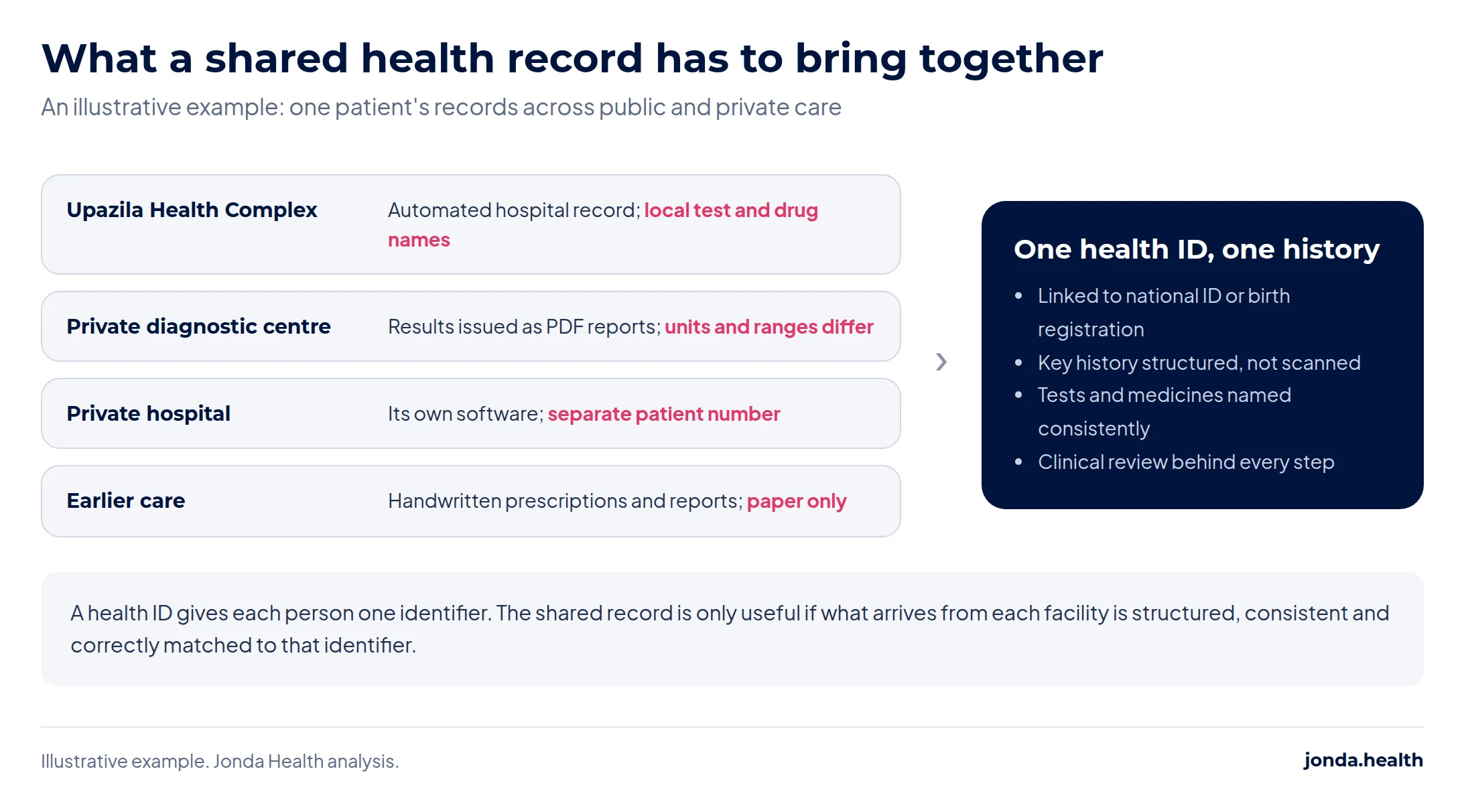
In the records we work with across Asia and Africa, the same patterns appear again and again, and Bangladesh has its own versions of each.
AI can do much of the heavy lifting at speed, and we use it extensively ourselves, but it needs clinical review and quality checks behind it. That is why we argue that healthcare AI will not work without trusted data infrastructure.
Who this affects
India is building a similar health ID based system, which we cover in our guide to India's digital health mission and data protection rules.
How Jonda Health can support you
At Jonda Health, we have spent years working with health records across formats, languages and health systems in Asia and Africa, and we know how much of this work only becomes visible once real data starts to move. Depending on where your organisation is today, there are three ways we can help.
Frequently asked questions
What is Bangladesh's Shared Health Record?
The Shared Health Record is a centralised digital system of the Ministry of Health and Family Welfare. It identifies patients through a unique health ID, retrieves their visit and service records from different care points, builds a personal health profile, and allows records to be shared with consent. It includes registries for facilities, providers, locations and patients.
How does the health ID work?
Each person can obtain one health ID, issued after verifying their National ID or Birth Registration Number. A master client index links each health ID to demographic details so that the same person can be identified consistently across facilities.
How many hospitals are automated?
In June 2026, the Health and Family Welfare Minister told Parliament that automation systems were operational in 87 government hospitals: 61 Upazila Health Complexes, 14 district hospitals, 2 medical college hospitals and 10 national-level hospitals.
When will every citizen have an e-health card?
The government has said it plans to provide e-health cards to all citizens by 2028, starting with a pilot that will introduce unique health IDs, e-health cards and integrated automation in five districts.
Is health data protected under Bangladeshi law?
Yes. The Personal Data Protection Ordinance, 2025 treats health data as sensitive, requiring explicit consent and stronger protection. Parliament passed it as the Personal Data Protection Act, 2026 in April 2026. Organisations should check which obligations have commenced and how data classification and storage rules apply to them.
Sources: BSS (10 and 25 June 2026); The Daily Star (18 August 2026); Shared Health Record, Directorate General of Health Services; Dhaka Tribune (health ID; 9 April 2026); The Business Standard (September 2023); Prothom Alo (November 2025); Mahbub & Company. This article is for general information and is not legal advice.