
Pathology and imaging reports now flow to My Health Record by default. What that means for organisations already operating in Australia, those entering the market, and anyone who needs the results inside those reports to be usable.

Anyone who has cared for a patient across several providers will know the feeling of a record with gaps in it. A blood test done at one laboratory, an ultrasound at another, a result the patient remembers but nobody can find. Until recently in Australia, whether a pathology or imaging report reached a patient's My Health Record depended on the provider that produced it, which made it harder for patients and their care teams to see the full picture (Australian Digital Health Agency).
Since 1 July 2026, that has changed. Pathology and diagnostic imaging reports are now uploaded to My Health Record by default. For laboratories and imaging providers this is a compliance obligation. For clinics, specialists, digital health apps and research teams, it is something larger: far more diagnostic information is now flowing, to more places, more quickly.
This guide explains what the rules require, what the early results show, and what organisations already operating in Australia, or preparing to enter the market, should do to turn that flow of reports into information they can actually use. The last part draws on our experience at Jonda Health, where our work is turning health records from many different sources into structured, standardised information that clinicians and systems can actually use.
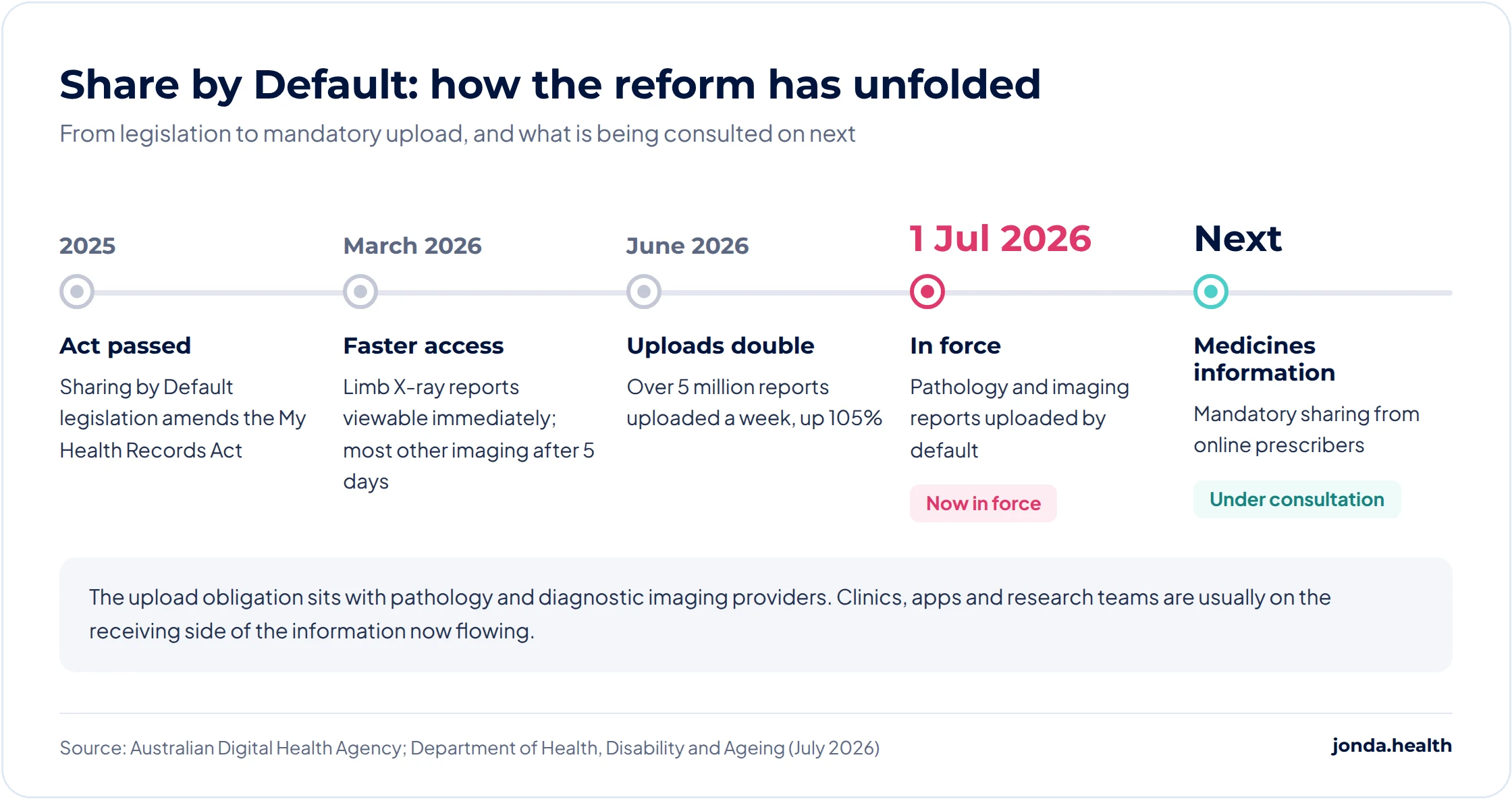
The legal obligation sits with pathology and diagnostic imaging providers: written reports authored by, or on behalf of, a pathologist or radiologist must be uploaded to My Health Record unless an exception applies. If your organisation receives or uses these reports rather than producing them, you are not the one uploading, but you are on the other end of a much larger flow of information. A few details matter for everyone in the chain.
Source: Australian Digital Health Agency, Better and Faster Access.
The rules also carry a financial lever. Providers that do not follow them may have to repay Medicare Benefits Schedule money received for the service and may face penalties. Linking data sharing to payment is a large part of why behaviour has shifted so quickly.
The volume of information moving through My Health Record has roughly doubled since the reforms were announced in 2023, and patients are using it.

Sector sentiment is also positive. Independent research cited by the Australian Digital Health Agency, drawing on 228 provider respondents, found 91% believe the policy direction is right for Australia and 92% expect fewer duplicate requests or missing information over time (Australian Digital Health Agency, 8 July 2026).
These numbers tell us that sharing is working. They do not yet tell us whether the information being shared can be compared, trended or analysed, which is the question the rest of this guide focuses on.
Share by Default makes reports available. It does not, on its own, make the results inside them consistent enough for software, analytics or AI to use.
A person reading a report can interpret it. A clinician knows that two differently named tests from two laboratories measure the same thing, and can mentally adjust for a different unit or reference range. Software cannot do that unless the data has been prepared for it. In our work at Jonda Health, which has involved more than 500,000 files in over ten languages, the same patterns appear again and again. The same test is captured under different names, abbreviations and panel structures from one laboratory to the next. Units and reference ranges differ, so values cannot be compared without conversion and context. Some institutions maintain their own local code sets, which need to be reconciled rather than simply mapped. Clinical meaning often sits in free text, such as a comment on a result or the impression section of an imaging report. And historical results sit in earlier documents and systems that were never part of any upload.
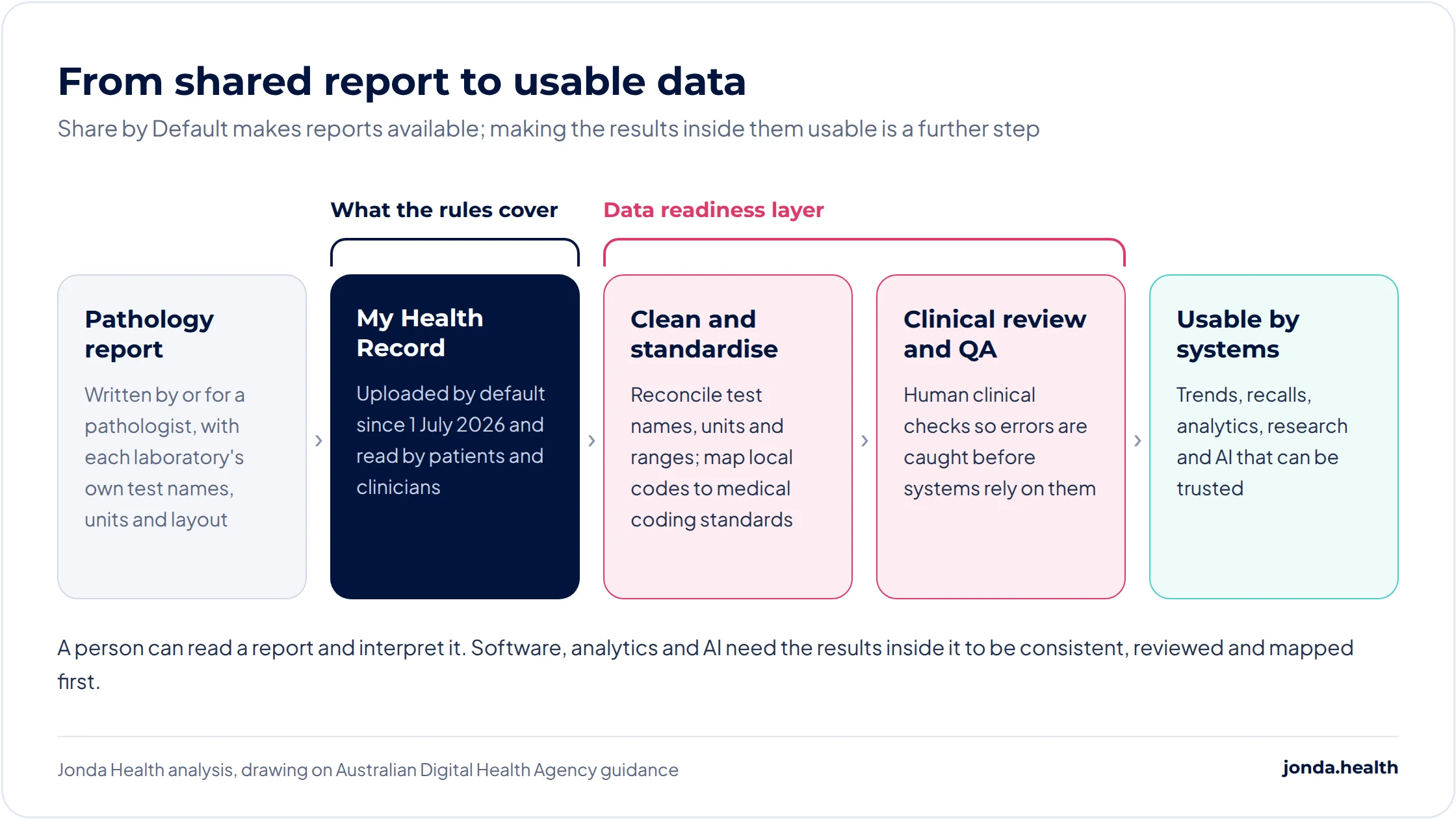
Making this information usable involves more than assigning codes. It means reading records across formats, cleaning and reconciling variant captures, clinical review and quality assurance, and then mapping to medical coding standards. None of this reflects poor practice; it is simply how clinical data is created in busy settings, across systems that were never designed to speak to each other. The same applies well beyond pathology: imaging reports, and in time the medicines information now under consultation, will raise the same questions. It is also why we argue that healthcare AI will not work without trusted data infrastructure.
If you receive results rather than produce them, the reform means more complete information about your patients, arriving from more sources. Reports are still sent directly to the requesting GP or provider as before, and My Health Record now fills in results ordered elsewhere. That completeness brings three practical challenges.
A patient's HbA1c, kidney function or lipid results may now come from several providers over a year. Viewing them one report at a time is manageable. Plotting them as a single trend, or triggering a recall when a value crosses a threshold, only works when names, units and ranges have been reconciled first.
Because most pathology reports are viewable as soon as they are uploaded, some patients will arrive at a consultation having already seen, and searched, their results. Clear communication at the point of ordering, and follow-up workflows that assume the patient may already know, reduce anxiety on both sides.
Digital health apps that display results to patients, or use them to personalise care, face the same variation across every user and every laboratory. An app that looks reliable with one provider's data can behave unpredictably when results arrive from ten. Planning for this early, rather than patching it case by case, saves significant rework.
For teams working with real-world data, Share by Default signals a system moving toward more complete diagnostic records. Whatever route your data comes through, whether a provider partnership, a registry or a research collaboration, the underlying reports are becoming more consistently captured and shared. That is good news, with an important caveat: completeness and comparability are different things.
Selecting patients by a laboratory threshold, or measuring change over time, assumes that a value from one laboratory means the same as a value from another. Where names, units, methods or reference ranges differ, that assumption needs to be tested and reconciled before analysis, not discovered afterwards.
A model trained or prompted on results that vary in structure will learn, or repeat, that variation. Consistent, structured inputs with clinical review behind them are what make outputs trustworthy, and they are also far more efficient to process than repeatedly asking a model to interpret raw documents.
Using health information beyond direct care carries its own legal and ethical obligations in Australia, and access to data held in My Health Record for secondary purposes is governed separately from the Share by Default rules. Organisations should take advice on their specific use case. Practically, data should be pseudonymised appropriately for the purpose, with free text treated carefully, since identifying details often hide in comments and narrative sections rather than in structured fields. We explain the distinctions in De-identification, Pseudonymisation and Anonymisation: What the Difference Means for Your Health Data.
For organisations bringing a health product or service into Australia, Share by Default is a useful lens on how the system works. Four things are worth understanding early.
None of this is a reason to hold back. Australia's direction of travel is clear, and organisations that arrive with data that is already structured and consistent will find conversations with local partners easier.
Australia is also investing in how data is structured, not only in whether it is shared. Sparked, the national FHIR accelerator, is led by CSIRO's Australian e-Health Research Centre in partnership with the Department of Health, Disability and Ageing, the Australian Digital Health Agency and HL7 Australia. Its standards are intended to make how data is captured, categorised and exchanged more consistent within and between software used across the sector (Sparked Program Review).
Two outputs are especially relevant. AU Core sets minimum expectations for how FHIR resources are used in Australian systems, and the AU eRequesting implementation guide focuses first on pathology and medical imaging requests in community care (Sparked).
Standards like these matter, and organisations should plan to align with them. They work best for new data captured in systems that implement them. The reports already flowing today, and the years of results behind them, will still arrive in the formats they were created in. Bridging that gap, by preparing existing and incoming data so it meets the standards, is where much of the effort will sit over the next few years.
Pathology and imaging are the first phase, not the last. Consultation is already progressing on mandatory sharing of medicines-related information from online prescribers (Australian Digital Health Agency), and the government has said it is exploring other types of key health information, subject to consultation and approval (Department of Health, Disability and Ageing).
Medicines data brings its own complexity: brand and generic names, strengths, dosing instructions written in free text, and histories that span prescribers and pharmacies. Organisations that build good habits with diagnostic data now will be better prepared as the scope widens.
Australia is not alone. Singapore's Health Information Act will require licensed providers to contribute key information, including laboratory results, to the National Electronic Health Record, with the first obligations beginning in September 2027. Both countries start with the same step, making sure information is shared, and both will face the same next question: whether that information is consistent enough to use. Organisations working across both markets can prepare once for both. We cover Singapore in detail in Singapore's Health Information Act: What Healthcare Providers Need Ready by 2027.
It is a set of reforms under which pathology and diagnostic imaging reports authored by, or on behalf of, a pathologist or radiologist are uploaded to My Health Record by default from 1 July 2026, unless an exception applies or an extension has been granted.
No. Only written reports are uploaded by default. The images themselves are not included.
Yes. A patient or their authorised representative can ask the provider not to upload a particular report, and can later hide, restrict or delete reports using My Health Record's privacy controls.
The upload obligation applies to pathology and diagnostic imaging providers. Clinics and apps are usually on the receiving side, although a clinic running its own pathology collection or imaging service should check whether it is in scope.
Providers that do not follow the rules may have to repay Medicare Benefits Schedule money received for the service and may face penalties. A provider with an approved extension must display a notice in its clinic and on its website.
Consultation is progressing on mandatory sharing of medicines-related information from online prescribers.
Sources: Australian Digital Health Agency (Better and Faster Access; media release, 8 July 2026); Department of Health, Disability and Ageing (Modernising My Health Record); Sparked Program Review, Evaluation Report 2023 to 2025; Sparked, AU eRequesting FHIR Implementation Guide R1. This article is for general information and is not legal advice.
Suhina Singh is a physician, the Founder and CEO of Jonda Health, and a health data strategist working at the intersection of artificial intelligence and clinical information systems.





