
eKonsulta closes on 31 December 2026, and every YAKAP clinic must submit through a PhilHealth-certified EMR. Choosing a system is the easy part. Here is how to make sure your patients' history arrives with it.

For many primary care clinics across the Philippines, the end of eKonsulta is a practical deadline with real consequences. Staff who have been encoding every patient encounter, downloading XML files and submitting them daily now need to move to a new system, and bring their patients' history with them.
Choosing a PhilHealth-certified EMR is an important decision, and many clinics have already made it. The harder question, and the one that is easy to underestimate, is what happens to the records themselves. A migration that moves the system but loses part of the history leaves clinicians with gaps they may not notice until a patient is sitting in front of them.
This guide explains what PhilHealth requires, what can get lost along the way, and how to plan a migration that protects patient history. It draws on our experience at Jonda Health, where our work is turning health records from many different sources into structured, standardised information that clinicians and systems can actually use. We have also designed and delivered a personal health record with a clinic in the Philippines, so these questions are close to home for us.
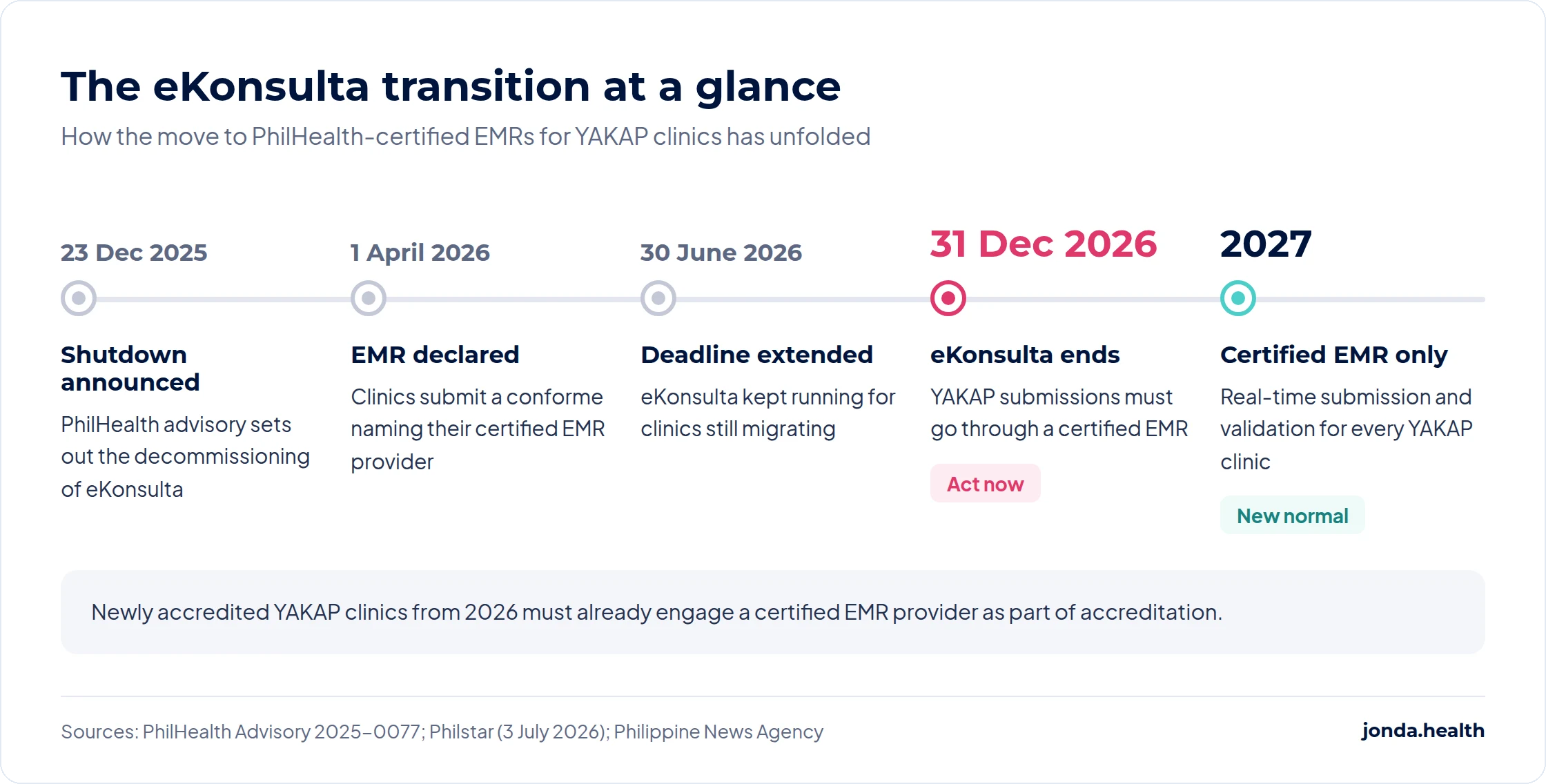
In December 2025, PhilHealth announced the decommissioning of eKonsulta as part of improvements to the Yaman ng Kalusugan Program (YAKAP). PhilHealth explained that YAKAP needs a fully interoperable system that can enforce real-time electronic submission and validation of health data, and that eKonsulta was only ever intended as a temporary mechanism (PhilHealth Advisory 2025-0077).
The original plan asked clinics to declare their chosen EMR service provider by 1 April 2026, migrate all patient data between April and June, and be fully migrated by 1 July 2026. PhilHealth later postponed the shutdown, keeping eKonsulta running until the end of the year to help clinics still transitioning (Philstar, 3 July 2026).
Source: PhilHealth Advisory 2025-0077. Clinics should always check PhilHealth's latest advisories, since dates and requirements can change.
PhilHealth has been clear that the move is about more than paperwork. It says providers who submit data in real time will benefit from fewer claim denials, faster claims processing and smoother interoperability with PhilHealth systems (PhilHealth), and has described EMR systems as the backbone of care coordination and timely reimbursement (Philippine News Agency).
That link cuts both ways. When data is submitted and validated in real time, errors in the underlying record surface quickly: a mismatched patient identifier, a missing field, a laboratory result recorded inconsistently. A clean migration is not only about keeping history. It is about starting the new system on a foundation that will not generate problems every time a claim is validated.
Every migration carries some risk of loss. In our experience, the gaps tend to fall into a few familiar patterns.
None of this reflects poor practice. It is simply how records build up in a busy clinic over years, across paper and more than one system.
Your certified EMR provider will move you onto the new system, and PhilHealth notes that providers can assist with migration. The patient history, though, deserves attention of its own, especially where it sits outside eKonsulta.
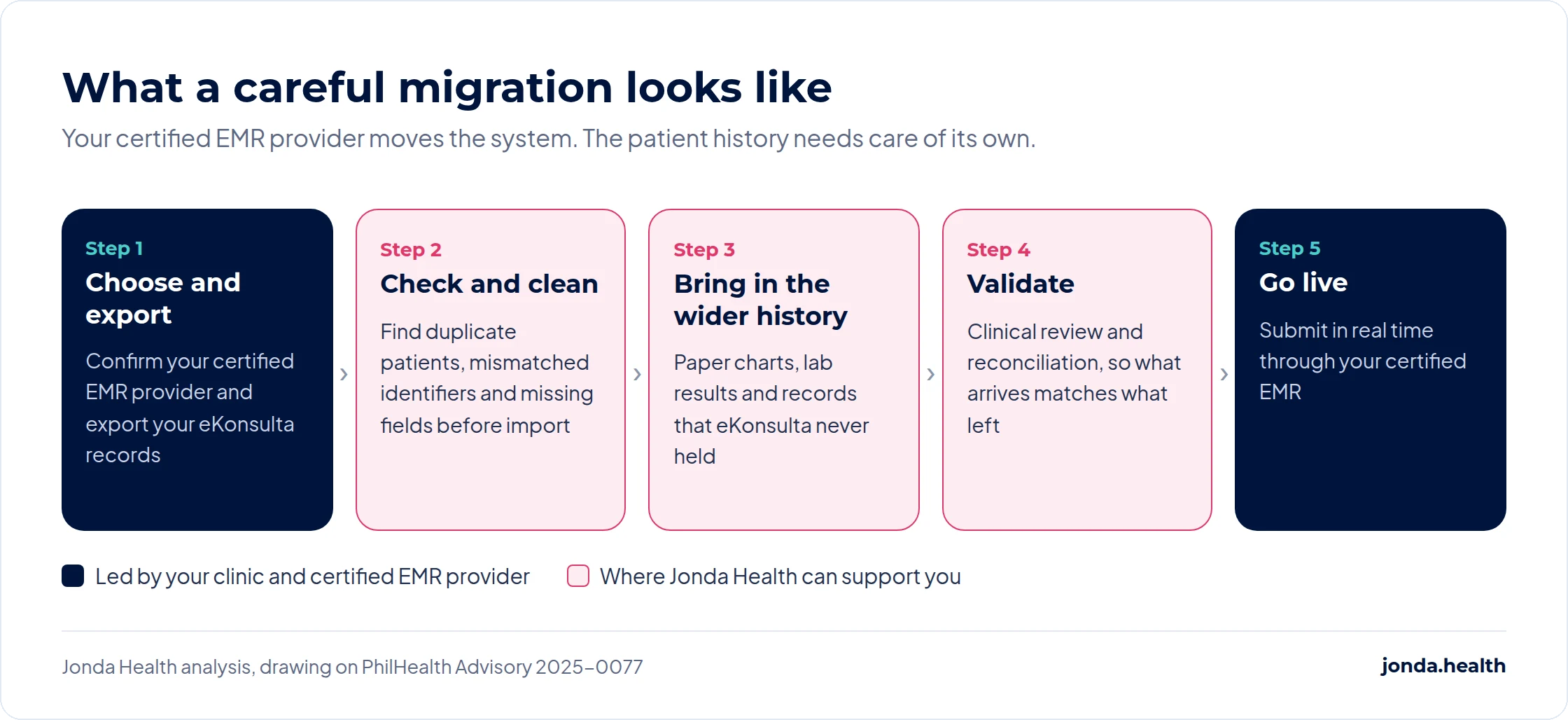
The middle steps are where most of the effort sits. Checking and cleaning before import is far easier than correcting records afterwards. Bringing in paper charts and laboratory results means reading documents, extracting the clinical content and structuring it so it sits properly in the new EMR. And validation, including clinical review, is what gives your team confidence that what arrives matches what left.
Most certified providers offer migration help, and it is worth being specific about what that covers.
The eKonsulta transition is part of a wider shift in the Philippines toward connected records. In June 2026, eleven electronic medical record systems demonstrated live electronic referrals at a national testing event for the draft Philippine Core and Philippine eReferral standards, which allow different systems to exchange patient data (University of the Philippines Manila). As exchange between systems becomes more common, the consistency of what sits inside each record will matter more, not less.
Clinics that migrate carefully now are not only meeting a deadline. They are building the foundation for the next steps: referrals that carry a usable history, claims that validate cleanly, and data that can support better care over time.
At Jonda Health, we have spent years working with health records across formats and languages, and we know how much of a migration only becomes visible once the work begins. We work alongside your certified EMR provider, not in place of it. Depending on where your clinic or network is today, there are three ways we can help.
PhilHealth originally set 1 July 2026 for the full shutdown of eKonsulta. It later extended operation until 31 December 2026 for YAKAP clinics that are still migrating. After that, YAKAP data must be submitted through a PhilHealth-certified EMR.
Yes. Clinics still using eKonsulta must move to a PhilHealth-certified EMR service provider, and newly accredited YAKAP clinics from 2026 must engage a certified EMR provider as part of accreditation.
PhilHealth publishes the list of certified service providers and their contact details on its website.
PhilHealth has said the selected EMR provider can extend assistance with migration. Clinics remain responsible for ensuring that all patient data and records are fully migrated, so it is worth agreeing early what will be moved, how it will be checked, and what happens to records held outside eKonsulta.
Many clinics hold paper charts, laboratory results and records from earlier systems. These are not covered by an eKonsulta export, so they need a separate plan if you want them available in your new EMR.
Sources: PhilHealth Advisory 2025-0077 (23 December 2025); Philstar, PhilHealth defers eKonsulta shutdown (3 July 2026); Philippine News Agency (December 2025 and March 2026); University of the Philippines Manila (July 2026). This article is for general information and is not legal or regulatory advice. Please check PhilHealth's latest advisories for current requirements.
Suhina Singh is a physician, the Founder and CEO of Jonda Health, and a health data strategist working at the intersection of artificial intelligence and clinical information systems.





