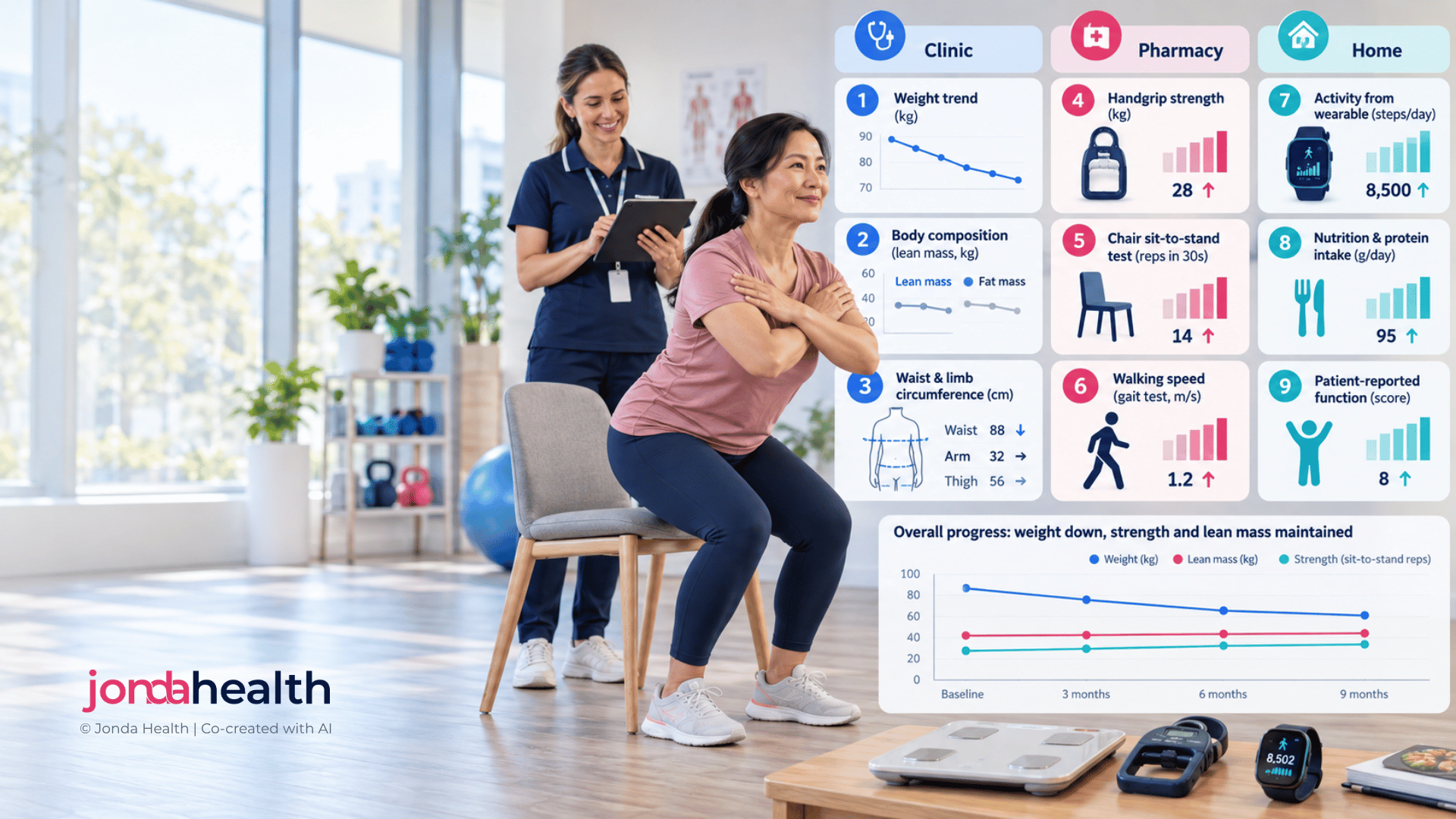
Every GLP-1 programme will be asked how much of the weight its patients lose is muscle. Few can answer with data. This guide sets out what to measure, how to measure it in a clinic, a pharmacy or at home, and how to show that your programme protects strength as well as reducing weight.
Suhina Singh
Founder & CEO, Jonda Health
October 22, 2026
·
9 min read
When people lose weight, they lose some lean tissue along with fat, whatever the method. GLP-1 (glucagon-like peptide-1) medicines produce large weight losses quickly, so the question of muscle has moved from the research literature into conversations with patients, employers and payers.
The good news is that muscle can be tracked with tools most programmes already have, or can add cheaply. The harder part is collecting the readings consistently, interpreting them correctly, and keeping them alongside the rest of the person's record so they can be reported. That is what the nine points below are about.
The nine points at a glance
01Know what "lean mass" really measures
02Take a baseline, especially for people at higher risk
03Choose a method that fits your setting
04Standardise every measurement
05Measure strength, starting with grip
06Add a quick test of function
07Record what protects muscle
08Set flags and a clear response
09Report strength kept, not only weight lost
Function is highlighted because it is what patients and payers care about most, and the cheapest layer to measure.
1. Know what "lean mass" really measures
Body composition scans usually split the body into fat and "lean" mass. Lean mass is everything that is not fat: skeletal muscle, but also water, organs, bone and connective tissue. So a report of "lean mass loss" is not the same as muscle loss, and treating the two as equal overstates the problem.
In the body composition substudy of the SURMOUNT-1 trial, about 75% of the weight lost with tirzepatide was fat and about 25% was lean mass, a ratio that was similar to placebo and held across sex, age and amount of weight lost.1 In the STEP 1 trial of semaglutide, total lean mass fell by 9.7%, yet lean mass made up a larger share of body weight at the end than at the start, because fat fell faster.2
Look et al., SURMOUNT-1 body composition analysis.1
Tip: In patient materials and payer reports, say "lean mass" when you mean the scan result and "muscle" only when you have a muscle-specific measure. The precision builds trust.
2. Take a baseline, especially for people at higher risk
A later reading means little without a starting point. A joint advisory from four obesity and nutrition societies recommends assessing muscle strength and function at the start of GLP-1 therapy, and considering a measure of muscle mass where available.3
Baseline matters most for people who have less muscle to spare: older adults, people who are already weak or frail, people with limited mobility, and anyone who has lost a lot of weight before. For these groups, a small loss of muscle can make a real difference to daily life.
Pitfall: Programmes often add muscle tracking a few months in, after a patient raises it. Without a baseline, you can only say where the person is now, not what has changed.
3. Choose a method that fits your setting
There is no single right tool. The advisory lists bioelectrical impedance analysis, air displacement plethysmography and dual-energy X-ray absorptiometry (DEXA) as options for measuring muscle mass, alongside simple strength and function tests.3 The right mix depends on where your programme meets its patients.
DEXA scan
Clinic
The usual reference method for fat and lean mass. Precise, but needs a scanner, a referral and a visit.
Bioimpedance
Clinic or home
Scales and handheld devices that estimate composition from an electrical signal. Cheap and repeatable, but sensitive to hydration.
Grip strength
Any setting
A handheld dynamometer gives a number in kilograms in under a minute. Works in a pharmacy or clinic.
Chair stand and walking tests
Any setting
Need only a chair, a timer and a measured distance. A chair-stand test can be observed over video.
Tip: A telehealth programme can start with function tests by video and bioimpedance at home, then use DEXA for the people its flags pick out (see point 8).
4. Standardise every measurement
Body composition readings move with things that have nothing to do with muscle. Bioimpedance in particular shifts with hydration, recent meals and exercise, and different devices use different equations. A change between two readings is only meaningful if the conditions were the same both times.
Same device, or at least the same model, every time
Same time of day, ideally in the morning before eating
No hard exercise in the hours before
Device model and software version stored with each reading
For grip strength, the same hand, position and number of attempts
Who took the reading, and where: clinic, pharmacy or home
Pitfall: Mixing readings from a clinic scanner and a home scale on one chart can create a "loss" or "gain" that is really a change of device.
5. Measure strength, starting with grip
Strength is what people notice in daily life, and grip strength is the easiest way to measure it. The sarcopenia guidelines give reference thresholds for low grip strength, and they differ between Asian and European populations. The Asian Working Group for Sarcopenia (AWGS 2019) uses less than 28 kg for men and less than 18 kg for women.4 The European Working Group (EWGSOP2) uses less than 27 kg for men and less than 16 kg for women.5
A reading below the bar is a flag for review. These thresholds were developed for sarcopenia in older adults, so use them as reference points, not a diagnosis.
Tip: Record which guideline your thresholds come from. A programme serving patients in Singapore and London may reasonably use AWGS for one group and EWGSOP2 for the other.
6. Add a quick test of function
Function tests show whether strength is translating into everyday ability. They are quick, cheap and easy to repeat, and the advisory names sit-to-stand, stair climb and timed-up-and-go as examples.3 The sarcopenia guidelines give reference points for two of the simplest.
Test
How it works
AWGS 2019 flag4
EWGSOP2 flag5
Five-times chair stand
Stand up from a chair five times as fast as possible, arms folded
12 seconds or longer
Longer than 15 seconds
Walking speed
Time a walk over a measured distance at usual pace
Under 1.0 m/s (6 m walk)
0.8 m/s or slower
For most programmes, the trend matters more than the threshold. A person whose chair-stand time is getting steadily slower deserves attention before they cross any line.
7. Record what protects muscle
Measuring muscle is only half the story; payers will also want to see what your programme does to protect it. The joint advisory proposes a protein target of 1.2 to 1.6 g per kg of body weight per day during weight reduction, compared with the general reference of 0.8 g/kg. It also notes that higher protein alone is unlikely to preserve muscle without structured resistance or strength training.3
Joint advisory of the American College of Lifestyle Medicine, American Society for Nutrition, Obesity Medicine Association and The Obesity Society.3
Tip: Capture protein and training in a simple, repeatable way, such as a weekly check-in question or an app log, so you can later show how many patients met their targets.
8. Set flags and a clear response
Data only protects patients if someone acts on it. Decide in advance what counts as a flag, who sees it, and what happens next, and write it into the programme so it does not depend on one clinician remembering.
The specific actions are clinical decisions for your team; the point is that each flag has a named next step.
9. Report strength kept, not only weight lost
Most GLP-1 reporting stops at kilograms lost. A programme that can also show grip strength and function held steady across its patients tells a stronger story, and answers the muscle question before anyone asks it. For employers and insurers, function is also closer to what they care about: people staying active and able to work.
Pair every weight figure with a strength or function figure from the same patients and the same period.
This works best when muscle data sits in the same record as weight, laboratory results and medication history, so the report can be produced without a separate spreadsheet exercise each quarter.
How Jonda Health can help
Muscle tracking adds more readings from more places: scan reports from imaging centres, bioimpedance results from home devices, grip and chair-stand numbers from clinics and pharmacies. The challenge is bringing them together with the rest of the record so they can be compared over time and reported. That is the work we do.
JondaX
Bring the readings together
One API for scan reports, laboratory results, clinical documents and photographed device readings, in 10+ languages.
Keeps units, device and date with every reading, and maps results to medical coding standards or your own code sets.
Clinically trained reviewers check flagged results, with 99% field-level accuracy after expert review.
ISO 27001 certified, designed to comply with HIPAA, GDPR and PDPA, and deployable in country.
Jonda Health Services
Design the measurement plan
Which measures to use in each setting, and at which checkpoints.
Thresholds, flags and response pathways your clinical team can own.
Reporting that pairs weight with strength and function for each payer.
Consent, pseudonymisation and data flows that meet local rules.
See it on your own records. Send us a sample of real programme documents (up to 20 pages), such as scan reports and laboratory results, and we will run them through JondaX free of charge. If you would rather talk it through first, book a free 30-minute data readiness conversation.
Look M, Dunn JP, Kushner RF, et al. Body composition changes during weight reduction with tirzepatide in the SURMOUNT-1 study of adults with obesity or overweight. Diabetes, Obesity and Metabolism. 2025. doi:10.1111/dom.16275
Wilding JPH, et al. Impact of semaglutide on body composition in adults with overweight or obesity: exploratory analysis of the STEP 1 study. Journal of the Endocrine Society. 2021. pmc.ncbi.nlm.nih.gov/articles/PMC8089287
Nutritional priorities to support GLP-1 therapy for obesity: a joint advisory from the American College of Lifestyle Medicine, the American Society for Nutrition, the Obesity Medicine Association, and The Obesity Society. 2025. pmc.ncbi.nlm.nih.gov/articles/PMC12304835
Chen LK, et al. Asian Working Group for Sarcopenia: 2019 consensus update on sarcopenia diagnosis and treatment. Journal of the American Medical Directors Association. 2020;21(3):300-307. pubmed.ncbi.nlm.nih.gov/32033882
Cruz-Jentoft AJ, et al. Sarcopenia: revised European consensus on definition and diagnosis (EWGSOP2). Age and Ageing. 2019;48(1):16-31.