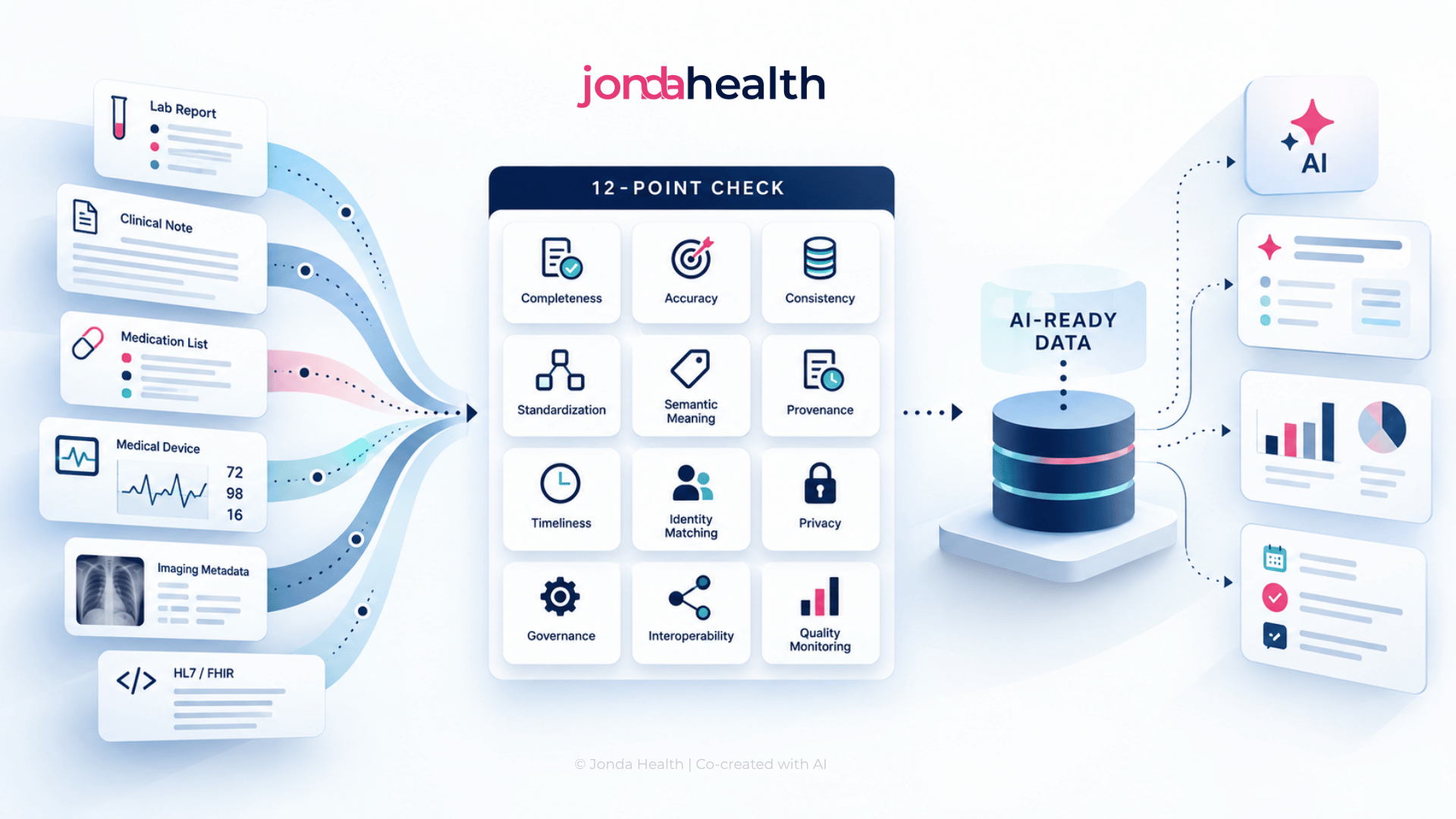
This 12-point checklist helps hospital and health system leaders assess whether their data is ready, and where to begin.

If you lead a hospital, a clinic group or a health system, there is a good chance that AI is now a standing item on your agenda. The board is asking about it, vendors are offering it, and your clinicians are already experimenting with it. There is also a good chance you have seen this pattern: a pilot that looked impressive in the demonstration, followed by months in which it never quite reached daily use.
When that happens, the model is rarely the cause. The more common reason is that the data the AI depends on is scattered across systems, locked inside documents, recorded differently at every site, or not clearly permitted for the purpose. None of this reflects badly on your teams. Healthcare data was captured to care for the patient in front of the clinician and to get the bill paid. It was never organised with reuse in mind, and everyone who has worked in a busy clinic understands why.
This checklist is intended to help you see where you stand. It asks twelve questions that you can work through with your clinical, IT and data leads in a single meeting. You do not need to have everything in place before you start with AI. You do need to know which gaps matter for the use case you have in mind, so that you can invest in the right place.

The layers build on one another. It is difficult to improve data you cannot locate, and there is little point in perfecting data you are not permitted to use. Most organisations find they are strong in one or two layers and thinner in the others, which is useful to know, because it shows where a modest investment will make the largest difference.
Most organisations hold clinical data in far more places than anyone expects: the main record system, the laboratory and imaging systems, departmental databases, a previous system that was never fully retired, shared drives, and paper. Ask whether someone could produce, within a week, a list of the systems that hold patient data, what each contains, in what format and covering which years. If that list does not exist, creating it is the most valuable first step you can take, and it is usually quicker than people fear.
Holding data and being able to use it are different things. Some systems offer good export tools and interfaces. Others make extraction slow, expensive or dependent on the vendor's goodwill. Check what your contracts say about access to your own data, in what format it can be exported, how long an extract takes and what it costs. It is far better to learn this now than at the moment an AI project is waiting on it.
A large share of clinical information never becomes structured data. It sits in scanned referral letters, laboratory reports received as PDFs, discharge summaries, faxes and free-text notes. A person can read these, and software cannot use them without further work. Estimate what proportion of the information your use case needs is held this way. For many organisations this is where the most clinically valuable history sits, particularly results from outside laboratories and records from before the current system.
Ask a simple question of your data: how many different ways is an HbA1c test named across your sites and the laboratories you use? The answer is often dozens. The same is true of diagnoses, medications and procedures. People cope with this variation without noticing it. An AI system treats each variation as a different thing, which quietly undermines every result it produces. If you operate more than one site, or have grown through acquisition, this question deserves particular attention.
Standards are what allow data to be combined, compared and shared. Check whether your clinical data is mapped to recognised medical coding standards or sits in local codes, whether units of measurement are consistent, and whether your systems can exchange data in formats such as FHIR or HL7. Few organisations are fully standardised, and it is not necessary to be. What matters is whether the data needed for your chosen use case can be brought to a common standard at a reasonable cost.
Clinicians work under real pressure, and when time is short the record is what gives way. Fields are left empty, free text is used where a structured field exists, and duplicate patient records build up. It helps to measure this plainly. For the data elements your use case depends on, what proportion of records have them filled in, and how often are they right? A sample audit of a few hundred records will tell you more than any assumption, and it also shows where a change to the workflow would help the clinician as much as the data.
Many of the most valuable uses of AI, such as recognising deterioration, predicting risk or supporting the management of chronic disease, depend on seeing a patient over time. A single result says little. The trend across several years says a great deal. Check how far back your usable data goes, whether records from previous systems were migrated or archived, and whether results from outside your organisation ever make it into the record. The depth of the longitudinal record is often what separates an AI tool that is interesting from one that is clinically useful.
Data collected to deliver care may or may not be available for other purposes, such as training a model, research or sharing with a partner. The answer depends on your jurisdiction, on what patients were told and on your own policies. Check whether your consent wording covers secondary use, whether you have a body that can approve new uses of data, and whether that process takes weeks or many months. Patients extend a great deal of trust when they share their information, and an organisation that can show exactly what it is permitted to do, and why, is in a much stronger position than one working on assumptions.
Most AI work does not require knowing who the patient is. Check whether you are able to de-identify or pseudonymise data reliably, including the names and identifiers that hide inside free text and scanned documents, where they are hardest to find. Check where your data is permitted to be processed, particularly if a vendor's AI runs in another country. Read the terms of the AI tools your staff already use, because clinicians who paste patient information into a consumer AI tool are usually doing so to save time, and the practical remedy is to give them a safe alternative.
In many organisations data quality belongs to everyone, which in practice means it belongs to no one. Ask who is accountable for the quality of clinical data, whether they have the authority and budget to act, and whether you have people who understand both the clinical meaning of the data and its technical structure. That combination of skills is scarce. It is worth being honest about whether you have it in-house, need to develop it, or would do better to bring it in.
A one-off exercise to clean data for a pilot produces a dataset that starts ageing the day it is finished. An AI tool in daily use needs data that arrives continuously, in a consistent form, with quality checked along the way. Ask whether the work done for your last data project could be repeated next month with little effort, or whether it would need to be done again from the beginning. Moving from project to pipeline is what turns data from a recurring cost into a lasting asset.
Readiness only means something in relation to a purpose. A broad ambition to "use AI" gives your teams nothing to prepare for. A specific aim, such as reducing the time clinicians spend finding a patient's previous results, or identifying patients whose kidney function is declining, tells you precisely which data matters, how good it has to be and how you will know whether the effort was worthwhile. Choose a first use case that is valuable, achievable with the data you can realistically prepare, and visible enough to build confidence for the next one.
For each question, give yourself 0 if the answer is no or unknown, 1 if it is partly true, and 2 if it is true and you could show the evidence. Score it with a specific use case in mind, and ask your clinical, IT and data leads to score it separately before you compare notes. The places where they disagree are often the most revealing part of the exercise.
A score of 0 to 8 suggests you are at the foundation stage. This is where most organisations begin. The priority is to understand what you hold (questions 1 to 3) and to choose a first use case (question 12), so that everything which follows has a purpose. Purchasing AI tools at this stage usually leads to the stalled pilot described at the start of this guide.
A score of 9 to 16 suggests you are building. You have real strengths alongside some gaps. Look at which layer scored lowest, since that is likely to be what holds back your first use case. For many organisations at this stage it is consistency and standardisation (questions 4 and 5) or data locked inside documents (question 3).
A score of 17 to 24 suggests you are ready to move. Your foundations will support a serious AI initiative. The focus now is on keeping the data flowing reliably (question 11), and on treating your data as an asset whose value grows as it becomes more complete and more usable.
Whatever the total, a low score on questions 8 or 9 deserves attention before anything else, because permission and privacy are the two gaps that cannot be corrected afterwards.
You can complete this checklist on your own, and we hope you do. If you would value a partner for any part of it, Jonda Health works with healthcare organisations in two ways.
The first is Jonda Health Services, which provides a health data AI readiness assessment as part of its Health Data Foundations work. We work through the questions in this guide alongside your teams, examine the data itself and not only the descriptions of it, and leave you with a clear view of where you stand, which gaps matter for your chosen use case and a practical order in which to address them. Our team brings experience across clinical practice, health data, interoperability, product, AI and delivery. We have also made our own wrong turns while building in this field, and we are glad to share what we learned so that you can avoid repeating them. You do not need to have everything worked out before getting in touch. Many of our conversations begin with a single unanswered question.
The second is JondaX, our health data transformation engine, which addresses several of the gaps this checklist tends to surface. JondaX turns laboratory reports and other clinical documents, including PDFs, scans and images, into structured data (question 3). It resolves the different ways the same test is captured across sites and sources, normalises units and maps results to medical coding standards or to your own code set (questions 4 and 5). It brings historical and external results into one consistent longitudinal record (question 7), de-identifies documents as part of processing (question 9), and runs as a continuous pipeline and not a one-off project (question 11). It works across more than ten languages, with clinical review and quality assurance by Jonda Health's own team, and to date it has processed more than 500,000 files and more than 26 million data points.
Jonda Health is ISO 27001 certified, and JondaX is designed to comply with HIPAA, GDPR and PDPA.
If you would like to talk through your score, or the use case you have in mind, we would be glad to hear from you. Get in touch at hello@jonda.health, or book a free 30-minute data readiness conversation.
It means that the data an AI system needs can be located, extracted, trusted, combined across sources, used with proper permission and kept flowing reliably. Readiness is always relative to a specific use case, not an absolute standard.
The most common reason is the data, not the model. Information is spread across systems, locked inside documents, recorded inconsistently or not clearly permitted for the purpose, so a pilot that worked on a prepared dataset cannot be sustained in daily use.
No. Choose a specific first use case, identify the data it depends on, and bring that data to the quality it requires. The work you do for the first use case builds the foundation for the next.
An internal first pass using this checklist can be completed in a single meeting. A full assessment that examines the data itself is scoped after a first conversation, because it depends on your data, your systems and your goal.
At a minimum, a clinical lead, an IT or systems lead, whoever is responsible for data and analytics, and someone who covers privacy and governance. Scoring the checklist separately and comparing the answers is a useful way to begin.
Jonda Health Services provides a health data AI readiness assessment for hospitals, clinic groups and health systems, and JondaX, the health data transformation engine from Jonda Health, addresses the most common gaps, including data locked in documents and inconsistency across sources.
Suhina Singh is the founder and CEO of Jonda Health, a Singapore-based health data infrastructure company. A physician by training, she works with health systems across Asia-Pacific to harmonise, de-identify and standardise clinical data so it can be trusted and used. Jonda Health is ISO 27001 certified.





