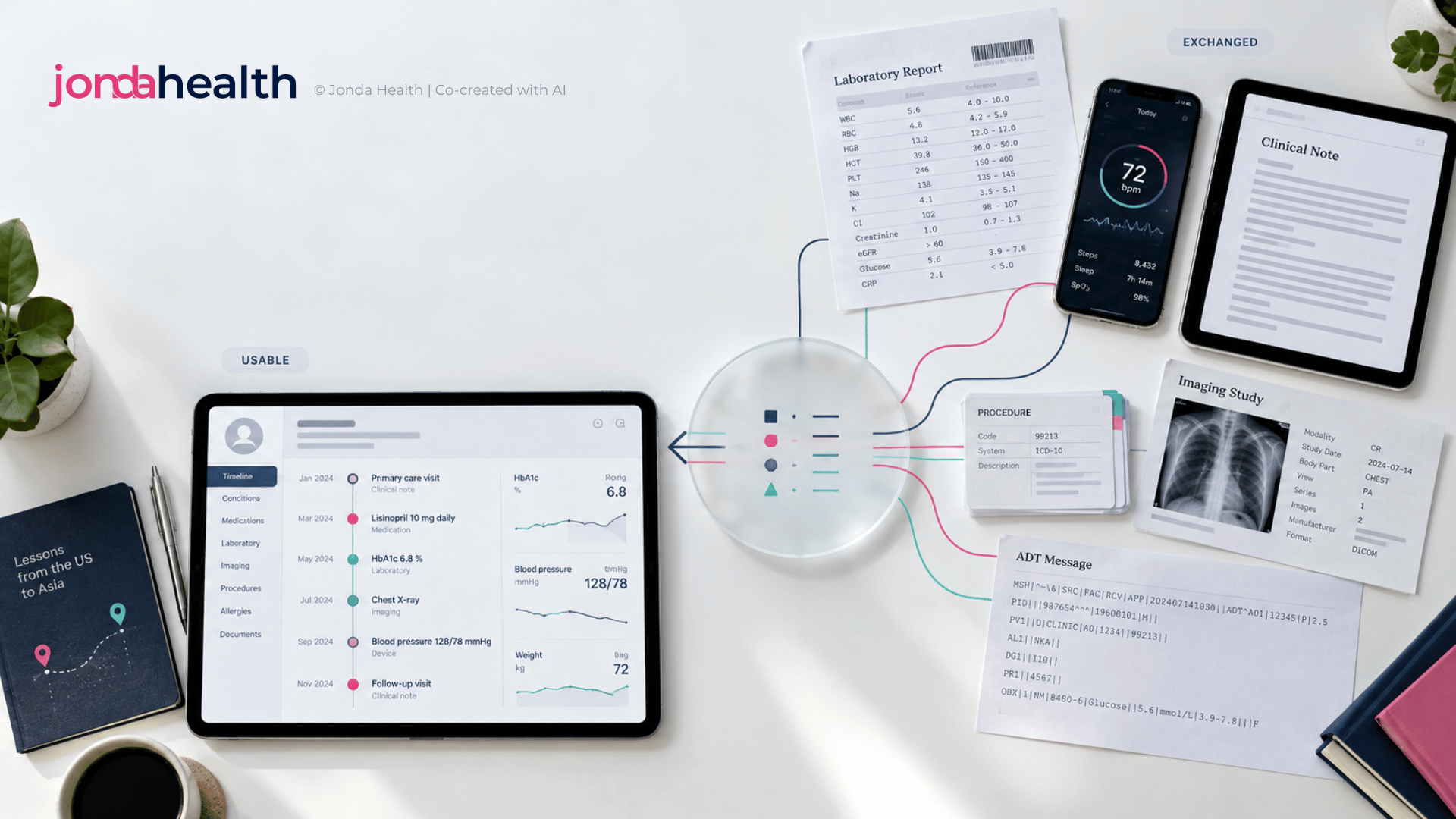
The US is moving health records faster through new national networks. What the Medicare-led framework does, and why exchange alone does not make data usable.

Few health systems in the world have struggled with fragmented records as visibly as the United States. Patients still fill in the same forms at every visit, and clinicians still chase results from other providers by phone and fax. Over the past year, the US government has tried a different way to fix this: rather than writing new regulations, it has asked the industry to commit publicly to making health data flow, and to show results quickly.
The programme is led by the US Centers for Medicare & Medicaid Services, and it has just passed its first anniversary. Numerous participating companies reached general availability in July 2026, and new use cases were launched at the one-year mark. For health systems, laboratories and health technology companies in Asia, it offers useful lessons about what fast, patient-centred data exchange can achieve, and about the part of the problem that exchange alone does not solve.
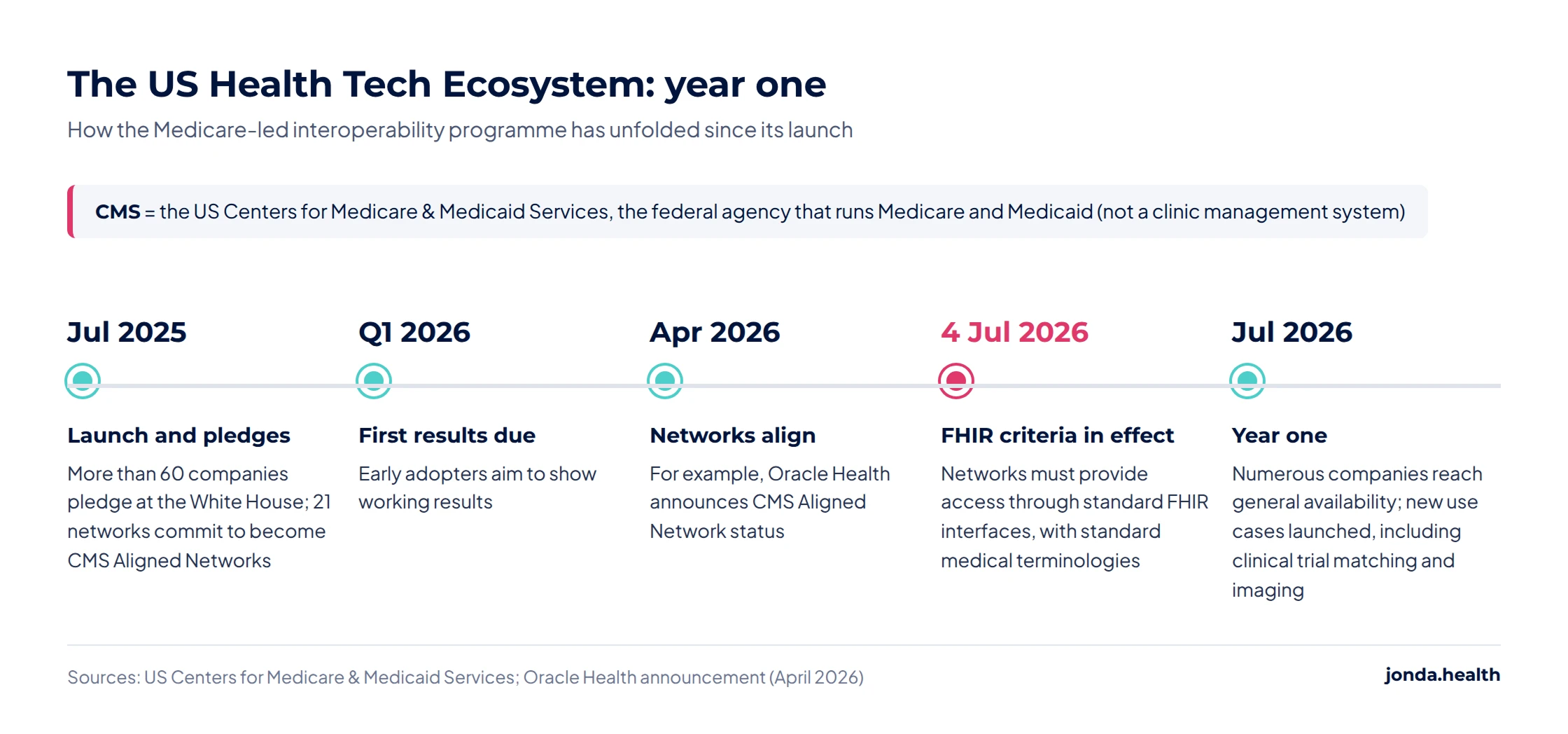
In July 2025, more than 60 companies pledged at the White House to deliver results in the first quarter of 2026. Twenty-one data networks pledged to meet the new criteria to become "CMS Aligned Networks", eleven health systems and providers committed to support patient use, and seven electronic health record (EHR) vendors committed to help exchange data and "kill the clipboard".
The effort has two parts. The first is the CMS Interoperability Framework, a set of criteria that data networks can meet to be listed as a CMS Aligned Network. The second is a set of patient-facing goals, most memorably "Kill the Clipboard", which aims to replace paper intake forms with digital check-in.
Importantly, it is voluntary. The agency describes the framework as an open, standards-based and market-friendly blueprint, and states that it is not intended to create new regulatory burdens. Commentators have noted that the approach is designed to move faster than the consensus-based timelines of earlier national exchange efforts, while avoiding any central federal database.
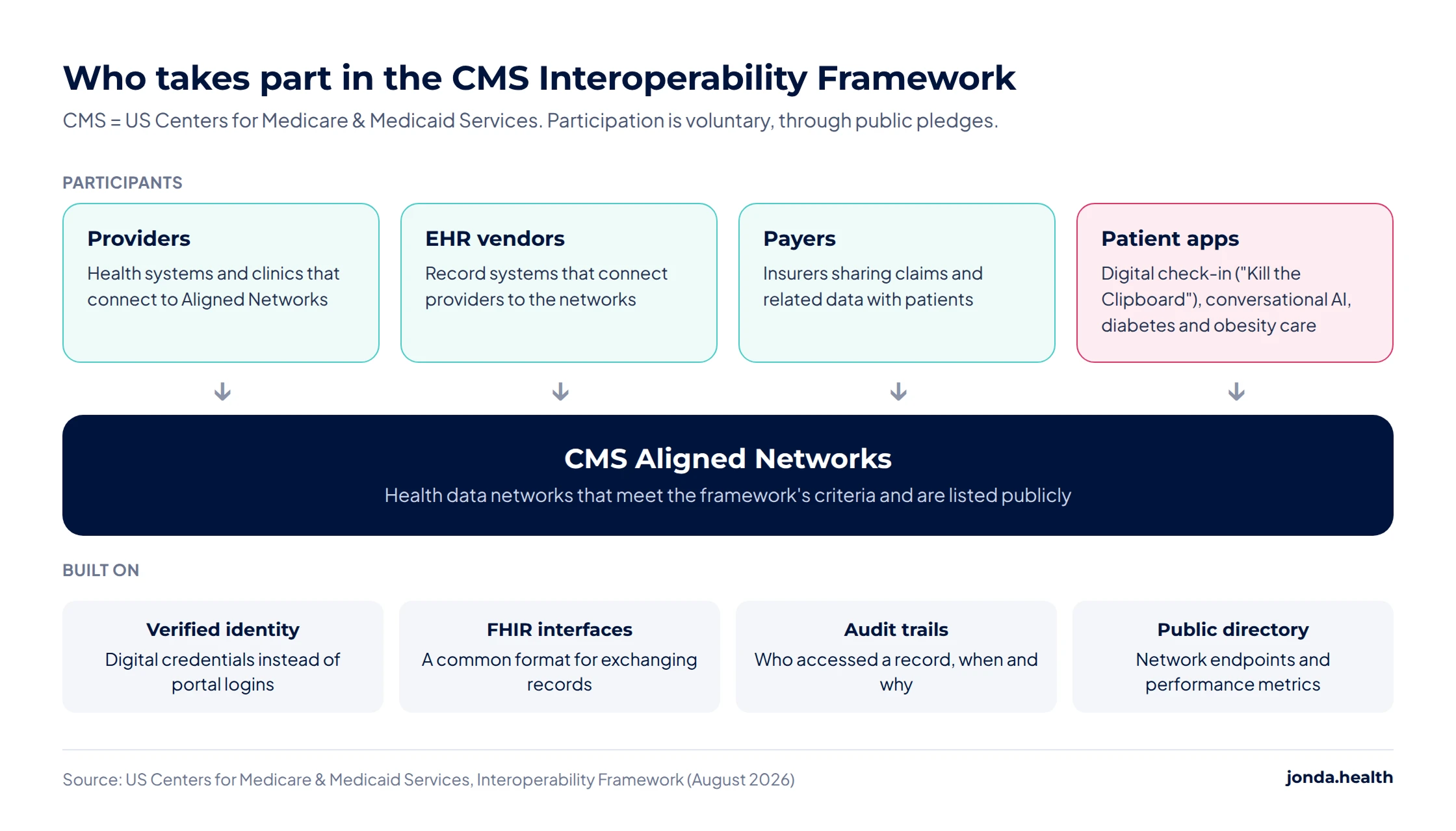
The framework brings together several kinds of participant around the networks themselves: providers that connect to Aligned Networks, EHR vendors, payers (insurers), and patient-facing apps. The first cohort of patient apps focused on three areas: digital check-in, conversational AI assistants, and diabetes and obesity prevention and management.
The criteria are detailed, but the main ideas are easy to follow.
The first is patient access. Patients should be able to use applications of their choice to access their medical information wherever it sits on the network, including both structured and unstructured data. Apps do not need special status to take part.
The second is verified identity instead of portals. If a patient uses a high-assurance digital identity credential through an approved service, every connected node must return their information without the patient needing to know which providers hold it, set up portal accounts or take additional steps. Clinicians gain similar access for treatment when they use a verified credential and are listed as active providers.
The third is common standards. Since 4 July 2026, networks must provide access to data through FHIR APIs (a widely used standard for exchanging health records electronically), with compliance to standard terminologies for laboratory results, medications and conditions.
The fourth is transparency. Networks must keep an accounting record of every network-facilitated transaction, showing who accessed a patient's data, when and why. They must also publish their participants and endpoints in a national provider directory and share metrics on queries, which CMS may use to build scorecards.
Progress has been real. Oracle Health, for example, announced in April 2026 that it had become a CMS Aligned Network, alongside a digital check-in solution in support of Kill the Clipboard. At the one-year anniversary in July 2026, the agency added new use cases and work groups, including price transparency, modern scheduling, clinical trial matching, bulk FHIR data exchange, pharmacies, and a diagnostic imaging work group nicknamed "Ditch the Disk".
The breadth of that list says something important. Once records can move, attention turns quickly to what the data can be used for: finding patients for clinical trials, exchanging whole populations of records, and sharing images without physical media.
Buried in the framework's criteria is a detail that anyone who works with clinical data will recognise. Chart notes and clinical documents, such as radiology reports, scanned or faxed laboratory results and external specialists' notes, are to be returned in human-readable formats such as PDF, TIFF or JPG.
This is a sensible, practical choice. Much of the most important clinical information in any health system still lives in documents rather than structured fields, and it would be unrealistic to wait until all of it is structured before sharing it. But it also shows the gap between exchange and usability. A network can now deliver a scanned lab report to a clinician or an app within seconds. That report is still an image. The values inside it are not yet data that a system can trend over time, compare against another laboratory's results, or feed into an AI model.
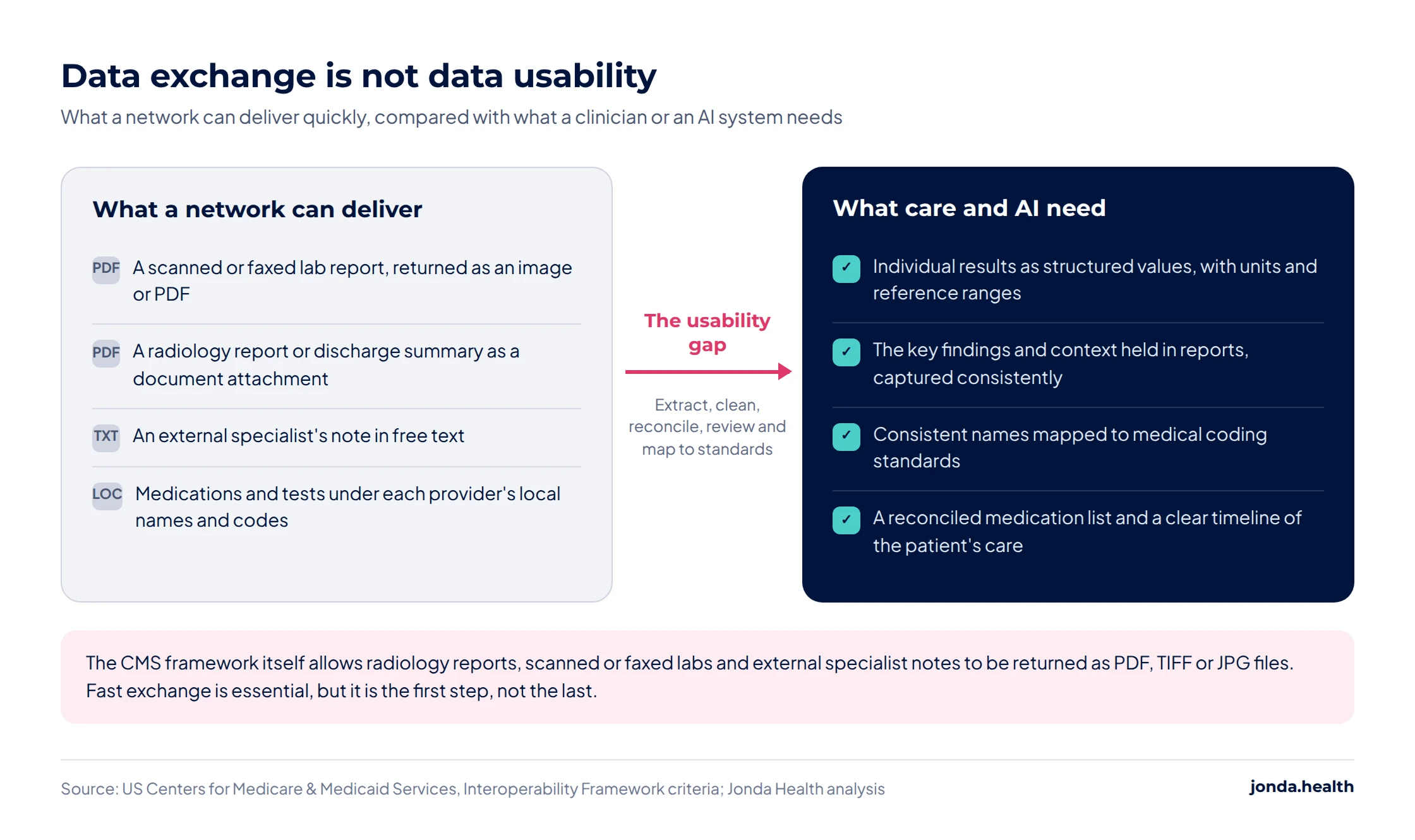
The same is true well beyond laboratory results. Discharge summaries and imaging reports carry the context of a patient's care in narrative form. Specialist notes arrive in free text. Medications and tests appear under each provider's own names and codes, with different units and reference ranges. To make these records genuinely useful for care, research or AI, someone has to extract the information, clean it, reconcile differences between sources, review it clinically and map it to medical coding standards, then keep doing so as new records arrive.
The framework's own requirement for standard terminologies shows that the agency understands this. The challenge is that the requirement applies to data that is already structured, while a large share of what clinicians need arrives as documents. Closing that gap is where much of the remaining work, and much of the value, now sits. As we argue in Healthcare AI Will Not Work Without Trusted Data Infrastructure, fast pipes need trustworthy data flowing through them.
Asia's health systems are diverse, and none will copy the US model directly. Several of its ideas are worth studying closely.
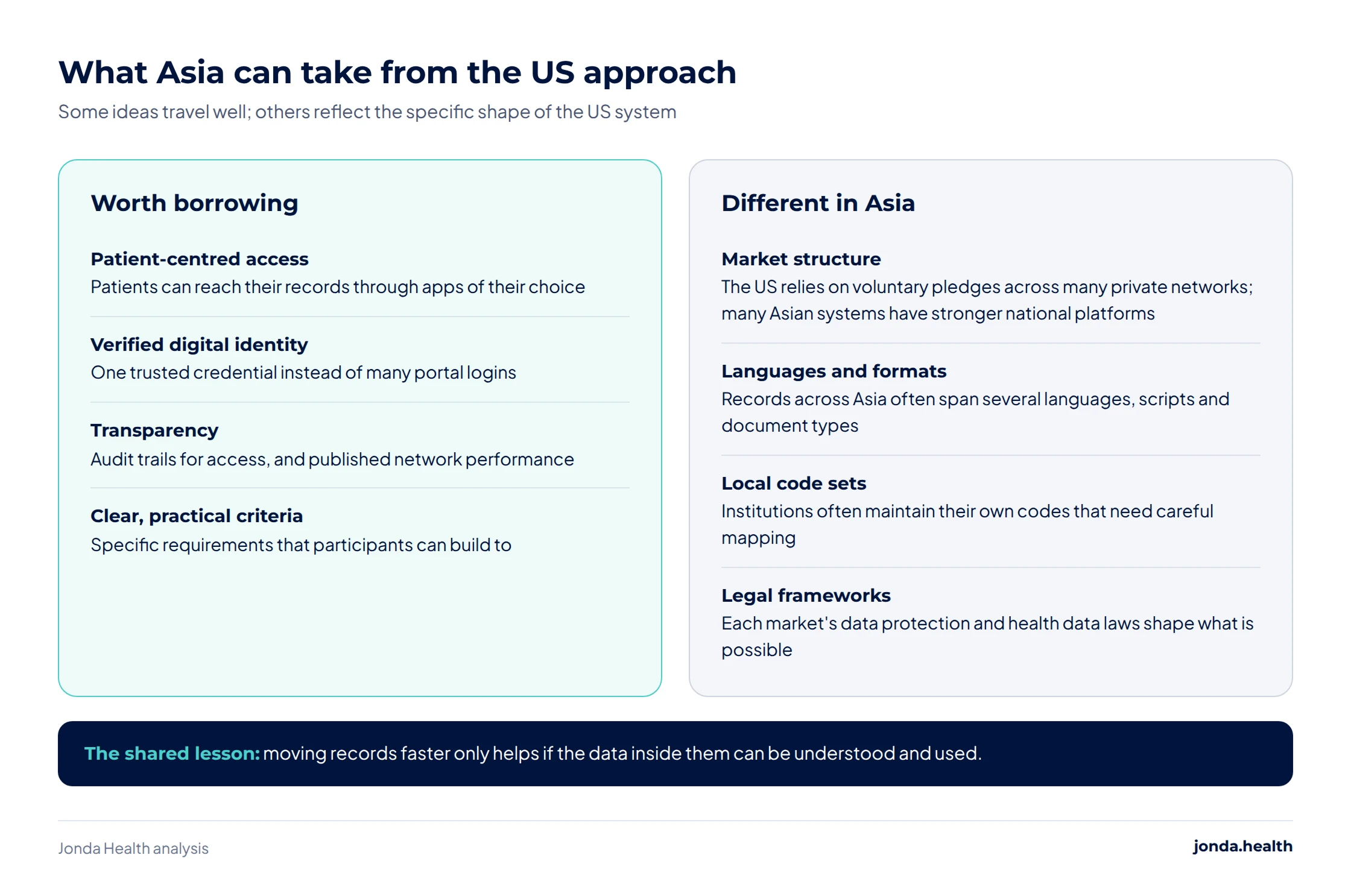
Patient-centred access is the first. Designing exchange around the patient, who can pull their records into an app of their choice, changes the incentives for everyone involved. Verified digital identity is the second: one trusted credential replacing a separate login for every portal is a simpler experience and a stronger control. The third is transparency. Audit trails that show patients who accessed their records and why, and published performance metrics for networks, build trust in a way that policy statements alone cannot. The fourth is the practical tone of the criteria, which are specific enough for participants to build to.
Other parts reflect the particular shape of the US system. The US relies on voluntary pledges across many private networks, while many Asian markets have stronger national platforms. Singapore, for example, is putting its National Electronic Health Record on a statutory footing, as we explored in Singapore's Health Information Act: What Healthcare Providers Need Ready by 2027. Records across Asia also routinely span several languages, scripts and document types, and many institutions maintain their own local code sets. These realities make the usability gap wider, not narrower, which is why exchange and data readiness need to be planned together.
Europe offers a third model, built on permits and secure environments for reusing data, which we covered in The European Health Data Space: What Secondary Use Means for Healthcare Data Teams in Asia. Across all three, the same lesson emerges: moving records faster only helps if the data inside them can be understood and used.
CMS stands for the US Centers for Medicare & Medicaid Services, the US federal agency that runs the Medicare and Medicaid programmes. It is leading the Health Tech Ecosystem initiative and the CMS Interoperability Framework. It is not a clinic management system.
It is a health data network that voluntarily meets the criteria of the CMS Interoperability Framework and is listed publicly by the US Centers for Medicare & Medicaid Services. The criteria cover patient access, verified identity, FHIR-based exchange, audit trails and network transparency.
It is a patient-facing goal of the initiative that aims to replace paper intake forms with digital check-in, so patients can share their health information with a provider using a verified digital identity rather than filling in forms by hand.
No. It is a voluntary framework that networks, EHR vendors, providers, payers and app developers can pledge to meet. It operates alongside existing US privacy laws, including HIPAA.
Not on its own. Interoperability moves records between systems, but much clinical information still travels as documents, free text or local codes. Making it usable for AI requires extracting, cleaning, reconciling, clinically reviewing and standardising that data.
Sources: US Centers for Medicare & Medicaid Services (Interoperability Framework and Health Technology Ecosystem pages, and July 2025 press release); Oracle Health announcement (April 2026); Connecting for Better Health. This article is for general information and is not legal advice.
Suhina Singh is a physician, the Founder and CEO of Jonda Health, and a health data strategist working at the intersection of artificial intelligence and clinical information systems.





