Family health apps promise one place for everyone's health information. Behind that promise sit records from many providers, people at every life stage and questions about who can see what. This guide covers the 7 things that decide whether the data holds up.
In most families, one person quietly becomes the keeper of everyone's health information. They remember when the vaccinations are due, keep the folder of a parent's hospital letters, photograph the children's school health checks and forward lab reports to whichever doctor needs them next. Family health apps exist to make that role easier, and many people are glad to use them.
Building one is harder than it looks. A single family account may hold a newborn, a teenager, two working adults and a grandparent with several long-term conditions. Their records come from different clinics, labs and sometimes countries. Each person has different rights over their own information, and those rights change as children grow up. Getting the data right is what separates an app people trust with their family from one they quietly stop opening.
This guide is written for product, clinical and data leads at family health record apps, caregiver and elder-care apps, parenting and children's health apps, and telehealth services with family accounts. It is organised in three parts: people and permissions, the records themselves, and context and privacy.
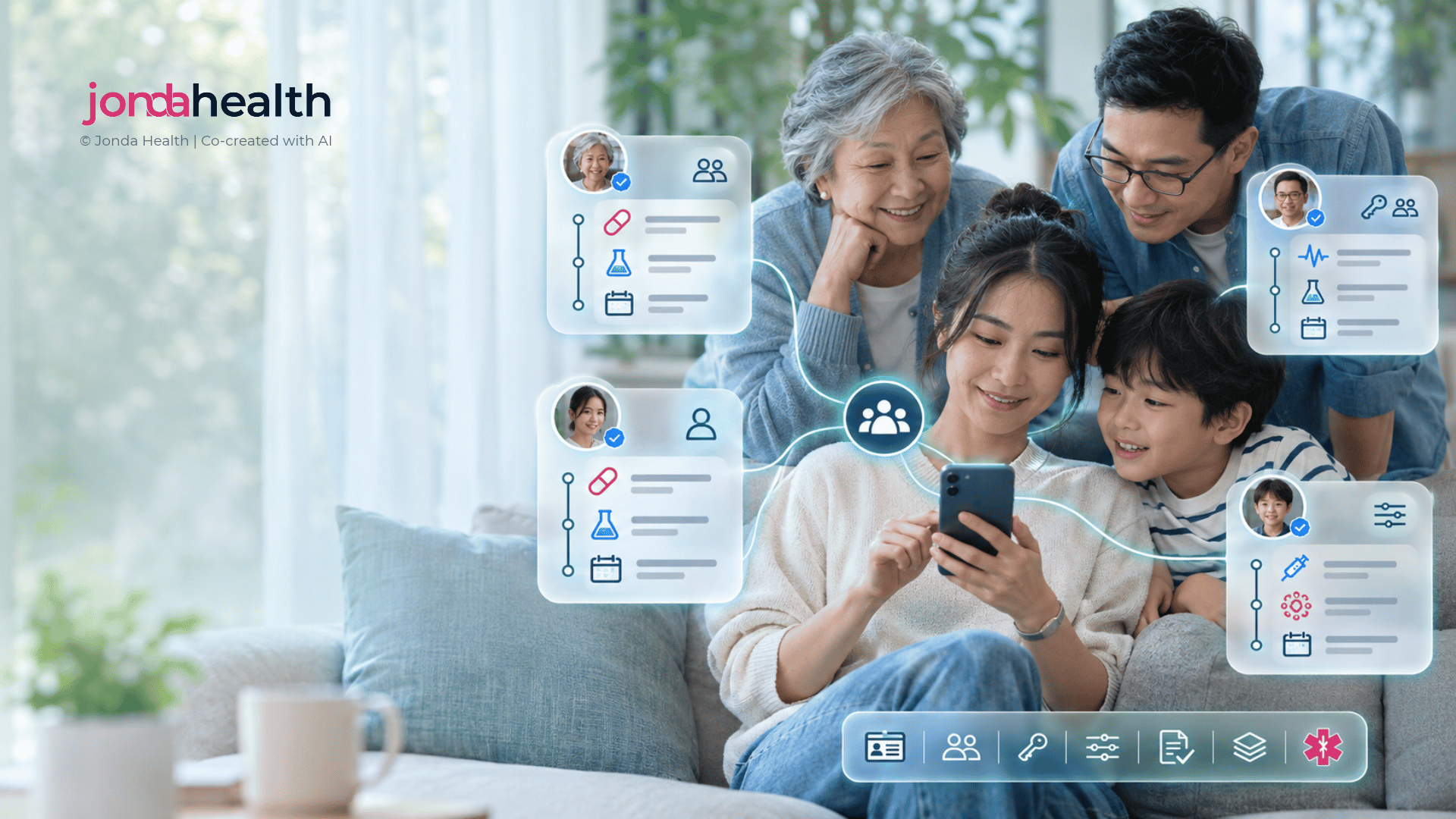
Figure 1. One family account. The account holder manages records for four other people, each with a different access level (full, limited, shared by choice or delegated) and records arriving from different sources: clinics, labs, paper booklets, scanned letters, device readings and records from another country.
Figure 1 shows why a family app is really several health records sharing one login. Each profile has its own sources, its own life stage and its own rules about access. The 7 points below follow from that.
The first job of a family app is to put every record in the right person's profile. That sounds simple until two family members share a surname, a phone number and an email address, a parent uploads a stack of reports for everyone at once, and names are spelt differently by different clinics. Even professional systems struggle with this. Industry estimates put the duplicate record rate in electronic health record systems at around 8 to 12 per cent, and a RAND Corporation report found an average of 8 per cent, rising to 15 to 16 per cent in large systems.1 A study of nearly 400,000 duplicate records found that misspellings accounted for 53 per cent of first-name mismatches.2
In a family app, the risk runs both ways: one person's results land in a sibling's profile, or one person ends up with two profiles that never join up. Match every incoming document on more than a name (date of birth, sex and the provider's own identifiers where present), ask the user to confirm when a match is uncertain, and make it easy to move a record that landed in the wrong place.
Families run on delegation. Parents manage young children's records, adult children help elderly parents, and partners share some things but not others. Each of these needs a clear basis: who granted access, to what, and until when. Access also has to change over time, especially as children become teenagers and then adults.
Health systems handle this very differently. A study of adolescent patient portal policies in the United States found extreme variation, from blocking portal access entirely during adolescence to giving access only to the adolescent, with parents' proxy rights ranging from complete to highly limited.3 As one example, Michigan Medicine moves parents to a limited proxy view when a child turns 11 and turns proxy access off at 18.4 Table 1 shows how access commonly shifts across a family.
Table 1. Common access patterns across a family. Exact ages and rules vary by country and provider, so the app's settings need to be configurable rather than fixed.
As Table 1 shows, there is no single rule that fits every family member. Design the consent and sharing flows into the app from the start, with each permission recorded, visible to the people it affects and easy to change. These flows sit in the app itself, and the data layer underneath needs to respect them on every record it returns.
Families do not get their care from one provider. A child sees a paediatrician and a dentist, the parents have employer health checks and lab tests from whichever lab is closest, and a grandparent may have years of hospital letters from another city or another country. Much of this arrives as PDFs, scanned paper or phone photos, in more than one language, and only some of it comes from systems that can send structured data.
Plan the app for this reality. Let users capture documents easily (photograph, upload, forward), extract the data rather than just storing the image, and handle the languages your users actually receive their reports in. A family app that only shows tidy data from a few connected providers will always be missing the records that matter most to the person using it.
Once records are in, the family will want to see trends: is a child's iron improving, is a parent's kidney function stable, has a partner's cholesterol changed since last year. That only works if results from different labs can sit on one timeline. The same test often has different local names, different units and different reference ranges from lab to lab.
Map each result to a consistent test name and medical coding standard, convert units where a single unit is needed, and keep the original value, unit and reference range exactly as reported. Where results from two labs cannot be compared directly, say so rather than drawing a line between them. This is the work that turns a folder of reports into a health history.
What counts as "normal" changes across a lifetime. Adult reference intervals are frequently not appropriate for children,5 which is why the CALIPER (Canadian Laboratory Initiative on Paediatric Reference Intervals) programme has built age- and sex-specific reference intervals for children and adolescents.6 Growth follows its own references too: the World Health Organization (WHO) child growth standards cover birth to 5 years, and the WHO growth reference covers 5 to 19 years.7 Pregnancy and older age bring their own considerations.
Figure 2. The reference points for "normal" change across a lifetime. Growth is read against WHO child growth standards to age 5 and the WHO growth reference from 5 to 19. Children's lab results need age- and sex-specific paediatric reference intervals rather than adult ranges. Pregnancy and older age bring their own considerations.
Figure 2 is a reminder that a family app cannot apply one set of rules to everyone. Keep the reference range that came with each result, record the person's age and relevant status (such as pregnancy) at the time of the test, and never apply an adult range to a child's result. If the app explains results to users, have clinicians decide how each life stage is handled.
Family health history is one of the most useful things a family app can hold, and one of the least structured. The US Centers for Disease Control and Prevention (CDC) describes a useful family health history as covering three generations of biological relatives, including the name of each condition and the age at diagnosis, or the age and cause of death for relatives who have died.8
A family app is well placed to help, because relatives may already be in the same account. Record family history as structured data (which relative, which condition, age at diagnosis) rather than free text, so it can inform screening reminders and conversations with doctors. Crucially, one person's diagnosis should only appear in another person's family history if that person has agreed to share it. The same CDC guidance encourages respecting relatives' privacy when they prefer not to share.8
Families are close, but not everything is meant for everyone. A teenager may seek confidential care, an adult may not want a partner to see a particular result, and an elderly parent may want help with appointments but not with every detail of their health. The Society for Adolescent Health and Medicine has published recommendations on protecting adolescent confidentiality in electronic health records,9 and the same thinking applies to family apps.
Local law adds firm requirements. Under India's Digital Personal Data Protection (DPDP) Act, a child is anyone under 18, and Rule 10 of the DPDP Rules, 2025 requires verifiable consent from a parent before a child's personal data is processed, coming into force on 13 May 2027.10 Some exemptions exist, including for certain healthcare purposes, so take legal advice on how they apply to your app. Wherever you operate, design for the most private sensible default, let each person see who can access their information, and make sensitive results easy to keep private.
Table 2 brings the 7 points together for your product, clinical and data teams.
Table 2. A checklist of the 7 things family health apps must get right with their data.
The thread running through all 7 points: a family account is several health records that happen to share a login. Each person's data needs to be accurate, comparable and theirs to control.
Family health teams usually come to us at one of two moments. Some are designing the app and want to get profiles, permissions and the data model right before they build. Others have users uploading reports and readings already, and need that data to become structured, comparable and trustworthy. We support both.
JondaX has processed more than 500,000 files and 26 million data points at 99.9 per cent field-level accuracy, across more than 10 languages, and takes about two weeks to integrate. It works behind your app: your users keep using your interface, and JondaX returns structured data in the format your system expects. You can try it yourself on lab and medical device data, and talk to us about clinical documents and other data types.
A family health app helps one person, often a parent or carer, keep track of health information for several family members: children's vaccinations and growth, a partner's results, an elderly parent's medicines and appointments. The hard part is not the interface but the data: records arrive from many providers, in many formats, for people at very different life stages.
Access should change as a child grows. Many health systems give parents full access for young children, then limit some information during adolescence to protect a teenager's confidentiality, and end parental access at adulthood unless the young person agrees.4 The exact rules vary by country and provider,3 so the app needs access settings that can change by age and by type of information.
Children's bodies change rapidly as they grow, and adult reference intervals are frequently not appropriate for them.5 Research programmes such as CALIPER have built age- and sex-specific paediatric reference intervals for this reason.6 A family app should keep the reference range that came with each result and avoid applying adult ranges to children.
Results need to be structured, matched to the right person, and harmonised: the same test mapped to one name, units converted where needed and each lab's reference range kept. Without this, a family's results cannot sit on one timeline or be compared over time.
Yes, for apps processing digital personal data of people in India. The Act treats anyone under 18 as a child, and the DPDP Rules, 2025 require verifiable consent from a parent before processing a child's personal data, with this rule coming into force on 13 May 2027.10 Some exemptions exist, including for certain healthcare purposes, so app teams should take legal advice on how the rules apply to them.
Yes. JondaX, from Jonda Health, turns lab reports and medical device readings, including PDFs and phone photos, into structured, harmonised data through one API, with clinical review built in for anything flagged. A free self-serve trial covers lab and medical device data.
This article is for general information and is not legal or medical advice.
About the author. Suhina Singh is the Founder & CEO of Jonda Health, a health data infrastructure company that turns fragmented clinical data, digital and non-digital, into structured, standardised information that clinicians and systems can actually use. Jonda Health is ISO 27001 certified and works with digital health companies, hospitals, laboratories, registries and life sciences teams. Get in touch at hello@jonda.health.