Scales, Cuffs and Phone Photos: 10 Ways to Turn GLP-1 Home Readings Into Evidence
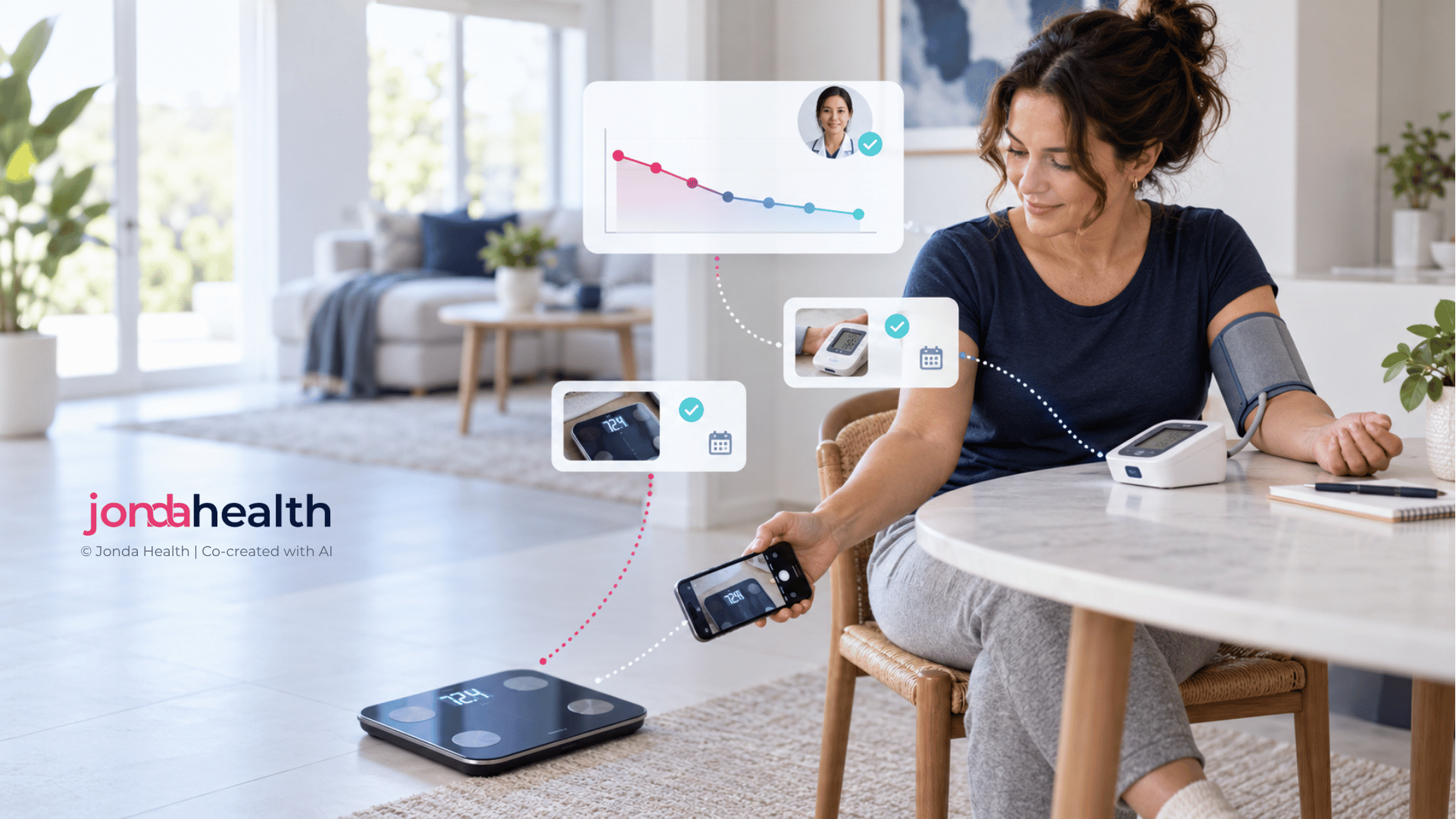
Most of what a GLP-1 programme knows about its patients between appointments comes from readings taken at home. This guide covers how to collect them so they can be trusted, trended and acted on, whether they arrive from a connected device or a photo of a screen.
Suhina Singh
Founder & CEO, Jonda Health
October 25, 2026
·
8 min read
A patient on a GLP-1 programme might see a clinician every few weeks, but they step on a scale far more often. Home readings are how a programme notices that someone has plateaued, is losing weight faster than expected, or has stopped engaging altogether. They are also a large part of the evidence a programme will later show to payers.
The catch is that home readings are the least controlled data a programme collects. They come from many brands of device, in different units, entered or photographed by patients at all hours, sometimes on a scale shared by the whole household. The ten points below turn that stream into something a clinician can rely on.
The ten points at a glance
01Collect the readings that matter, not every reading
02Support every capture route patients use
03Keep the unit with every value
04Use the time it was taken, not the time it arrived
05Make sure it belongs to the right person
06Keep the source photo or device record
07Catch impossible values early
08Report the trend, not the daily noise
09Agree which readings need action
10Treat missing readings as data
1. Collect the readings that matter, not every reading
More data is not better if nobody looks at it. Decide which readings each patient should send and how often, based on their conditions, and tell them clearly. A weekly weight at the same time of day is often more useful than daily readings taken whenever someone remembers.
Reading
Who it is for
An example schedule
Weight
Everyone
Weekly, same day and time, before breakfast
Blood pressure
People with hypertension or on blood pressure medicines
As agreed with the clinician, often a few readings a week
Blood glucose
People with diabetes, especially on insulin or a sulfonylurea
As agreed with the clinician, plus any time symptoms suggest a low
Waist or body composition
Programmes tracking body composition
Monthly, same device and conditions
Schedules are illustrative. Your clinical team sets the right frequency for each patient.
2. Support every capture route patients use
Connected devices are convenient, but many patients, especially outside high-income markets, use basic scales, blood pressure monitors and glucose meters that cannot send data anywhere. If your programme only accepts connected devices, it quietly excludes them. Support all three routes, and record which one each reading came through.
3. Keep the unit with every value
Scales show kilograms or pounds, and glucose meters show millimoles per litre or milligrams per decilitre, depending on the country and the settings. A diabetes threshold such as fasting glucose of 7.0 mmol/L is the same as 126 mg/dL.1 If the unit is not captured with the value, the number cannot be trusted.
4. Use the time it was taken, not the time it arrived
Patients often send readings in batches: a week of photos on a Sunday evening, or a device that syncs when it next finds a connection. If your system stamps each reading with the upload time, a week of morning weights becomes seven readings at 9pm on the same day, and the trend chart is wrong.
Read the time from the device, the photo's metadata or the screen itself, and keep the upload time separately.
5. Make sure it belongs to the right person
Households share scales and blood pressure monitors, and some connected scales recognise users by weight alone. A partner's reading landing in a patient's record looks like a sudden gain or loss of several kilograms. Ask patients to confirm who each device belongs to, and check readings that jump far from the person's recent trend before they reach the chart (see point 7).
Tip: For photographed readings, a short prompt at upload ("Is this your reading?") costs the patient a second and saves a clinician a confusing conversation.
6. Keep the source photo or device record
A home reading only counts as evidence if someone can go back and check it. Keep the original photo of the screen, or the device's own record, linked to the value it produced. When a reading looks unusual, a clinician can open the photo in seconds instead of calling the patient. When a payer audits an outcome, the programme can show where each number came from.
Pitfall: Photos sent through messaging apps are often compressed, and small digits or units can become unreadable. Where you can, let patients upload directly from their camera or gallery.
7. Catch impossible values early
Typos, misread screens and wrong units produce readings that are impossible or extremely unlikely. Simple checks catch most of them before they reach a chart or trigger a false alarm.
What arrives
What probably happened
What to do
8.24 kg after 82.6 kg last week
A missing digit or decimal point
Hold and ask the patient, or check the photo
181.7 kg after 82.6 kg last week
Pounds recorded as kilograms
Check the unit before accepting
A 6 kg drop in two days
A different person, or a different scale
Confirm the person and the device
Blood pressure of 210/170 with no symptoms reported
A misread screen, or a reading that needs urgent attention
Check the photo straight away, then follow your urgent pathway if it is real
The aim is not to discard surprising readings, but to check them before anyone acts on them. A real but alarming reading must still reach a clinician quickly.
8. Report the trend, not the daily noise
Body weight moves from day to day with meals, fluid and the time of the reading. Plotted as daily points, those swings can look like progress one day and failure the next. A weekly average shows the real direction, and it is what patients, clinicians and payers should see first.
Illustrative data. The weekly average moves steadily even when single days look like setbacks.
9. Agree which readings need action
Some home readings should reach a clinician the same day. The GLP-1 product labels warn that the risk of low blood sugar rises when these medicines are used with insulin or a sulfonylurea.2, 3 Diabetes guidelines classify glucose below 3.9 mmol/L (70 mg/dL) as level 1 hypoglycaemia and below 3.0 mmol/L (54 mg/dL) as level 2.4 A programme should decide in advance which readings raise a flag, who sees it and how fast.
Classification from the American Diabetes Association Standards of Care.4 Response pathways are a clinical decision for your team.
Tip: Patients should know what to do themselves if they have a low reading, and should never wait for someone to review their upload. The programme's flag is a safety net, not the first response.
10. Treat missing readings as data
When readings stop arriving, something has usually changed: side effects, cost, a supply problem, or a person who has quietly stopped treatment. Stopping is common in real-world GLP-1 use, with studies finding that around half or more of people stop within a year.5 A gap in home readings is often the earliest sign, weeks before a missed refill or appointment.
Illustrative. Set your own rule for how long a gap should be before someone gets in touch.
How Jonda Health can help
Home readings arrive as connected-device data, photos of screens and typed numbers, from hundreds of device models. Turning them into checked, time-stamped data linked to the right person is the part most programmes find hardest to build. We already turn photographed device readings into structured data for chronic disease monitoring programmes.
JondaX
Make home readings usable
Medical device scan reads photos of scales, blood pressure monitors and glucose meters and returns structured values with their units.
One API for device readings, connected-device data, laboratory reports and clinical documents.
Clinically trained reviewers check flagged results, with 99% field-level accuracy after expert review.
ISO 27001 certified, designed to comply with HIPAA, GDPR and PDPA, and deployable in country.
Jonda Health Services
Design the monitoring around it
Which readings to collect from whom, and how often.
Plausibility checks, flags and response pathways your clinical team can own.
Engagement rules for missing readings and check-ins.
Consent, pseudonymisation and data flows that meet local rules.
See it on your own readings. Send us a sample of real photos of home devices and related documents (up to 20 pages or images) and we will run them through JondaX free of charge. If you would rather talk it through first, book a free 30-minute data readiness conversation.
American Diabetes Association Professional Practice Committee. Diagnosis and Classification of Diabetes. Standards of Care in Diabetes, Section 2. Diabetes Care (published annually).
Novo Nordisk. Wegovy (semaglutide) injection, US prescribing information. accessdata.fda.gov/drugsatfda_docs/label/2024/215256s011lbl.pdf
Eli Lilly. Zepbound (tirzepatide) injection, US prescribing information. pi.lilly.com/us/zepbound-uspi.pdf
American Diabetes Association Professional Practice Committee. Glycemic Goals and Hypoglycemia. Standards of Care in Diabetes, Section 6. Diabetes Care (published annually).
Gasoyan H, et al. Discontinuation and reinitiation of dual-labeled GLP-1 receptor agonists among US adults with overweight or obesity. JAMA Network Open. 2025;8(1):e2457349; and Grosicki GJ, et al. Diabetes, Obesity and Metabolism. 2025. pubmed.ncbi.nlm.nih.gov/39743934