
Malaysia is compressing nearly two decades of change into a little over two years. What is being built, why the design choices matter, and how data quality protects the investment.

Few health systems in the region are moving as quickly as Malaysia's. As recently as 2025, around 14% of the country's public hospitals had been digitalised, and none of them were yet connected to one another. The original target for digitalising the public health system was 2045. On 30 August 2026, the government raised its investment to RM1 billion and confirmed a far more ambitious goal: all public hospitals digitalised by the end of 2028.
The vision behind this is clear and compelling. The Health Minister, Datuk Seri Dr Dzulkefly Ahmad, has described the aim as a truly interoperable national electronic medical record, connecting public and private hospitals and clinics both horizontally and vertically. The ambition is known as One Record, One Citizen.
This article explains what Malaysia is building, why the design choices matter, and why we believe data quality deserves a place alongside connectivity and systems as the rollout accelerates. It is written for Malaysian hospitals, laboratories, clinics and technology vendors, and for teams across the region who are watching Malaysia as a model.
The programme brings together several initiatives, led by the Ministry of Health with support from the Ministry of Communications and the Malaysian Communications and Multimedia Commission.

The first is PERSADA, the National Digital Health Ecosystem and Connectivity Catalyst, launched in June 2026. It is built on a cloud-based clinical management system (in this article, we always write this term in full to avoid confusion with other uses of the acronym "CMS"). The initiative is being implemented across 150 government hospitals and more than 2,400 public healthcare facilities through 2028, with the aim of 81% of patients receiving treatment within an hour. The additional funding announced in August is intended to speed up internet connectivity and the rollout of electronic medical records across public clinics and hospitals.
The second is the continued expansion of the Total Hospital Information System, which integrates clinical, administrative and financial systems within a hospital.
The third is One Record, One Citizen itself. For this national EMR project, the Ministry intends to divide the country into four zones, each covered by its own EMR. Alongside this, the Ministry has announced plans for a National Health Interoperability Platform to help people access their health records online, and has said it will adopt globally recognised standards, including FHIR, with the HIMSS digital maturity models as a guiding framework.
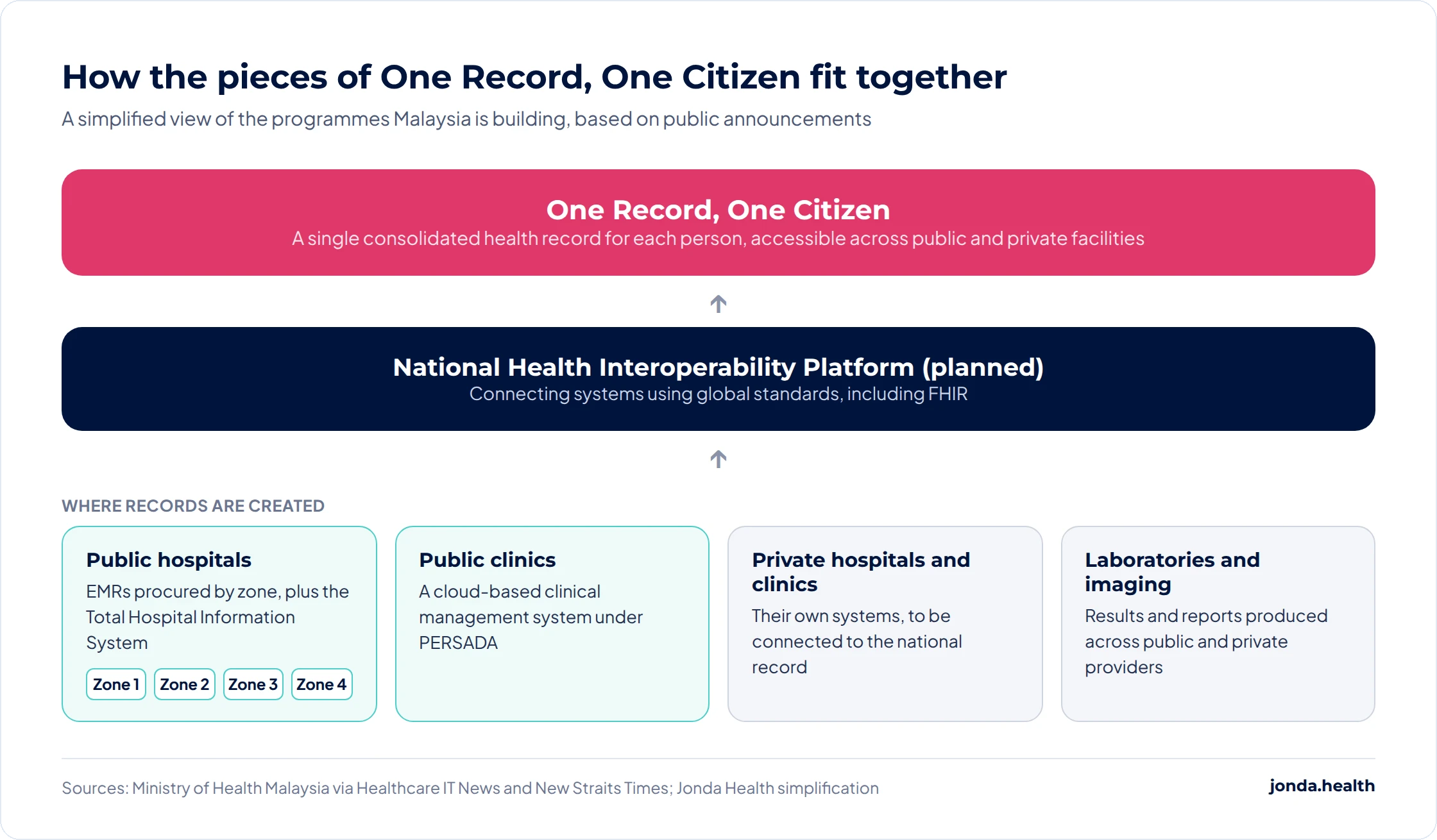
Choosing four zones with four EMRs is a pragmatic decision. It spreads delivery risk, allows regions to move at their own pace, and avoids depending on a single vendor. It also means that the real test of One Record, One Citizen will not be whether each zone goes live, but whether the records in each zone mean the same thing when they come together.
The same is true for the ambition to include private hospitals and clinics. Private providers already run a wide range of systems, each with its own way of naming tests, recording medications and structuring reports. Connecting them to a national record is a technical task. Making their data consistent with the public sector's is a data task.
This is where the Ministry's commitment to global standards such as FHIR is so important. FHIR defines how records are exchanged. What travels inside those records, and whether it can be understood consistently across four zones and many private providers, depends on the quality and consistency of the data itself.
Moving from 2045 to 2028 compresses nearly two decades of change into a little over two years. That speed brings real benefits: patients will see faster, more connected care sooner, and clinicians will spend less time chasing paper.
It also brings responsibility. In a short time, Malaysia's public health system will create very large volumes of new digital data. The decisions made now about how that data is structured, named and standardised will shape how useful it is for decades. Several realities will need careful attention. Historical records, some still on paper and some in older systems, will need to be brought across with care so patient histories are complete. Laboratory results from public and private laboratories will arrive with different test names, units and reference ranges. Clinical notes and reports may mix Malay and English. And each system will bring its own local codes.
None of this is unusual. It is the reality of every large health system. But it is much easier to address as the system is built than to fix once millions of records have been created.
In our work with clinical data across the region, we see a consistent pattern. Digitalisation projects measure success by systems installed and facilities connected. Those measures matter. What they do not capture is whether the data inside the systems is ready to be shared, compared and used.
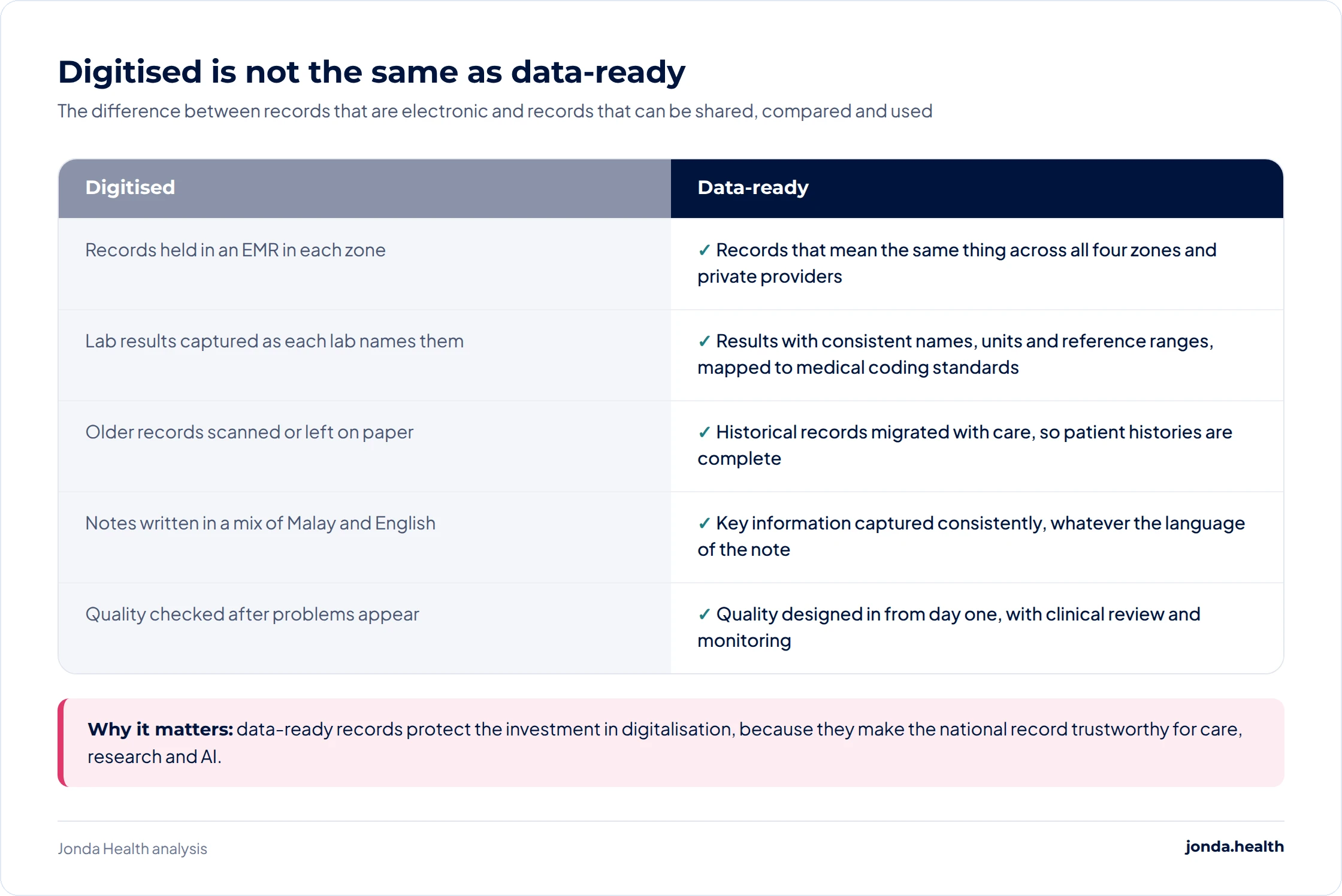
Data-ready records have a few qualities in common. They mean the same thing wherever they were created. Laboratory results carry consistent names, units and reference ranges, mapped to medical coding standards. Medications are recorded in a way that can be reconciled across providers. Historical records are migrated with care. And quality is designed in from day one, with clinical review and ongoing monitoring, rather than checked after problems appear.
AI can help with much of this at scale, and we use it extensively ourselves. But in healthcare, speed without checks creates risk. Automated extraction and mapping need clinical review, clear audit trails and careful attention to where patient data is processed. As we argue in Healthcare AI Will Not Work Without Trusted Data Infrastructure, the value of any national data platform depends on the trustworthiness of what flows through it.
Seen this way, data quality is not a criticism of the rollout. It is how the investment is protected. A national record that clinicians trust will be used, and a record that is used will improve care, support research and prepare Malaysia for the responsible use of AI. This is the work JondaX was built to support, and you can read how we approach it below. We explore the wider idea in When Health Data Becomes an Asset: What Readiness Actually Requires.
One Record, One Citizen is a public programme, but its success will depend on private hospitals, clinics, laboratories and technology vendors too. Many private providers will want to be ready to connect when the national platform opens to them.
Private organisations also operate under Malaysia's Personal Data Protection Act, which was significantly amended in 2024. Since June 2025, data controllers have been required to appoint data protection officers and to notify breaches, and individuals have gained a right to data portability. Health information is treated as sensitive personal data. For private providers, getting data governance right is therefore both a compliance requirement and a foundation for taking part in a connected national system. Public sector bodies are covered by separate arrangements, so organisations should confirm which rules apply to them.
Malaysia is not alone in this journey, and recent moves elsewhere offer useful lessons.

Singapore has put contribution to its national record on a legal footing and paired it with security and data quality requirements, as we explored in Singapore's Health Information Act: What Healthcare Providers Need Ready by 2027. Australia has mandated sharing one data type at a time, starting with pathology and imaging reports, which allows each type to be done well before moving to the next. The United States has shown that records can move quickly between networks, while many still travel as PDFs and scanned images, a reminder that exchange is not the same as usability, as we discussed in Data Exchange Is Not Data Usability. And Europe is making data quality visible through dataset descriptions and a planned quality label, which we covered in The European Health Data Space.
The common thread is that connection targets work best when they are paired with clear expectations for data quality.
It is Malaysia's vision for a single consolidated health record for each person, accessible across public and private health facilities. The national EMR project behind it divides the country into four zones, each with its own EMR, connected through a planned National Health Interoperability Platform.
PERSADA, the National Digital Health Ecosystem and Connectivity Catalyst, is a joint initiative of Malaysia's health and communications ministries, launched in June 2026. It uses a cloud-based clinical management system to digitalise public healthcare facilities and expand connectivity through 2028.
The government is aiming to digitalise all public hospitals by the end of 2028, brought forward from an original target of 2045, supported by funding increased to RM1 billion in August 2026.
No. In Malaysia, the term refers to a cloud-based clinical management system used in public clinics. In US health policy, CMS usually means the US Centers for Medicare & Medicaid Services. We write both out in full to avoid confusion.
They can take stock of their records, standardise key data such as laboratory results, map local codes to medical coding standards, adopt FHIR-based interfaces and make sure their data governance meets the amended Personal Data Protection Act.
Malaysia's acceleration is a significant opportunity for patients, clinicians and the wider health ecosystem. Building data quality into the rollout from the start will help make sure One Record, One Citizen is not only connected, but trusted and useful. There are two ways we can support you on that journey.
Prefer email? Get in touch at hello@jonda.health.
Sources: Ministry of Health Malaysia and Bernama, via Healthcare IT News, New Straits Times, The Star and OpenGov Asia; Baker McKenzie and Data Protection Report on the Personal Data Protection (Amendment) Act 2024. This article is for general information and is not legal advice.
Suhina Singh is a physician, the Founder and CEO of Jonda Health, and a health data strategist working at the intersection of artificial intelligence and clinical information systems.





