
The Philippines is building the national standards that will let health systems exchange records. What PH Core and eReferral are, where they stand today, and why the data inside your system matters as much as the standard itself.

The Philippines has set itself an ambitious goal. Under its National Health Compact, the country aims for 90% of health facilities to use interoperable electronic medical records in 2026, and all of them by 2027 (Philippines National Health Compact). Earlier efforts at a national health information exchange ran into infrastructure limits, governance challenges and uneven digital readiness (Frontiers in Digital Health), so this time much of the focus is on getting the standards right first.
That is where PH Core comes in. It is the shared language that should allow a hospital in Baguio, a rural health unit in Aklan and a specialist centre in Manila to exchange records reliably, whatever system each of them uses.
This guide explains what PH Core is, what the latest testing showed, and what hospitals and EMR vendors should do now. It draws on our experience at Jonda Health, where our work is turning health records from many different sources into structured, standardised information that clinicians and systems can actually use. Much of our clinical review team is based in the Philippines, so the country's progress matters to us directly.
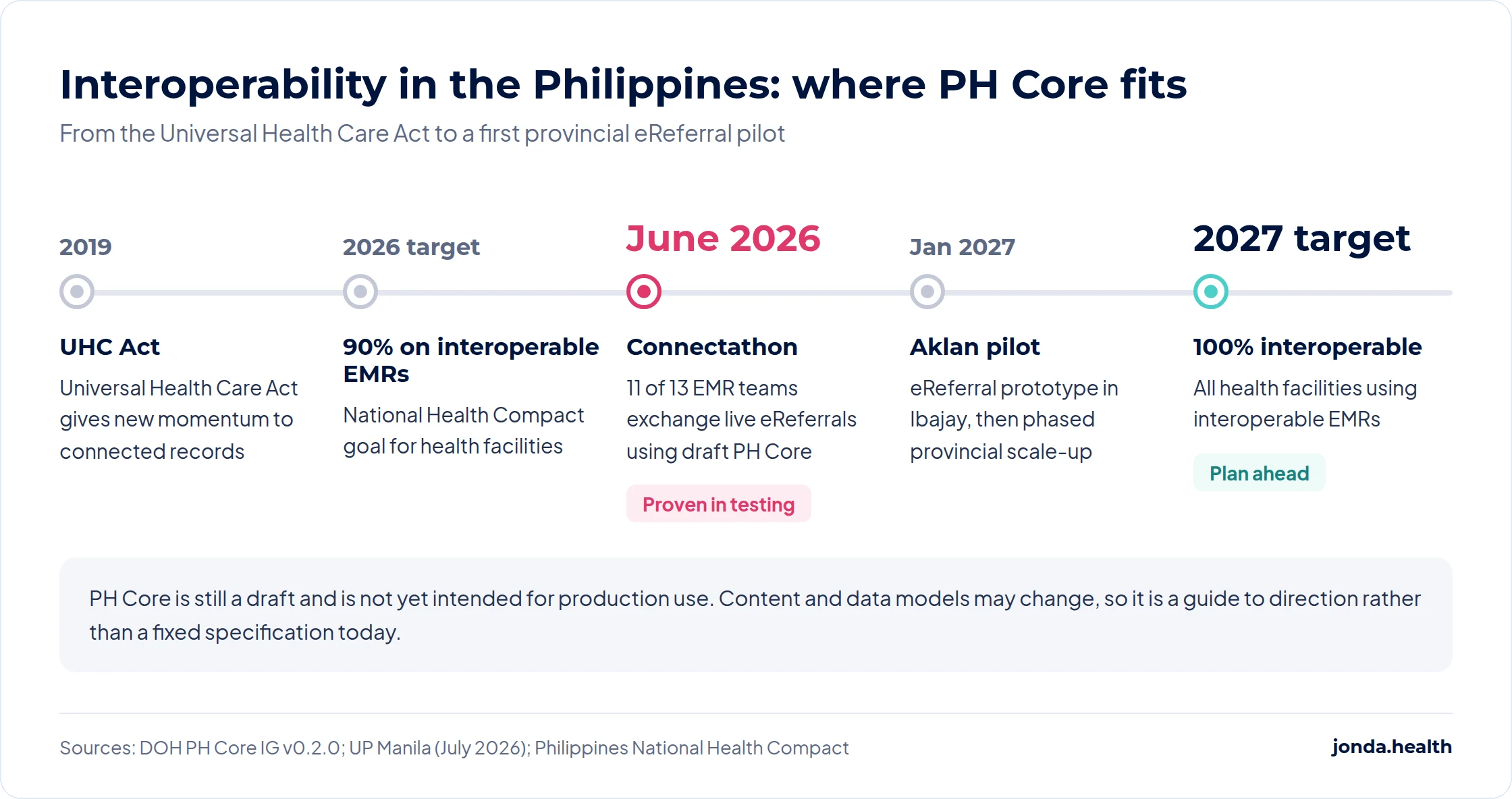
PH Core is a FHIR Implementation Guide that sets out nationally agreed core clinical and administrative data standards for health information exchange in the Philippines. The Department of Health oversees its development through the University of the Philippines Manila National Telehealth Center, with technical assistance from CSIRO Australia and participation from PhilHealth and other partners (PH Core Implementation Guide).
In practical terms, PH Core defines common profiles for patients, practitioners, organisations, encounters and observations, including national identifiers such as the PhilHealth ID, and links them to international medical coding standards. Other guides, such as the Philippine eReferral guide (PHeReF), build on it for specific uses.
It is important to be clear about its status. PH Core is currently a draft, version 0.2.0, and states that it is not yet available for public or production use, with content and data models still subject to change (PH Core). That makes now a good time to understand it and prepare, rather than to build rigidly against today's version.
In June 2026, thirteen EMR teams gathered in Aklan for a three-day testing event, and eleven of them demonstrated live, end-to-end electronic referrals across a mix of vendor and in-house systems. The event was convened by the University of the Philippines Manila National Telehealth Center to build, test and validate the draft PH Core and eReferral guides, supported by CSIRO Australia and the Australian Government, in collaboration with the Department of Health and the Aklan provincial government (University of the Philippines Manila).
Organisers noted that the core technical capability is no longer in question, and that the work ahead is to make exchanges progressively more complete and more real. An eReferral prototype begins in Ibajay, Aklan in January 2027, followed by a phased provincial scale-up (UP Manila).
That phrase, more complete and more real, is worth dwelling on. The connectathon used a synthetic patient scenario. Real referrals will carry real histories, and that is where the next set of challenges sits.
A standard like PH Core defines the structure a record travels in. It cannot, on its own, make the content consistent. A system can pass a conformance test and still send a referral with a laboratory result that cannot be compared, or a medicine recorded only under a local brand name.
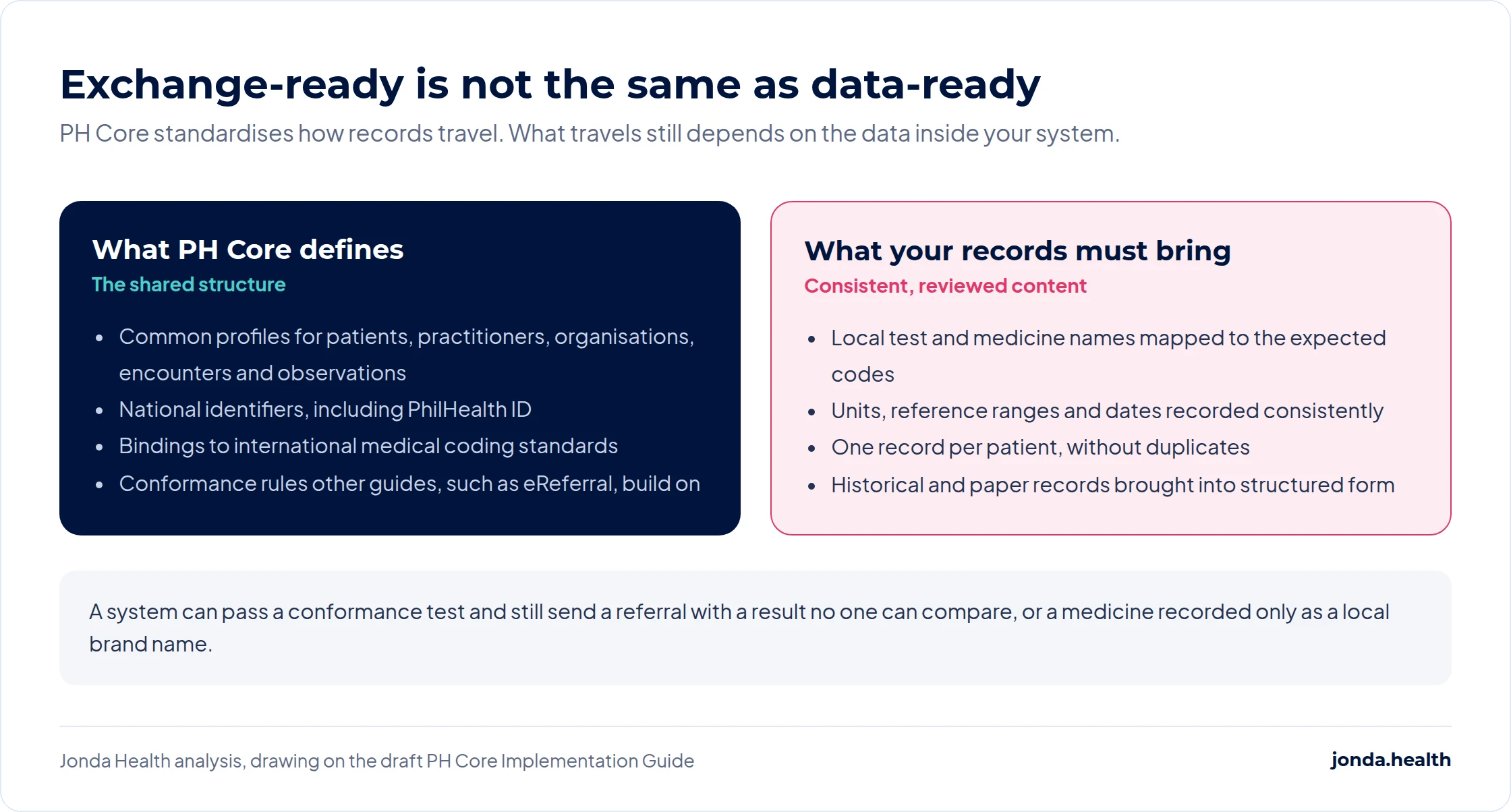
In the records we work with across the region, the same patterns appear again and again. Laboratory tests carry local names and abbreviations, with different units and reference ranges. Medicines are recorded under brand names, generic names or local codes. Some institutions maintain their own internal code sets. A great deal of clinical meaning sits in free text, and much of the history is in PDFs, scans or paper charts. None of this reflects poor practice; it is how records build up across busy facilities and systems that were never designed to speak to each other.
Mapping that content to the codes PH Core expects is more than a lookup exercise. It means interpreting local terms, reconciling units, resolving duplicates and putting clinical review behind the result, so that what arrives at the receiving facility can be trusted. That is why we argue that healthcare AI will not work without trusted data infrastructure, and the same holds for exchange.
Hospitals, provincial health offices and health care provider networks will be among the first to feel the benefit of eReferral, and the first to notice gaps in what arrives. The practical questions are straightforward: how consistently are your laboratory results, medicines and diagnoses recorded today, how much of your history is outside your EMR, and how many duplicate patient records do you carry?
Starting that assessment now means that by the time exchange is live in your area, the records you send are ones your referral partners can use, and the records you receive can sit alongside your own. For clinics also moving off eKonsulta, the same preparation helps twice; we cover that in Moving Off eKonsulta: How YAKAP Clinics Can Migrate Without Losing Patient History.
For EMR vendors, PH Core is both a technical task and a client-readiness question. Building the profiles and passing conformance is the part most teams plan for. The part that often takes longer is helping each client bring their existing data into shape, especially when they arrive with years of history in another system, spreadsheets or paper.
Vendors who can offer clients a reliable path for that preparation, whether in-house or with a partner, are likely to see smoother onboarding and fewer support issues once exchange goes live.
At Jonda Health, we have spent years working with health records across formats and languages, and we know how much of the work behind interoperability only becomes visible once real data starts to move. Depending on where your organisation is today, there are three ways we can help.
PH Core is the Philippines' draft FHIR Implementation Guide, setting nationally agreed core clinical and administrative data standards for health information exchange. It is developed under the Department of Health through the University of the Philippines Manila National Telehealth Center, with technical assistance from CSIRO Australia.
PH Core is currently a draft (version 0.2.0) and states that it is not yet available for public or production use. Organisations should follow its development closely and watch for guidance from the Department of Health and PhilHealth on adoption.
The Philippine eReferral Implementation Guide (PHeReF) builds on PH Core to support electronic referrals between facilities. It was tested at a national connectathon in June 2026 and will be piloted in Aklan from January 2027.
Conformance means your system can package and exchange data in the agreed structure. The content still needs to be consistent: local test and medicine names mapped to the expected codes, units recorded consistently, duplicates resolved, and historical records structured.
FHIR (Fast Healthcare Interoperability Resources) is an international standard from HL7 for exchanging health information between systems. Implementation Guides like PH Core adapt it to a particular country or use case.
Sources: Department of Health, Draft PH Core Implementation Guide v0.2.0; University of the Philippines Manila (July 2026); Philippines National Health Compact; Zuniga et al., Frontiers in Digital Health (2026). This article is for general information and is not regulatory advice.





