
A practical guide to AIHGle 2.0: what changed from 2021, who is responsible for what, and why the data underneath every AI tool deserves as much attention as the tool itself.

Most healthcare organisations in Singapore are no longer asking whether to use AI. They are asking which tools to trust, who signs off on them, and what happens when something goes wrong. A consultation summarised by an AI scribe, a chest X-ray flagged by an algorithm, a patient reminder written by a language model: each raises the same practical question of who is responsible for making sure it is safe.
The updated Artificial Intelligence in Healthcare Guidelines, known as AIHGle 2.0 (read as "agile"), are Singapore's answer. Co-developed by the Ministry of Health (MOH) and the Health Sciences Authority (HSA), they were launched on 10 March 2026 and build on the framework first issued in 2021 (MOH circular, 13 March 2026).
This guide explains what AIHGle 2.0 says, who it applies to, and where we expect organisations to find the work hardest. That last part draws on our experience at Jonda Health, where our work is turning health records from many different sources into structured, standardised information that clinicians and systems can actually use.

What is AIHGle 2.0?
AIHGle 2.0 is a consolidated set of recommendations and best practices for the safe development, deployment and use of AI in healthcare. MOH describes its intent clearly: AI should augment and empower healthcare professionals in enhancing healthcare delivery, with patients at the heart of it (Ministry of Health).
Although it applies broadly, the guidelines focus on AI that uses machine learning and deep learning, because complexity, opacity and scale amplify the risks. They also target two categories of use (Baker McKenzie).
The guidelines rest on seven ethical principles: safety, fairness, transparency, explainability, robustness, security and data protection, and alignment with human values and goals. These echo the principles of medical ethics that clinicians already work by, applied to a new kind of tool.
MOH highlights three key updates (MOH circular). The first is stronger accountability, through clear responsibilities for developers, deployers and users. The second is greater trust, through guidance on transparency so that people can make informed decisions. The third is updated guidance on deployment, including how to assess and mitigate risks.
The guidelines also address emerging developments directly, including generative AI and direct-to-consumer AI applications, and MOH has described AIHGle as a living document that will be updated as technology develops. For organisations, that means treating AI governance as an ongoing practice rather than a one-time approval.
Who owns what
The most practical change is clarity about roles. AIHGle 2.0 recommends that each party's responsibilities are formalised and documented across the AI lifecycle, for accountability, transparency and comprehensive risk management.

Developers, such as manufacturers, are responsible for building and validating AI for its intended use, and for being clear about what it can and cannot do. AIHGle 2.0 also points developers to HSA's requirements, with examples of when an AI tool is considered a medical device.
Deployers are the healthcare organisations that bring AI into their services. They carry responsibility for internal governance, for choosing appropriate solutions, and for assessing and managing risk in their own setting. This is the role many hospitals, clinic groups and laboratories are only now formalising.
Users are the healthcare professionals working with AI day to day. The guidelines are clear that AI should support, not replace, their judgement, and that transparency matters so patients and clinicians can make informed decisions.
AIHGle 2.0 is guidance. Separately, HSA regulates software that meets the definition of a medical device, and MOH states that AIHGle 2.0 complements HSA's regulatory guidelines for software as a medical device. HSA updated those guidelines in December 2025, with clarifications on cybersecurity, machine learning and a streamlined pathway for managing software changes (Lexology summary of HSA's May 2026 briefing).
In practice, anyone building or buying AI should ask two questions early. Does this tool meet the definition of a medical device, and if so, what does HSA require? And regardless of the answer, how does it measure up against AIHGle 2.0's expectations? Organisations should take advice where the answer is not obvious.
Alongside the guidelines, MOH published a deployers' toolkit to support new adopters with internal governance and with selecting appropriate AI solutions, and an infographic summarising the responsibilities of developers, deployers and users. The materials are available at go.gov.sg/aihgle.
For a hospital or clinic group, the toolkit is a sensible starting point for building an AI governance process: who decides, on what evidence, and how tools are reviewed once they are in use. We would add one question to every procurement conversation: what data was this tool validated on, and how closely does it resemble ours?
Much of the discussion around AIHGle 2.0 focuses on governance structures and roles. Both matter. In our experience, though, the part organisations most often underestimate is the condition of the data that every stage of the AI lifecycle depends on.
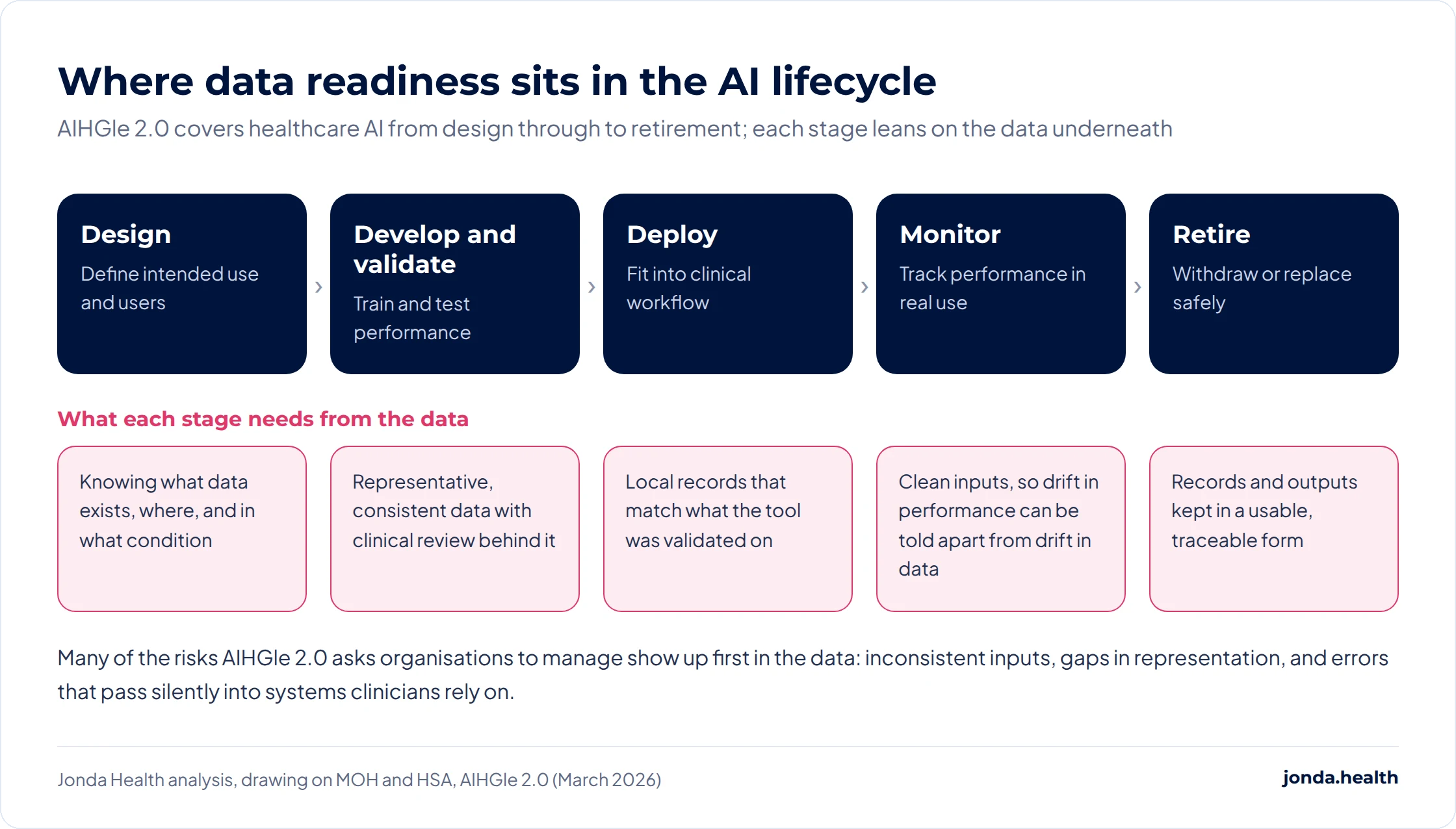
A tool validated on well-structured data from one institution may behave differently when it meets local records with different test names, units, languages and formats. Monitoring is harder when you cannot tell whether a change in performance comes from the model or from the data flowing into it. And in the records we work with across the region, the same patterns appear again and again: laboratory results named in several ways, medications recorded under brand names, generic names and local codes, diagnoses captured as free text, and results from overseas providers arriving as PDFs or scans, sometimes in another language.
AI can do a great deal of this preparation at speed, and we use it extensively ourselves. The lesson we have learned is that speed alone is not enough in a regulated setting. Teams that build this layer in-house often find that costs climb as models are run repeatedly over the same documents, that general-purpose AI tools raise questions about where patient data is processed, and that without clinical review and quality checks, errors pass silently into systems clinicians rely on. That is why we argue that healthcare AI will not work without trusted data infrastructure.
Pharma and life sciences organisations increasingly play more than one role at once. A company running an AI-enabled patient support programme may be a developer of the tool, a deployer of it through partners, and responsible for how nurses and coordinators use it. The same applies to in-house applications and research projects that use AI to analyse real-world data.
AIHGle 2.0 is a useful lens for these projects even where a team is not a healthcare provider, because it sets out what hospitals and clinicians will expect of any tool that touches their patients. Clear documentation of roles, transparency about limitations and a credible plan for data quality make partnerships easier to agree and pilots more likely to hold up. Where data is reused for research or analytics, the privacy distinctions matter too; we explain them in De-identification, Pseudonymisation and Anonymisation: What the Difference Means for Your Health Data.
Singapore is often watched as a reference point in the region, and AIHGle 2.0 sits alongside a wider shift in how health data is governed. From September 2027, the Health Information Act begins requiring providers to contribute key information to the National Electronic Health Record, and we cover that in Singapore's Health Information Act: What Healthcare Providers Need Ready by 2027. Australia is on a similar path with its own reforms, covered in Share by Default in Australia: What Clinics, Health Apps and Research Teams Need to Know.
The common thread is simple. Rules for sharing data and rules for using AI both depend on the same foundation: data that is consistent, reviewed and appropriately protected. Organisations that invest in that foundation once will find each new requirement easier to meet.
AIHGle 2.0 is the updated Artificial Intelligence in Healthcare Guidelines, co-developed by Singapore's Ministry of Health and Health Sciences Authority and launched on 10 March 2026. It builds on the 2021 guidelines and addresses newer developments such as generative AI.
AIHGle 2.0 is guidance setting out recommendations and best practices. It complements HSA's regulatory guidelines for software as a medical device, which apply where an AI tool meets the definition of a medical device.
It sets out responsibilities for developers of healthcare AI (for example, manufacturers), deployers (healthcare organisations) and users (healthcare professionals).
It targets two categories of use: clinical AI that supports clinical decisions, and clinical operations AI that sits within a clinical workflow without directly making clinical decisions, such as tools that transcribe and summarise consultations for a doctor's review.
MOH published a toolkit alongside the guidelines to support new adopters with internal governance and with selecting appropriate AI solutions.
Sources: Ministry of Health circular MH 70:47/1 (13 March 2026); Ministry of Health, Emerging regulatory policy issues; Baker McKenzie (31 March 2026); Lexology summary of HSA's regulatory updates webinar (May 2026). This article is for general information and is not legal advice.
Suhina Singh is a physician, the Founder and CEO of Jonda Health, and a health data strategist working at the intersection of artificial intelligence and clinical information systems.





