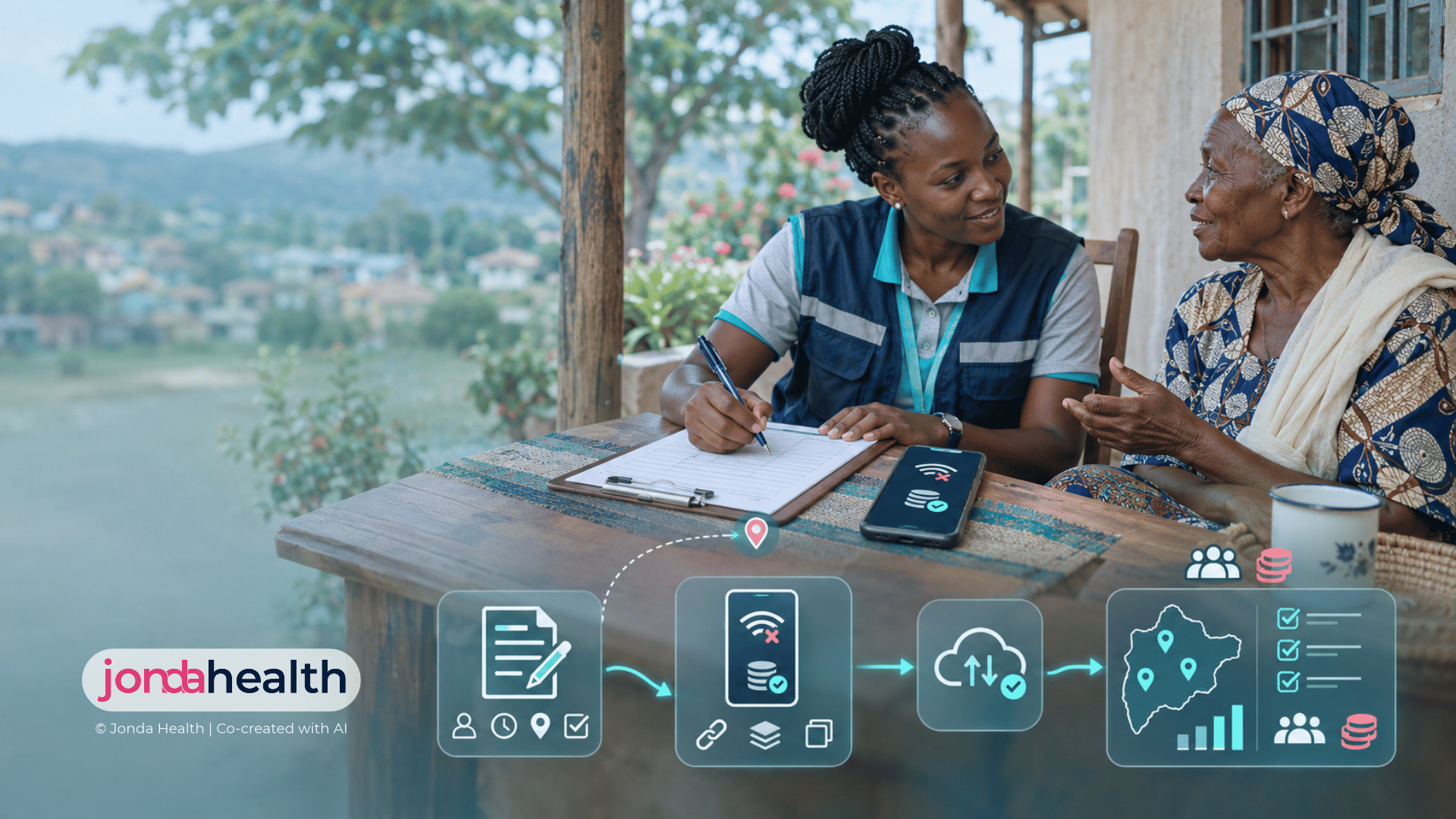
Community health workers reach people no clinic can, and much of what they record starts on paper or on a phone with no signal. This guide covers the 8 data rules that decide whether that work reaches the people who plan, fund and run health programmes.
In many countries, the first and sometimes only contact a family has with the health system is a community health worker. They test for malaria, measure children for malnutrition, follow up pregnancies, check blood pressure, refer people to clinics and record what they see. The World Health Organization (WHO) guideline on community health worker programmes recognises their substantial potential, while noting that support for them and their integration into health systems remains uneven across and within countries.1
Data is a large part of that integration. What community health workers record shapes how programmes find gaps, target resources, report to funders and show impact. Yet it often starts in a paper register, passes through a supervisor's tally sheet, and reaches a national system weeks later, if it reaches it at all. As programmes move from donor funding to national ownership, and as governments digitise their health systems, the quality of community data matters more than ever.
This guide is written for national programme managers, implementing partners and NGOs, and the teams that build tools for community health workers. It is organised in three parts: capturing data in the field, making it accurate and connected, and keeping it trustworthy.
Figure 1. Community health data travels from a household visit, through a community health worker's phone or register and a health facility, to national systems such as DHIS2 (District Health Information Software 2). The pink markers show where it is most often lost along the way: records never synced or transcribed, people duplicated or not linked, and referrals or totals that never reconcile.
Figure 1 shows the journey this guide follows. Each of the 8 rules below is about one of these hand-offs, or about the trust that holds the whole chain together.
A tool that works well in a city office can fail in a village with no signal. Community health tools need to work fully offline, including the checks that catch mistakes. The DHIS2 Android Capture app, for example, is built to work fully offline: users can capture data, run validations and apply programme rules without a network connection, and synchronisation happens later.2
Offline work raises its own questions. What happens when the same person's record is updated on two devices before either syncs? How long can data safely sit on a phone? What does a worker see when a sync fails? Agree the answers before rollout, test them in the places with the worst coverage, and give supervisors a simple view of which devices have not synced recently.
Even in digital programmes, paper stays: registers kept as a back-up, tally sheets for monthly reporting, referral slips carried by patients, and forms used when a phone is broken or a battery is flat. Many programmes are still mostly paper-based, and years of historical records exist only on paper.
Treat paper as a data source, not a failure. Use standard forms with clear boxes, so they can be read consistently. Where registers are photographed, turn the photo into structured data rather than storing it as an image nobody will search. Link each record to a person and household, and flag anything unclear for review. A study in South Africa that compared paper and phone-based systems for community health workers found that only 40 per cent of workers consistently achieved more than 90 per cent accuracy when transferring data on paper.3 Paper is not going away, so the route from paper to data has to be reliable.
Following people over time is what turns visits into care: a child's growth, a pregnancy through to delivery, a referral through to treatment. In many communities, people do not have a national ID number, names are spelt differently by different workers, and dates of birth are estimated.
Use a household-based identifier alongside personal details, record how each person is related to the household head, and capture a phone number or national ID where one exists without making it required. When records reach the facility, match them on several details rather than name alone, and send uncertain matches to a person to confirm. Without this, one child becomes three records and coverage figures become impossible to trust.
Every extra question costs time in a household visit and adds a chance of error. Research in Malawi found that the quality of data collected by health surveillance assistants improved markedly after the data collection instruments were adjusted and their workload reduced.4
Agree a minimum dataset that serves the programme's decisions, align it with national and WHO indicator definitions, and resist adding fields for one-off requests. Where several partners run programmes in the same area, aim for one shared form rather than a different form for each funder. A shorter form completed well is worth more than a long form completed partly.
Community health workers increasingly use rapid diagnostic tests (RDTs), thermometers, blood pressure monitors, glucometers and arm-circumference tapes. Each produces a reading that has to be interpreted and written down correctly. Faint lines on a test cassette are easy to misread, and numbers copied from a device screen are easy to mistype.
Figure 2. A photo taken at the point of care becomes a reviewed result. The photo is read into a result with a status, linked to the person, worker, date and place. Clear results are recorded, unclear ones (a faint line, a blurred image) are flagged for review, and the photo stays as evidence for supervision.
Figure 2 shows an approach that is gaining ground. Taking a photo of the test or device screen creates a record that can be read consistently and reviewed later. In one field evaluation with community health workers in Kenya, a smartphone-based reader called RDTScan achieved 96.3 per cent accuracy compared with expert interpretation of malaria tests.5 In Rwanda, Jhpiego, Audere and the Rwanda Biomedical Center have worked with community health workers on an AI-supported app for malaria testing that also generates real-time surveillance data.6 Whatever tool is used, keep the photo, record whether the reading was clear, and send unclear results to a person.
Community data is most useful when it joins up with the rest of the health system. That means referrals that close the loop (did the child who was referred reach the clinic, and what happened?), and community activity that shows up in national reporting rather than sitting in a separate system. DHIS2, for example, supports community health workers capturing data on the same platform used for facility reporting, or reporting basic data by SMS where smartphones are not available.7
Whether community data is captured directly in the national system or in a separate tool, three things decide whether it connects: shared indicator definitions, identifiers that link the same person across community and facility records, and a mapping from the programme's data to national indicators that is written down and maintained. Where several tools and partners feed the same system, structure and map their data to one agreed model before it is loaded.
Data quality problems in community programmes are well documented. A mixed-methods study in Kenya and Malawi found that only 15 per cent of data was reported consistently between community health workers and their supervisors, and identified barriers including missing data collection tools, inadequate training and supervision, a lack of quality control and incomplete registers.8 In Rwanda, a study of 204 community health worker registers found composite accuracy of 61 to 72 per cent across health centres when registers were compared with household interviews and client records.9
Figure 3. Two studies of community health data quality. In Kenya and Malawi, only 15 per cent of data was reported consistently between community health workers and their supervisors. In Rwanda, the composite accuracy of community health worker registers ranged from 61 to 72 per cent across health centres. The lighter part of the second bar shows the range.
As Figure 3 shows, the gap between what happens in households and what reaches reports can be large. The same Kenya and Malawi study found that supportive supervision was highly valued as an enabler of data quality.8 Build simple checks into the tool (impossible values, missing required fields, a visit dated before a birth), review a sample of records against registers or households routinely, and give workers and supervisors feedback they can act on. WHO's Data Quality Review toolkit sets out standard measures, including completeness, timeliness and consistency, that programmes can adapt.10
Community health workers carry sensitive information about whole households: HIV status, pregnancies, mental health, family planning. Phones are shared with family members, lost on long journeys and occasionally stolen. Paper registers sit in homes and health posts.
Encrypt data on devices, require individual logins rather than shared accounts, limit each worker's access to their own households, and remove data from devices once it is safely synchronised where the programme allows. Explain to households what is recorded and why, and follow national rules on consent and on where health data is stored and processed. Many governments now expect health data to stay in country, and programmes moving from donor funding to national ownership need data arrangements that will satisfy them.
Table 1 brings the 8 rules together for programme, technology and monitoring and evaluation teams.
Table 1. A checklist of the 8 data rules for community health worker programmes.
The thread running through all 8 rules: design for the conditions community health workers actually work in, and make every hand-off from household to national system one that keeps the data intact.
Programmes usually come to us at one of two moments. Some are planning a new digital tool, a transition from donor funding or a move to national systems, and want the data design right from the start. Others have years of paper registers and records from several tools, and need them turned into data a national system can use. We support both.
JondaX has processed more than 500,000 files and 26 million data points at 99.9 per cent field-level accuracy, across more than 10 languages including French. It already turns photographed medical device readings into data for a chronic disease programme run with an insurer in Africa. Because register and form layouts differ between programmes, the most useful first step is a sample run on a set of your own forms, so you can see how they perform before committing to anything.
Community health workers often work on paper, without reliable connectivity, with long forms and limited supervision, and their data passes through several hands before it reaches a national system. A study in Kenya and Malawi found that only 15 per cent of data was reported consistently between community health workers and their supervisors.8
Yes. Tools such as the DHIS2 Android Capture app are built to work fully offline, including validations and programme rules, and synchronise when a connection is available.2 Programmes still need clear rules for what happens when the same record is changed on two devices before syncing.
Paper registers and forms can be photographed and turned into structured data, rather than stored as images. This works best when forms are standard, photos are taken with simple guidance, each record is linked to a person and household, and anything unclear is flagged for review rather than guessed.
Research systems have shown this can work. In one field evaluation with community health workers in Kenya, a smartphone-based reader achieved 96.3 per cent accuracy compared with expert interpretation.5 Photos of test cassettes also create a record that supervisors can review later.
Community data can be captured on the same platform used for facility reporting,7 or captured in a separate tool and then structured, checked and mapped to national indicators before it is loaded. Either way, programmes need agreed indicator definitions, identifiers that link people across levels, and quality checks along the way.
Devices are shared, lost and stolen, so data on them should be encrypted, protected by individual logins, limited to what each worker needs and removed once synchronised where possible. Programmes should also follow national rules on consent and on where health data is stored and processed.
About the author. Suhina Singh is the Founder & CEO of Jonda Health, a health data infrastructure company that turns fragmented clinical data, digital and non-digital, into structured, standardised information that clinicians and systems can actually use. Jonda Health is ISO 27001 certified and works with health programmes, ministries, laboratories, hospitals and digital health companies. Get in touch at hello@jonda.health.