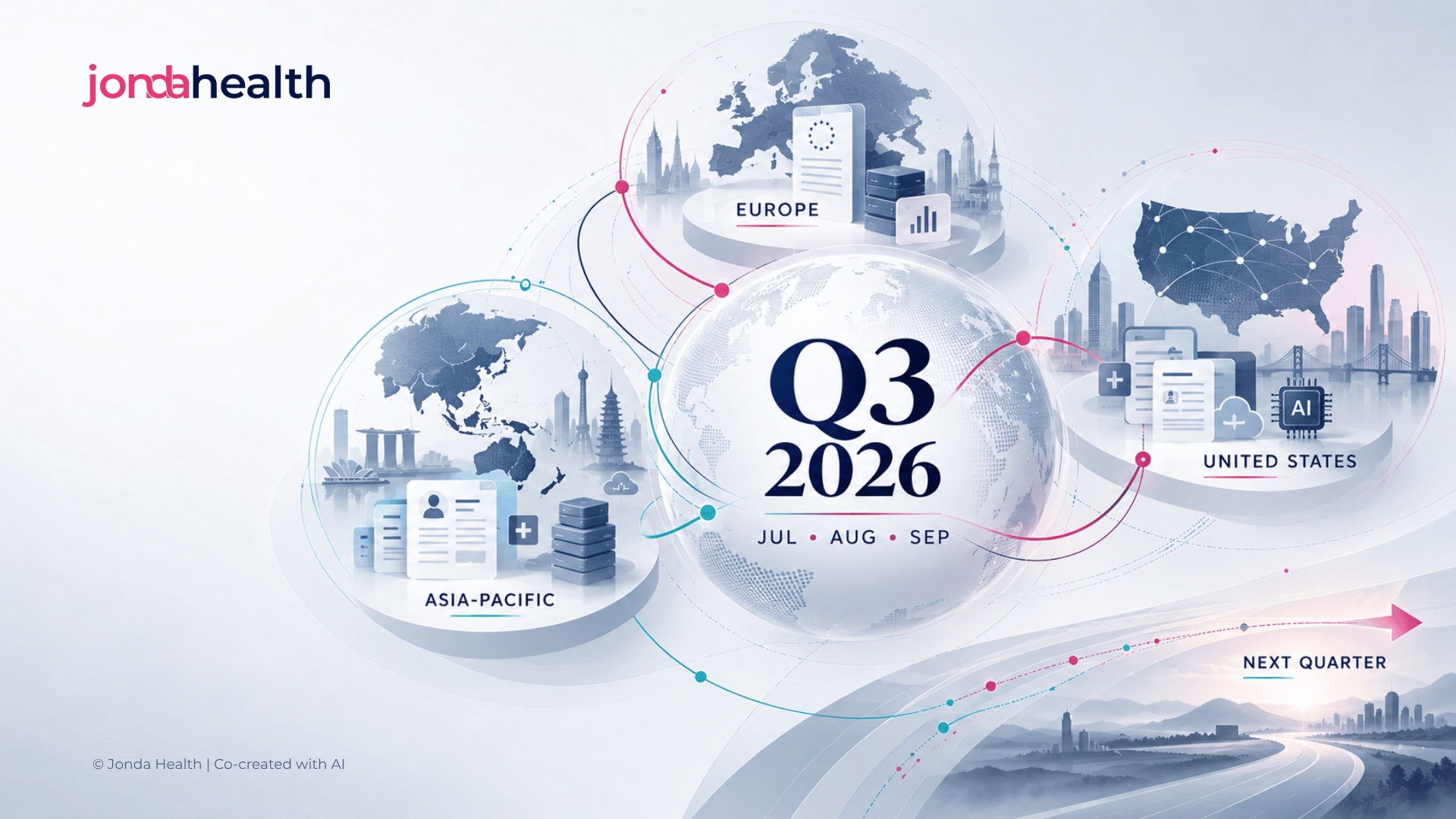
The key health data, interoperability and AI developments from July to September 2026 across Asia, Europe and the US, and what to watch next quarter.

Welcome to our quarterly Health Data Briefing, a short guide to the developments in health data, interoperability and AI that matter most to healthcare organisations in Asia and the teams that work with them. Each quarter we summarise what happened, explain why it matters, and look ahead to what is coming next.
The thread running through July to September 2026 is clear. Governments across the region and beyond are moving from connecting health data to making it shared by default, and they are starting to ask whether that shared data is usable.

On 1 July 2026, Australia's Share by Default reforms took effect. Pathology and diagnostic imaging reports written by, or on behalf of, a pathologist or radiologist must now be uploaded to My Health Record by default, unless an exception applies or an extension has been granted. The requirement covers the written reports, not the diagnostic images themselves.
The early numbers are striking. The Australian Digital Health Agency reports that consumer views of these reports have risen by 433% since the reforms were announced in 2023, to more than 3 million a week, and provider uploads have risen by 105%, to more than 5 million a week. The next phase is already funded: the 2026 to 2027 Budget committed a further A$47.5 million to extend the requirements to prescribed and dispensed medicines information and to GP chronic condition management plans.
Why it matters: Australia has chosen to mandate sharing one type of data at a time, starting with laboratory and imaging reports. For pathology and imaging providers, and for anyone building on this data, the volume of shared reports is rising quickly, and so is the importance of their consistency and quality.
Singapore's Health Information Act, enacted in February 2026, is now moving from law to practice. GP clinics have been able to apply for the NEHR Connect Grant since 1 July, and applications for hospitals, clinical laboratories, radiology and nuclear medicine services open on 1 November, with both windows closing on 31 August 2027. The first providers must begin contributing to the National Electronic Health Record by September 2027.
Singapore is also reorganising how healthcare is regulated. The Ministry of Health's regulatory functions and manpower will transfer to the Health Sciences Authority in November 2026.
Why it matters: Singapore's approach pairs the obligation to contribute with requirements for security and data quality. We covered what providers need to prepare in Singapore's Health Information Act: What Healthcare Providers Need Ready by 2027.
On 22 July 2026, South Korea unveiled its AI Basic Healthcare Strategy. It covers three areas: AI-supported services for patients, nationwide digital health infrastructure, and a sustainable healthcare AI ecosystem. A shared "Public Healthcare AI Highway" will connect regional and local public hospitals to a common AI platform, starting in the second half of 2026 and expanding to all 72 designated institutions by 2029. An integrated emergency AI platform will be piloted in Daegu, and the country's Personal Health Record platform will be expanded.
Why it matters: Korea is moving from individual AI pilots to shared infrastructure. That makes the consistency of data across participating hospitals a system-wide concern rather than a local one.
Malaysia has increased its investment in digitalising the public health system to RM1 billion, with an additional RM350 million to speed up internet connectivity and the rollout of electronic medical records. The government has brought forward its target for digitalising all public hospitals from 2045 to the end of 2028, supported by the One Record, One Citizen national EMR project and the rollout of a cloud-based clinic management system across government facilities.
Why it matters: moving from paper to electronic records at this pace will create large volumes of digital health data quickly. Planning for how that data will be structured and standardised, alongside how it is captured, will shape how useful it becomes.
The Digital Omnibus on AI entered into force on 27 July 2026. It moved the high-risk deadlines for standalone systems, including emergency triage and some healthcare eligibility uses, to 2 December 2027, and for AI in medical devices and in vitro diagnostics to 2 August 2028. The high-risk requirements themselves, including data governance, did not change.
Why it matters: the extra time is best used on the long-lead work of documenting and improving training data. We explain what this means for healthcare AI teams in Asia in The EU AI Act Delay: What It Means for Healthcare AI Teams in Asia.
Preparations continue for the European Health Data Space. EU member states must designate their Health Data Access Bodies by March 2027, and most of the rules on reusing health data for research and innovation apply from March 2029.
Why it matters: the EHDS will make data quality visible through dataset descriptions and a planned quality label. We explore what this means for Asian organisations in The European Health Data Space: What Secondary Use Means for Healthcare Data Teams in Asia.
In the United States, the voluntary interoperability programme led by the US Centers for Medicare & Medicaid Services (CMS, the federal agency that runs Medicare and Medicaid) passed its first anniversary. From 4 July 2026, networks meeting its criteria must provide access to data through FHIR interfaces. Numerous participating companies reached general availability in July, and new use cases were added, including clinical trial matching, bulk data exchange and a diagnostic imaging work group.
Why it matters: the framework still allows radiology reports, scanned laboratory results and specialist notes to travel as PDF or image files, a reminder that exchange and usability are different problems. We explore this in Data Exchange Is Not Data Usability: Lessons for Asia From the US Push for Interoperability.

Three observations stand out from this quarter.

It is Jonda Health's quarterly summary of the most important developments in health data, interoperability and healthcare AI, written for healthcare organisations in Asia and the teams that work with them.
From 1 July 2026, pathology and diagnostic imaging reports written by or on behalf of a pathologist or radiologist must be uploaded to My Health Record by default, unless an exception applies or an extension has been granted.
In the United States section, CMS means the US Centers for Medicare & Medicaid Services, the federal agency that runs Medicare and Medicaid. Where Malaysia is discussed, we refer to its clinic management system in full to avoid confusion.
Sources: Australian Digital Health Agency; Singapore Ministry of Health; RAPS; Digital Watch Observatory; Healthcare IT News; The Star; European Commission; US Centers for Medicare & Medicaid Services; Medical Republic. This briefing is for general information and is not legal advice.
Suhina Singh is a physician, the Founder and CEO of Jonda Health, and a health data strategist working at the intersection of artificial intelligence and clinical information systems.





