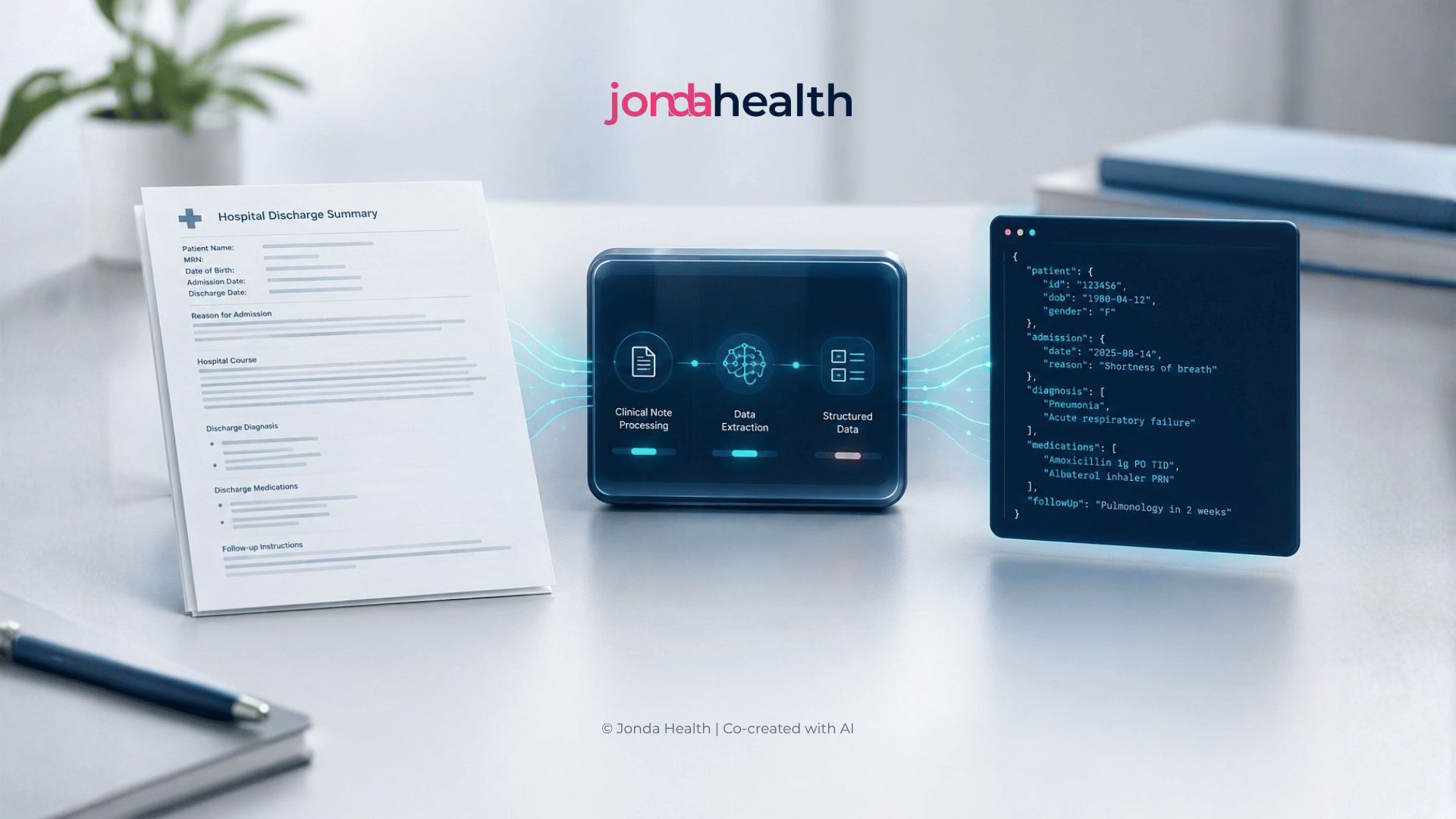
Why multimodal foundation models halt when transcribing standardised medical templates, and how engineering teams can design reliable, compliant fallback architectures without silent data drops.

When an engineering team builds an automated extraction pipeline for medical records, laboratory reports are usually the first milestone. A blood test or a metabolic panel follows a predictable tabular layout: named test markers on the left, numeric values in the middle, and units with reference intervals on the right. Once that pipeline is stable, teams naturally turn to clinical notes, such as hospital discharge summaries, specialist consultation notes, and outpatient progress records.
That is where many data pipelines run into an unexpected barrier. An image or portable document format (PDF) file of a routine clinical note is submitted to a modern multimodal foundation model. The application programming interface (API) returns an HTTP 200 status code indicating a successful network request. Yet the parsed output contains zero clinical notes, zero narrative sections, and zero extracted entities. The model has stopped generating entirely, citing a recitation block.
This does not indicate a system crash or an erroneous prompt. Rather, it is the result of an automated safety filter designed to prevent the model from regurgitating copyrighted literature or memorised web corpora. In medical documentation, where the clinical objective is faithful transcription, that safeguard creates a serious engineering dilemma. This guide explains why recitation filters trigger on clinical documentation, how to avoid common latency traps, and how to build a resilient, responsible fallback architecture.
Figure 1: Responsible pipeline flow routing recitation statuses to clean text extraction before escalating edge cases to clinical review.
Large language models (LLMs) and vision-language foundation models are trained on massive public web datasets. To protect intellectual property and respect copyright boundaries, model providers implement safety filters that monitor output generation. If a sequence of generated tokens matches a memorised training excerpt beyond a specific threshold, generation halts immediately. The candidate response is terminated, and the finish reason is flagged as recitation.
In creative writing or software code generation, this safeguard prevents unintentional plagiarism. In clinical data processing, however, it clashes directly with the objective of the task. Health records often follow public domain structures: Subjective, Objective, Assessment, and Plan (SOAP) notes, regional hospital discharge summaries, or psychiatric intake evaluations.
When a physician completes a standard template, the printed headings, standard disclaimers, and boilerplate instructions (such as post-operative wound care or follow-up timelines) match the template text word for word. When a multimodal model reads the page as an image, its visual encoder maps these patterns. If the model determines that the extracted sequence is reproducing a memorised document structure verbatim, it terminates generation to remain compliant with safety policies.
When engineering teams encounter empty outputs from recitation stops, an intuitive reaction is to reinforce the prompt. Developers often run local OCR on the document and concatenate the full raw text alongside the high-resolution image in the API request, asking the model to verify one against the other.
In our testing, combining high-resolution image rasters and lengthy text streams in a single prompt creates substantial performance penalties. Multimodal foundation models must tokenize both visual grid tiles and character sequences. Passing hundreds of words of clinical narrative alongside multi-page images expands token consumption rapidly.
Furthermore, in our operational observation, supplying redundant image and text streams does not reliably prevent recitation blocks. If the visual tokens continue to correlate strongly with a memorised template layout, the safety filter may still engage. The pipeline is left with a prolonged processing duration and an empty output payload.
A more effective pattern is to change the format through which the model receives the document. Foundation models evaluate training reproduction differently depending on input modality. When an image is submitted, the model functions as an optical transcriber, evaluating whether the visual document is being reproduced verbatim.
When the document is supplied as a text stream, the model operates in a structural transformation role. The prompt asks the model to ingest user-supplied text and map it into a strict JavaScript Object Notation (JSON) schema. Because the text is provided directly in the prompt context by the client, the model acts as an analytical parser rather than an unconstrained reproducer.
In our operational experience, converting document pages into text and requesting structured JSON parsing achieves clean completion statuses. The model extracts clinical headings, notes, and discrete instructions without triggering safety halts.
While extracting from text avoids recitation filters on standardised templates, multimodal image extraction remains valuable. Visual processing handles multi-column tables, stamps, handwritten margin notes, and complex layouts that simple text extraction can jumble. Therefore, replacing multimodal extraction entirely is unnecessary.
A resilient pipeline uses a two-tier approach: execute the primary extraction using the standard multimodal path, inspect the model completion metadata, and route to a text fallback only when a recitation status is detected.
To keep server latency and compute demand predictable, pipelines can maintain an asynchronous digital text stream alongside the ingested document raster. In a resilient two-tier design, if a primary multimodal call halts on a template layout, the orchestration layer can invoke the structured text fallback immediately. By maintaining accessible text representations rather than re-initiating ad-hoc extraction from scratch, the pipeline recovers from recitation flags without redundant computing overhead.
No automated fallback solves every document variation. In healthcare environments, a 95% or 98% extraction rate is not enough on its own. The remaining 2% to 5% of records represent patients with unreadable handwriting, conflicting medication dosages, or heavily damaged scans.
If both multimodal ingestion and text-level fallback encounter ambiguity, the system must not attempt unconstrained re-prompting. Repeatedly adjusting prompt phrasing to coax an answer from a hesitant model increases the risk of hallucination.
Instead, the pipeline should implement automated circuit breakers. When confidence scores fall below acceptable thresholds, the document, its extracted fragments, and the source image must be presented to clinically trained reviewers. Human-in-the-loop validation is not an operational failure: it is the quality assurance layer that safeguards clinical integrity across difficult or ambiguous records.
Use this evaluation matrix to assess whether your extraction pipeline handles clinical documentation robustly, or whether it remains exposed to silent drops and unnecessary latency.
If your pipeline shows two or more vulnerable patterns: Your system is likely dropping clinical records silently or incurring unnecessary computing latency on standard institutional documents. Prioritise candidate status inspection and structured text fallback.
If your pipeline follows resilient patterns but lacks human review: Your system will handle standard templates smoothly, but remains exposed to ambiguous handwriting and edge-case misinterpretation. Establish a formal reviewer workflow with session locking.
Turning messy clinical documents into reliable, structured health data does not require building and maintaining complex fallback infrastructure alone. There are two paths to support your team:
Foundation models have automated safety checks that monitor generated tokens against training corpora. Standardised clinical forms, such as hospital discharge summaries or SOAP notes, closely resemble public medical templates, which can trigger safety mechanisms designed to prevent verbatim reproduction.
An HTTP 200 response confirms that the network transaction and server execution were successful. The safety filter halts token generation within the model itself, returning candidate metadata indicating the termination reason rather than raising an HTTP error.
Increasing temperature introduces token variability, which may occasionally alter the output past the trigger threshold, but it compromises clinical integrity. In healthcare data extraction, temperature should remain near zero to minimise hallucination risk and maintain extraction determinism.
When fed clean text with instructions to map into a JSON schema, the model treats the input as user-directed source material to be transformed. When processing an image raster, the model acts as an open transcriber, making its safety filters more sensitive to verbatim memorisation.
JondaX provides a unified health data API and transformation engine, including the Clinical Notes (Beta) module, supported by a clinically trained review team. Jonda Health Services also provides data readiness assessments and workflow automation for healthcare providers.
This article is for general informational and engineering guidance only, and is not legal, regulatory, or medical advice.