Abstracting Molecular Markers and Genomic Reports: Why AI Needs a Human in the Loop
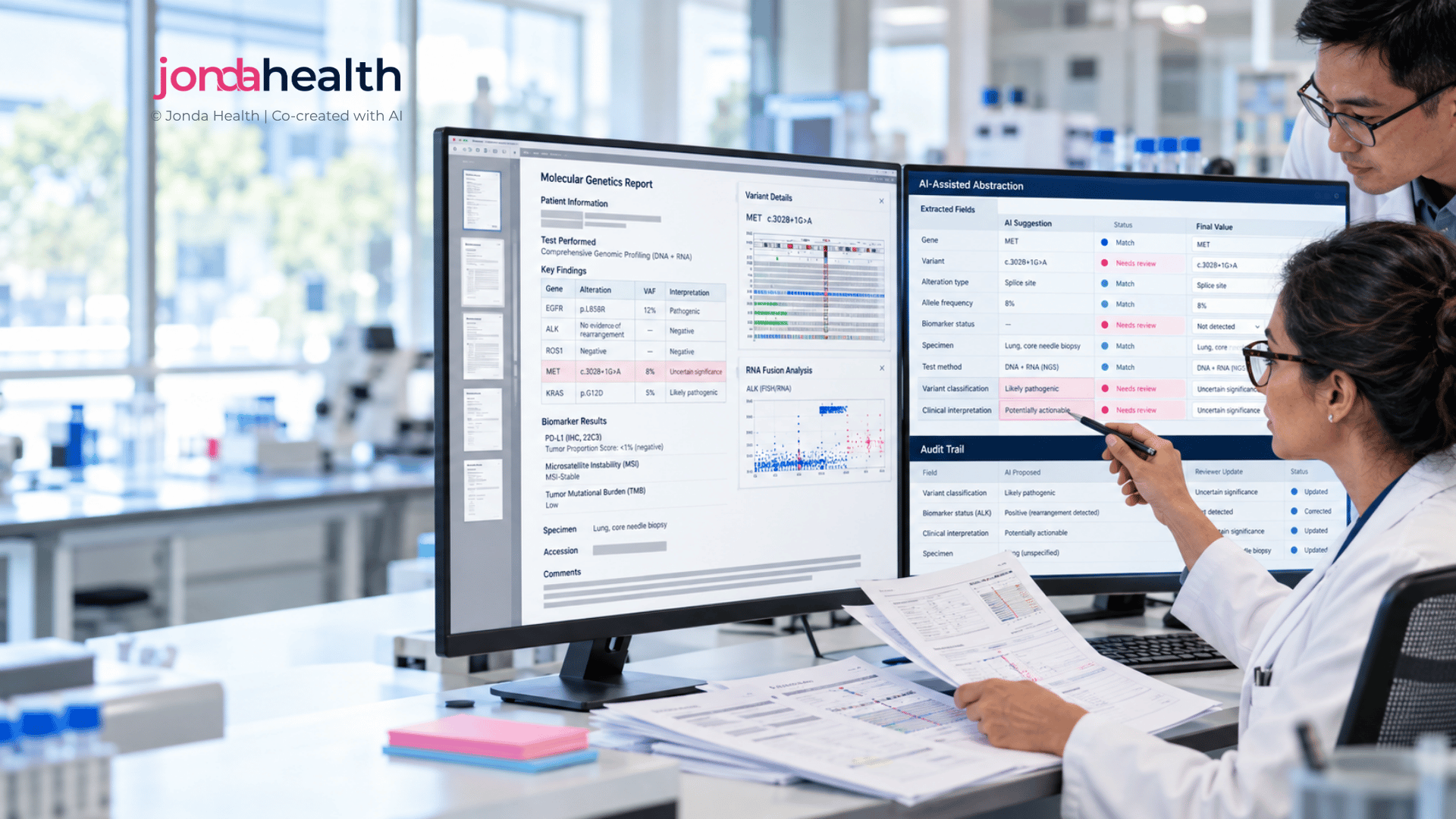
Molecular reports now steer cancer treatment. AI makes abstraction fast; a trained reviewer makes it right. Here is how the two work together.
Mugdha Raut
Team Lead - Quality Assurance
October 19, 2026
·
9 min read
A single molecular report can decide which therapy a cancer patient receives. Biomarkers such as EGFR, ALK, KRAS, BRAF, HER2, BRCA1/2, MSI status and tumour mutational burden now shape treatment choices across many cancer types.
Yet these results rarely arrive as data. They come as long PDFs from next-generation sequencing (NGS) panels, tissue tests such as FoundationOne4 and liquid biopsies such as Guardant360.5,6 Each lab has its own layout, vocabulary and appendices, and a patient may collect several reports across their journey: one at diagnosis, more at progression.
Registries, care programmes, trial screening teams and EHRs all need those findings as clean, structured fields. The question is no longer whether to use AI for this. It is how to pair AI with human expertise so that abstraction is both fast and right.
In short
Manual abstraction of genomic reports is slow and still error-prone.
AI reads fast, but misses context that changes clinical meaning: significance tiers, specimen type, negatives, germline findings.
The answer is a loop: AI extracts, rules flag, trained reviewers confirm what matters, and every correction makes the next run better.
324genes
analysed by a single tissue panel, FoundationOne CDx4
16,812patients
in a 2025 study separating blood variants from the tumour and from clonal haematopoiesis8
4tiers
in the AMP/ASCO/CAP system for classifying cancer variants, from strong significance to benign1
01 · The problem
Why manual abstraction alone falls short
Manual abstraction is slow, and slow work is not automatically accurate. Experienced abstractors are skilled, but the task works against them in four ways.
1
TurnaroundA comprehensive panel can cover hundreds of genes.4 Reading every report line by line takes time, and backlogs grow faster than teams can hire.
2
Transcription errorsOne wrong character in a protein change, or a misplaced decimal in a variant allele frequency, quietly changes the meaning of a result.
3
InconsistencyThe same finding is recorded as "EGFR exon 19 deletion" in one row and "EGFR p.E746_A750del" in the next. Each may be correct, but mixed levels of detail make the data hard to count, compare or analyse.
4
FatigueDense tables, appendices and repeated gene lists invite skipped lines, especially late in a long queue.
The result is data that arrives late and still needs checking. AI alone fixes the speed but not the judgement, which is why neither extreme works on its own:
Manual only
Abstractors read and key in every report
SpeedSlow
ConsistencyVaries
Clinical judgementStrong
AI only
Extraction released without review
SpeedFast
ConsistencyHigh
Clinical judgementLimited
Recommended
AI + human review
AI extracts, experts confirm what matters
SpeedFast
ConsistencyHigh
Clinical judgementStrong
02 · Where AI needs help
Why AI alone is not enough
AI reads a long report in seconds, but it can be confidently wrong, and in genomics a small error can change a treatment decision. These are the places where meaning hides in context:
1
NomenclatureOne alteration can appear as a protein change, a cDNA change, an exon-level description or a legacy name. All must resolve to one standard form.3
2
Clinical significanceReports separate actionable variants from variants of uncertain significance (VUS). Extracting a VUS as actionable is a serious error.1,2
3
Specimen and allele frequencyTissue and liquid biopsy results are read differently. A variant found in blood may come from clonal haematopoiesis, age-related changes in blood cells, rather than from the tumour.7,8
4
Complex alterationsA fusion is only meaningful with both partner genes, and an amplification with its copy number. Extracting the gene name alone loses the finding.
5
Genomic signaturesTMB, MSI and HRD are reported differently by each assay, and TMB values and cut-offs are not directly comparable across panels.9,10
6
What was not found"Not detected", "not tested" and "insufficient sample" mean very different things and must be kept apart.
7
Germline versus somaticSome findings may be inherited rather than tumour-only. They carry implications for the patient's family and need separate handling.
8
Therapy and trial tablesReports list drugs and trials linked to each finding. These are options, not the patient's treatment.
9
Amended reportsWhen a lab issues a corrected report, it must replace the original in the record, not sit beside it as a second result.
Two examples of what this looks like
A negative that was really "not evaluable"
Tissue NGS
Source report
ALK fusion: Not detected
Comment: tumour content below
assay threshold
→
AI extracted
ALK: Negative
→
Reviewer recorded
ALK: Not evaluable
(low tumour content)
A true negative and an uninformative test look alike as a single word. Recorded as negative, the result could close the door on retesting a patient who may still carry an actionable fusion.
A blood variant that may not come from the tumour
Liquid biopsy
Source report
DNMT3A p.R882H  VAF 1.2%
Note: possible clonal
haematopoiesis
→
AI extracted
DNMT3A p.R882H
Origin: tumour
→
Reviewer recorded
DNMT3A p.R882H
Origin: possible CH,
not attributed to tumour
DNMT3A is one of the genes most commonly affected by clonal haematopoiesis. The report's own note is easy to lose when values are pulled from a table, and keeping it changes how the finding is used.
Examples are illustrative, based on common reporting patterns rather than specific patient records.
AI
Does the reading
Pulls every gene, value and signature from long, varied reports in seconds, at volume.
RULES
Flag the doubts
Automatic checks catch impossible values and route low-confidence fields for review.
HUMAN
Makes the judgement
A trained reviewer confirms what carries clinical weight before the data is released.
Try it
One report, two outcomes
Here is what an AI pulled from an illustrative lung cancer NGS report. Everything looks plausible. Switch to the reviewed version to see what a trained reviewer changed before release.
03 · The workflow
How AI and human review work together
The strongest model gives AI the volume and gives people the decisions that carry clinical weight. In practice, that is a six-step loop.
Every record passes automatic checks; flagged and critical fields go to an expert, and each correction improves the next run.
1. Configure by cancer type
Decide which markers matter before extraction starts
The AI then extracts what is relevant to the programme, not every gene on the panel. For example:
LungEGFRALKROS1KRASBRAFMETRETNTRKPD-L1
BreastHER2BRCA1/2PIK3CAESR1
2. Extract and normalise with AI
Volume handled in seconds
Genes, alterations, allele frequencies, significance tiers, signatures, specimen type, assay and report dates are pulled out and mapped to standard nomenclature.
3. Run automatic checks
Catch the impossible, flag the uncertain
Rules catch impossible or inconsistent values: a frequency outside 0 to 100%, a gene not on the stated panel, a missing unit. Low-confidence fields are flagged.
4. Route to expert review
Where the human in the loop sits
A reviewer trained in molecular reporting checks every flagged field and every critical field, plus a sample of the rest, against the source report.
5. Release structured output
With a trail of who checked what
Verified data moves to the registry, EHR or analytics platform, ready to use.
6. Feed corrections back
Every fix makes the next run better
Reviewer corrections improve rules, prompts and templates, so the same mistake becomes less likely next time.
The effect compounds. As accuracy rises, fewer fields are flagged, review gets quicker, and experts spend their time on the genuinely difficult reports.
04 · Reviewer checklist
What the human reviewer checks
A good reviewer does not re-abstract the whole report. They verify the fields where an error would matter most:
Patient and report identityThe right patient, specimen, collection date and report version.
Each actionable alterationGene, exact change and nomenclature match the source text.
Significance tierActionable findings and VUS sit in the right category.
Allele frequency and copy numberValues, decimals and units are copied correctly.
SignaturesTMB, MSI and HRD values carry their units and the assay's own threshold.
Negatives and failures"Not detected", "not tested" and "insufficient sample" are recorded distinctly.
Germline flagsAny germline or incidental finding is marked for the right handling.
No leakage from therapy tablesListed drugs and trials have not been recorded as treatment given.
Each correction is logged with its reason. That log is what turns review into improvement.
05 · Measuring success
Measuring quality and promptness together
Speed without accuracy creates rework, and accuracy without speed leaves patients and programmes waiting. Track both, side by side:
Measure
Type
What it tells you
Field-level accuracy
QUALITY
How often each extracted field matches the source report
Critical-field error rate
QUALITY
Errors in the fields that can change care, tracked separately
Turnaround time
SPEED
Time from report received to verified data released
Clean-record share
SPEED
Proportion of records released with no corrections needed; the higher it is, the faster data moves
Correction rate by field
QUALITY
Which fields the AI gets wrong most, and where to improve next
Reviewer agreement
QUALITY
Whether two reviewers reach the same answer on the same report
When accuracy rises and turnaround falls at the same time, the combination is working.
06 · Readiness check
How ready is your molecular abstraction workflow?
Self-check
Tick what is already true for your team. Nothing is stored or sent.
Fast and right, not fast or right
Molecular data is only useful when it is both timely and trustworthy. AI removes the bottleneck of reading; human reviewers protect the meaning. Neither one alone delivers both.
At Jonda Health, this is how we already approach laboratory data: JondaX pairs AI extraction with human review so that results arrive structured, harmonised and checked.11 Molecular and genomic reports raise the stakes, which makes the human in the loop more important, not less.
Abstracting molecular reports by hand, or trusting AI without review?
Talk to us about building a workflow that gives you both speed and accuracy.
Can AI extract molecular markers from NGS reports on its own?
AI can extract genes, alterations and values from long reports in seconds. What it cannot reliably do on its own is judge context that changes clinical meaning: significance tiers, specimen type, results that were not evaluable, possible clonal haematopoiesis and germline findings. A trained reviewer checks those fields before the data is used.
What is a variant of uncertain significance (VUS)?
A VUS is a variant whose clinical impact is not yet known. In the AMP/ASCO/CAP system it sits in Tier III, separate from variants with strong or potential clinical significance. Recording a VUS as actionable can mislead treatment decisions, trial matching and analysis.
Why do liquid biopsy results need extra care?
A variant found in blood may come from clonal haematopoiesis, age-related changes in blood cells, rather than from the tumour. Reports often flag this, and the flag needs to travel with the finding into the structured data.
Does human review slow abstraction down?
Not when it is designed well. Reviewers focus on flagged and critical fields rather than re-reading every report, and each correction improves the AI, so fewer fields are flagged over time and review gets quicker.
References
Li MM, Datto M, Duncavage EJ, et al. Standards and Guidelines for the Interpretation and Reporting of Sequence Variants in Cancer: A Joint Consensus Recommendation of AMP, ASCO and CAP. Journal of Molecular Diagnostics, 2017. DOI.
Association for Molecular Pathology. AMP Assesses Clinical Implementation of Past Standards and Guidelines for Interpretation and Reporting of Sequence Variants in Cancer. 2022. AMP.
den Dunnen JT, Dalgleish R, Maglott DR, et al. HGVS Recommendations for the Description of Sequence Variants: 2016 Update. Human Mutation, 2016. DOI.
Oncology Nursing Society. FDA Approves First Liquid Biopsy NGS Companion Diagnostic Test for NSCLC. 2020. ONS.
Guardant Health. FDA Approves New Guardant360 Liquid CDx. May 2026. Business Wire.
CAP Today. Up Close on Clonal Hematopoiesis in cfDNA Testing. CAP Today.
Caris Life Sciences. Press release on "Characterization of plasma cell-free DNA variants as of tumor- or clonal hematopoiesis-origin in 16,812 advanced cancer patients", Clinical Cancer Research. February 2025. BioSpace.
Merino DM, McShane LM, Fabrizio D, et al. Establishing Guidelines to Harmonize Tumor Mutational Burden (TMB): Phase I of the Friends of Cancer Research TMB Harmonization Project. Journal for ImmunoTherapy of Cancer, 2020. PubMed Central.
Friends of Cancer Research. Friends of Cancer Research Releases Results of Phase 2 of TMB Harmonization Project. Friends of Cancer Research.