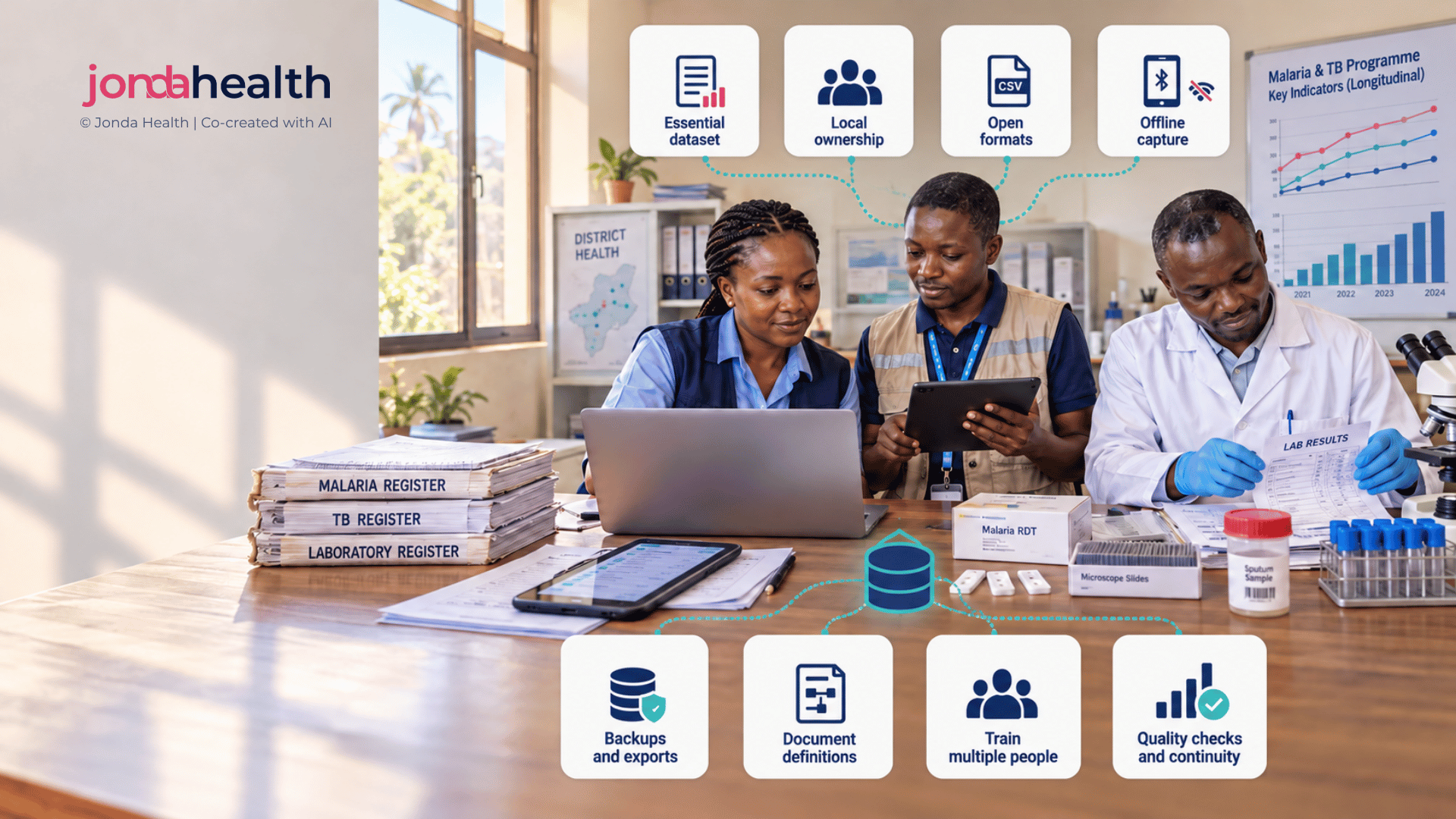
Donor cuts are straining malaria and tuberculosis programmes and the data systems behind them. Eight practical ways programme managers and implementing partners can protect the data they depend on.

Malaria and tuberculosis (TB) programmes are being asked to protect decades of progress with fewer people, fewer partners and less money. Much of the attention rightly goes to medicines, diagnostics and staff. The data that tells a programme where cases are, who has started treatment and whether its work is succeeding is under the same pressure, and it is often the first thing to quietly degrade.
This article is written for national programme managers, implementing partners and non-governmental organisations (NGOs) working in malaria and TB, particularly in rural settings where paper registers, rapid tests and community health workers still carry most of the load. It sets out eight practical ways to protect the data your programme depends on, using examples that have already been reported publicly.
Figure 1. The scale of the challenge, and of the funding gap.
The Global Fund provides nearly three quarters of all international financing for TB programmes and close to 60% for malaria4, so a shortfall in its replenishment matters a great deal to both diseases. At the same time, direct bilateral funding from the United States fell sharply in 2025. The World Health Organization (WHO) found that the countries most exposed to an immediate impact were those that had relied heavily on both bilateral US funding and Global Fund grants5.
The effect on data was named explicitly. In March 2025, WHO's Director-General warned that 27 countries in Africa and Asia were facing serious breakdowns in their TB response, including data and surveillance systems collapsing and community engagement work deteriorating6. Speaking ahead of the Global Fund's latest results report in September 2026, its Executive Director, Peter Sands, said that TB programmes had faced disruptions to case-finding and diagnosis, and that many countries scaled back prevention to protect core treatment services10.
None of this reflects a lack of commitment by programme teams. It reflects systems that were often built around a particular grant, partner or project, and that now need to stand on their own. The eight steps below are about making that transition deliberately, rather than discovering the gaps when a report is due.
Figure 2. Where programme data commonly leaks between the community and the national register.
Most programmes hold more data, in more places, than any one person can describe. There are paper registers at facility level, spreadsheets kept by district officers, partner-hosted databases, laboratory systems, and the national health information system, which in many countries runs on District Health Information Software 2 (DHIS2). Before anything can be protected, it helps to know what exists, where it sits, who maintains it and who pays for it.
The most useful single question is which systems depend on one funder or one partner. The South African example shows how a system that works well can still be fragile if a single grant carries it7. A simple inventory, kept current, turns an unknown risk into a list of decisions.
When an implementing partner closes a project, the data it collected does not always come back to the programme in a usable form. Sometimes it returns as an export nobody can open, sometimes as summary tables without the underlying records, and sometimes not at all because the hosting contract simply lapses.
Agreeing the terms of a data handover early protects everyone, including the partner. That means clarity on who owns the data, which formats it will be returned in, what documentation comes with it (field definitions, code lists, known issues), and how long the partner will remain available to answer questions after exit.
Figure 3. A short partner exit checklist for programme data.
In many rural programmes, a single malaria or TB case is written down several times: in a community health worker's notebook, in a facility register, on a monthly summary form, and again when someone types those summaries into a district or partner system. Every copy costs staff time, and every transcription is a chance for an error or an omission. With fewer staff, the copy that gets skipped is usually the one the national picture depends on.
The scale is large. Global Fund-supported programmes alone tested 360 million suspected malaria cases in 20244. Capturing a record once, in a structured form, and letting it feed every report that needs it is one of the most direct ways to do more with less. Increasingly, that can start from a photograph of a register page, a laboratory slip or a rapid test, rather than from someone retyping it.
Figure 4. Re-keying the same case several times compared with capturing it once.
When resources are tight, trying to keep every data element alive usually means that nothing is collected well. It is more useful to agree, with the national programme and with funders, the smallest set of data that drives real decisions: cases tested and confirmed, treatment started, treatment outcomes, stock levels for key commodities, and the indicators the programme must report.
Once that minimum dataset is agreed, it can be protected deliberately. That means clear definitions so every district counts the same thing in the same way, a named owner for each element, and a plan for what happens if a particular source stops reporting. Other data can still be collected, but everyone knows which data matters most when something has to give.
WHO estimates that 10.7 million people fell ill with TB in 2024, while around 8.3 million were newly diagnosed and reported2. Part of that gap sits in the space between a test and a treatment record. A sputum result or a GeneXpert result that never reaches the clinician, or reaches them but is never linked to the patient's treatment card, is a person who may be lost to care.
For malaria, the same principle applies to the link between a positive rapid diagnostic test (RDT) and the treatment that follows. Linking results to the people they belong to is not glamorous work, but it is where much of a programme's impact is won or lost. It depends on consistent patient identifiers, consistent test names across laboratories, and results that arrive as data rather than as a printed slip.
Malaria and TB data is health data about real people, many of whom face stigma. As programmes take on new tools and new partners to fill gaps, it is worth being clear about where data is processed and stored, which national laws apply, and who can see identifiable records.
Many countries now have data protection laws that set conditions on processing health data and on moving it across borders. Wherever possible, choose tools that can process data within the country. When data is shared for analysis or research, pseudonymise it so individuals are not directly identifiable from the shared dataset. We cover the practical steps in our guide to de-identifying health data.
Data quality problems are easiest to fix when they are visible early. Simple measures, tracked monthly, tell a programme a great deal: how many facilities reported, how many reported on time, how many records are missing key fields, and where numbers move in ways that do not make clinical sense. WHO's Data Quality Review toolkit offers a well-established framework for this kind of routine checking11.
Automation can now do much of the routine checking at speed, and it should. In health data, though, automated checks are not enough on their own. Someone with clinical understanding still needs to review the records that are flagged, because a value that looks unusual may be a genuine and important finding rather than an error.
Transition from donor support is not new. The Global Fund reports that 52 HIV, TB and malaria programmes across 38 countries have already transitioned away from its funding, with a further 12 programmes from eight countries transitioning in the current grant cycle4. What is new is the speed at which many more programmes now face the same conversation.
Domestic budget holders, such as ministries of finance and health insurance schemes, will ask what a programme achieves and what it costs to achieve it. Programmes that can show cases found, treatments completed and outcomes over time, with confidence in the numbers, are in a far stronger position. Seen this way, good programme data is not only a reporting obligation. It is the evidence that keeps the programme funded.
At Jonda Health, we work with health records across formats and languages every day, and we know how much of a programme's value depends on data that was captured well at the very start. Depending on where your programme is today, there are three ways we can help.
Data is how a programme knows where to send medicines and staff, and how it shows that its work is succeeding. When data systems weaken, it becomes harder to target scarce resources and harder to make the case for continued funding.
Usually not. Most of the gains described here come from getting better data into the systems you already use, capturing records once and linking them properly, rather than from replacing core systems.
Yes. Paper registers often hold years of history. With the right tools and review, they can be turned into structured data that supports analysis, reporting and continuity of care.
Process data within the country wherever possible, limit access to identifiable records, and pseudonymise data before sharing it for analysis or research, in line with national data protection law.
Start with the inventory in step one and the partner agreements in step two. Knowing what you hold and what could disappear gives you the clearest picture of where to act first.
This article is for general information and is not regulatory, legal or financial advice. Figures are drawn from the sources listed and may be revised as new data is published.