
PhilHealth is moving submissions to automated, real-time validation across hospitals and primary care. That makes the quality of your records a practical question of cash flow, not only compliance.

For many hospitals and clinics in the Philippines, claims are where data quality stops being abstract. A claim returned to the facility means staff time spent investigating, a corrected resubmission, and payment that arrives later than planned. When this happens often, it affects cash flow, and it pulls clinical and administrative teams away from patient care.
PhilHealth has been steadily moving its submissions to electronic, automated validation. That is good news for providers in the long run: faster processing, clearer rules and fewer manual errors. It also means that the condition of the records behind each claim matters more than it used to.
This guide explains what has changed, why data quality now affects claims so directly, and what providers can do. It draws on our experience at Jonda Health, where our work is turning health records from many different sources into structured, standardised information that clinicians and systems can actually use. Much of our clinical review team is based in the Philippines, so we see these challenges up close.
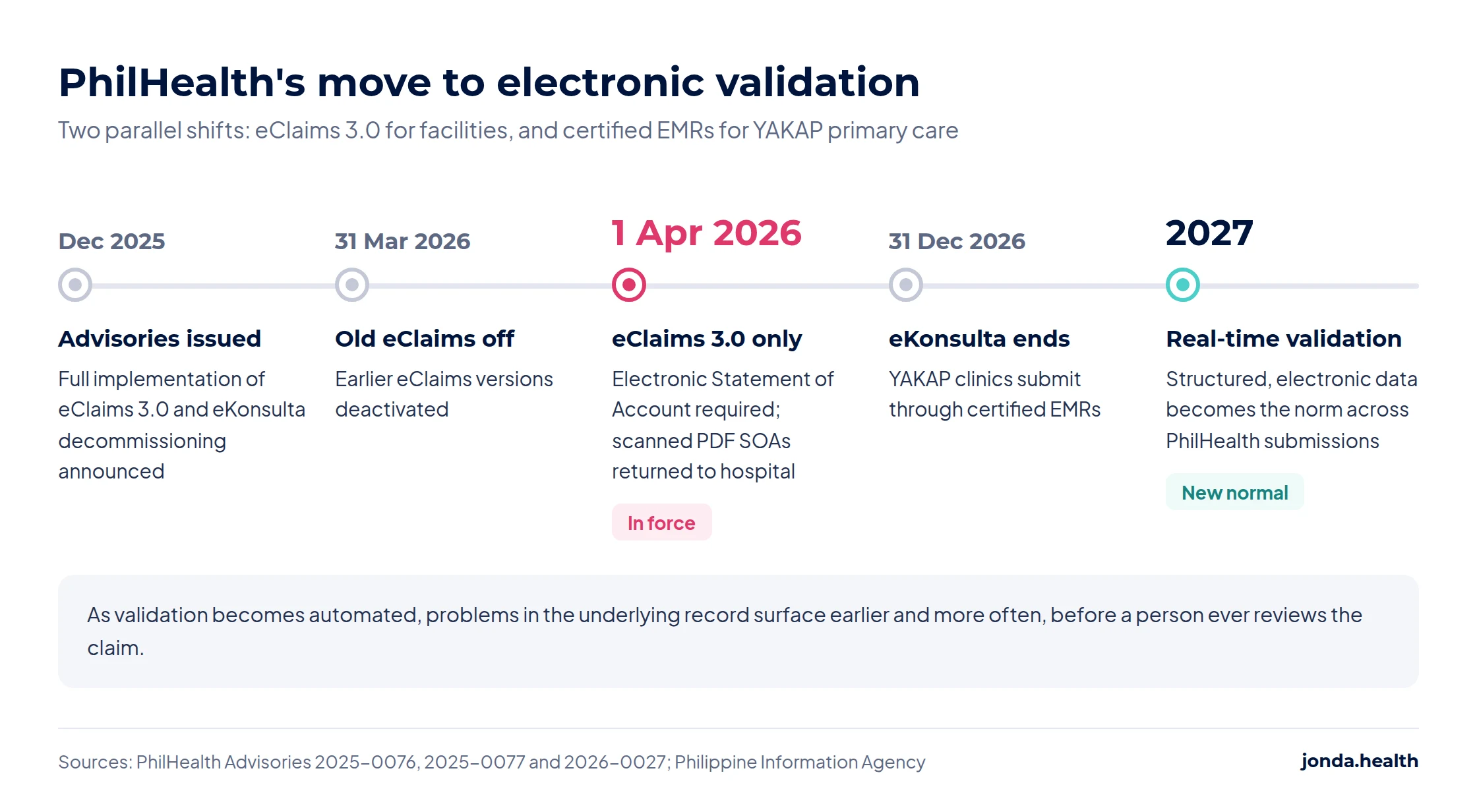
Two shifts are happening in parallel. For accredited health facilities, eClaims 3.0 became the only claims platform from 1 April 2026, with earlier versions deactivated. An electronic Statement of Account is now required for admissions, and claims submitted with a scanned PDF Statement of Account are automatically returned to the hospital. PhilHealth describes the aim as more efficient processing, automated data validation, fewer manual errors and faster reimbursement (Philippine Information Agency; PhilHealth Advisory 2026-0027).
For primary care, YAKAP clinics are moving from eKonsulta to PhilHealth-certified EMRs. PhilHealth has said that YAKAP needs a system that can enforce real-time electronic submission and validation of health data, and that providers who submit in real time will benefit from reduced claims denials, faster claims processing and smoother interoperability (PhilHealth Advisory 2025-0077). We cover that transition in detail in Moving Off eKonsulta.
Facilities should always check PhilHealth's latest advisories, since requirements and dates can change.
When claims were largely reviewed by people, many small inconsistencies were caught and corrected quietly along the way. Automated validation works differently. It checks what is in the submission, quickly and consistently, and returns what does not meet the rules. PhilHealth's President has described EMR systems as the backbone of seamless care coordination and timely reimbursement (Philippine News Agency).
That makes the record behind each claim more important. A patient's details that differ slightly between two systems, a required field left blank, or a result recorded in free text are all more likely to surface at validation. Each one is small. Together, across thousands of encounters, they can add up to a meaningful drag on payment and staff time.
Most issues that appear at validation begin much earlier, when the record is first captured. Looking upstream is usually more effective than working harder on corrections downstream.
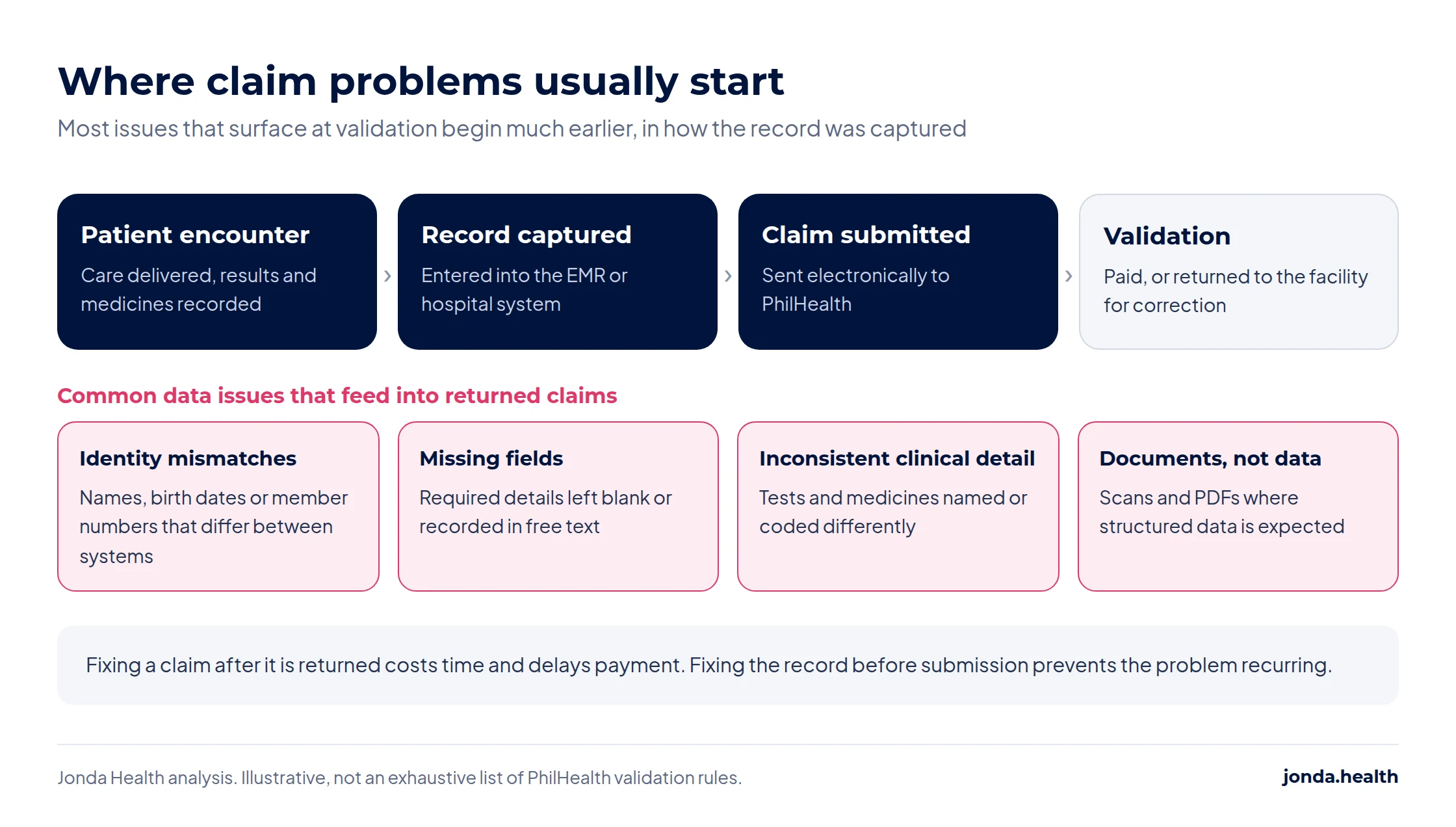
In the records we work with across the region, the same patterns appear again and again. Patient details are captured differently in different systems. Laboratory tests and medicines are named, abbreviated and coded in several ways. Important information sits in free text or scanned documents rather than structured fields. None of this reflects poor practice; it is how records build up in busy facilities, often across more than one system.
AI can help with much of this work at speed, and we use it extensively ourselves. The lesson we have learned is that in a regulated, financial setting, speed alone is not enough. Clinical review and quality checks are what make sure the corrected data is actually right, which is why we argue that healthcare AI will not work without trusted data infrastructure.
As the country moves toward shared exchange standards, the same data habits will help with interoperability too, which we cover in PH Core Explained.
At Jonda Health, we have spent years working with health records across formats and languages, and we know how often a problem that shows up at the end of a process began at the very start. Depending on where your organisation is today, there are three ways we can help.
eClaims 3.0 is PhilHealth's current electronic claims platform. It became mandatory for all accredited health facilities from 1 April 2026, when earlier versions were deactivated.
Claims can be returned for many reasons set by PhilHealth's rules. Under eClaims 3.0, for example, claims submitted with a Statement of Account in scanned PDF format are automatically returned. Facilities should check PhilHealth's advisories for the full, current requirements.
PhilHealth has said that providers who submit data in real time will benefit from reduced claims denials, faster claims processing and seamless interoperability with its systems. Results for any single facility will depend on the quality of the data it submits.
Automated validation checks what is in the submission. Mismatched patient details, missing fields, inconsistent clinical information or documents where structured data is expected are more likely to be caught, which can delay payment.
Yes. YAKAP clinics are moving to PhilHealth-certified EMRs for real-time submission, and eKonsulta closes on 31 December 2026. The same data habits help both hospitals and primary care clinics.
Sources: PhilHealth Advisories 2025-0077 and 2026-0027; Philippine Information Agency; Philippine News Agency (December 2025). This article is for general information and is not regulatory or financial advice. Please check PhilHealth's latest advisories for current requirements.





