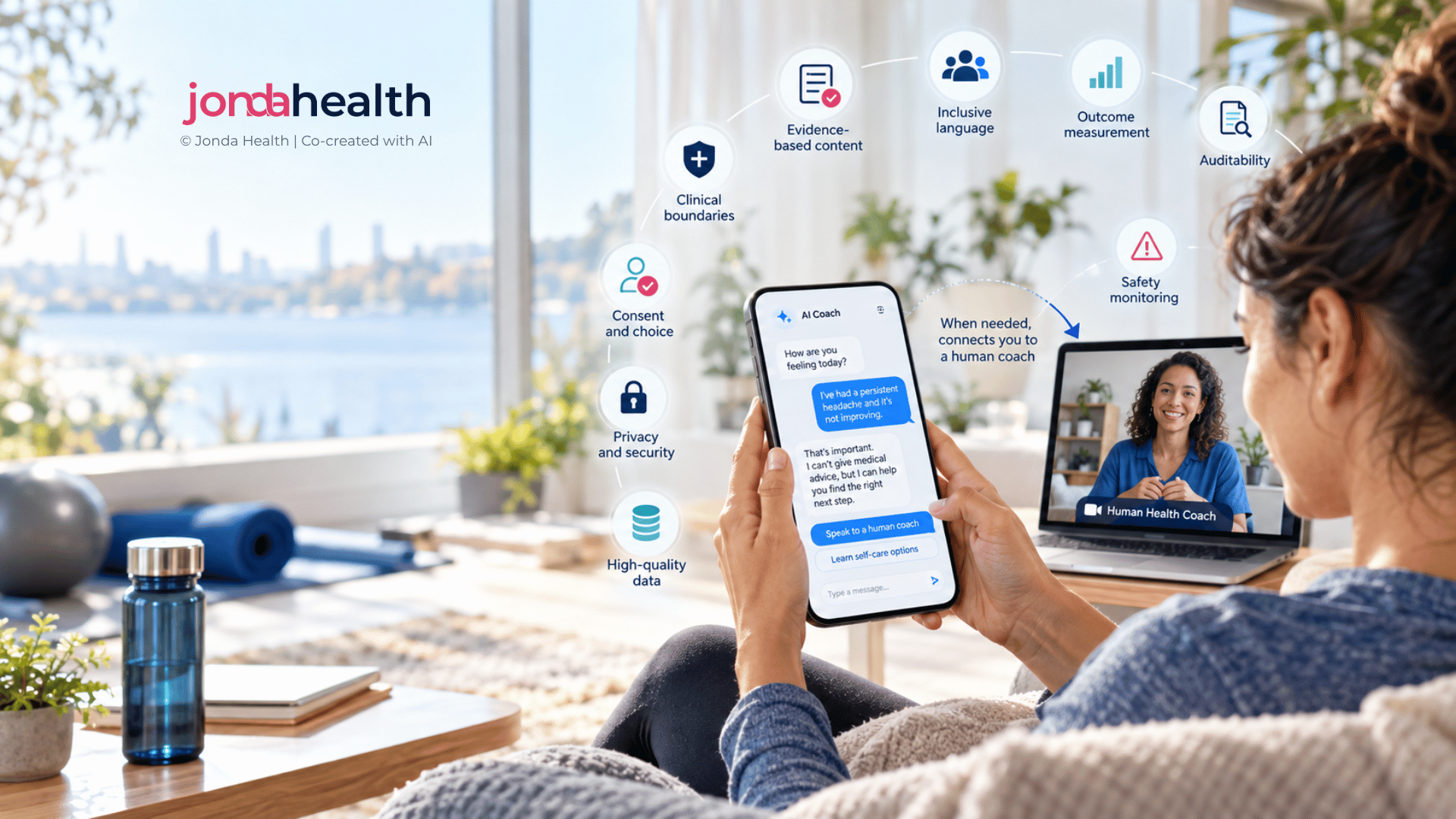
An AI coach can make a wellness programme feel personal at a scale no human team can match. It can also give confident advice based on the wrong number. Here are ten checks to run before members start talking to it.

An AI wellness coach is software, usually built on a large language model, that chats with programme members to explain results, set goals and encourage healthier habits. Before an insurer launches one, ten checks cover what it may do, what data it relies on, who oversees it and how member trust is protected.
AI coaching is one of the fastest-moving areas in insurance wellness. Large language models can hold a natural conversation, explain a health check result, suggest a realistic goal and check in when a member goes quiet. For insurers who have struggled to personalise wellness programmes at scale, the appeal is obvious, and many vendors now offer an AI coach as part of their platform.
The risks are just as real. An AI coach that reads a cholesterol value in the wrong unit, misses a finding written in the doctor's notes, or answers a worrying symptom with lifestyle tips can harm members and damage trust in the whole programme. Regulators and health authorities across Asia, Europe and elsewhere are paying close attention to where responsibility sits when AI is involved in health advice.
This guide is for wellness, digital and product leads inside insurers, and for the medical, compliance and data colleagues they will need alongside them. It sets out ten things to check before launching an AI coach, grouped into four questions: what the AI is allowed to do, what it knows, who stays in the loop, and how trust is protected.
Figure 1. Members only see the top layer. Safety depends on all three, and on the people watching over them.
A wellness coach encourages healthier habits, explains results in general terms, and helps members set and keep goals. Clinical advice interprets a person's results to guide diagnosis or treatment. The boundary between the two is easy to cross in conversation. A member asks whether they should stop a medicine, whether a symptom is serious, or what their result means for them specifically, and an obliging AI may simply answer.
Before launch, write down what the coach may do, what it must never do, and how it should respond when a member asks for something outside its scope. Test those boundaries with realistic questions, including ones designed to push past them.
Ask your vendor: "Show us the written scope for the coach, and examples of how it responds when a member asks about medication, symptoms or a diagnosis."
Ask your team: "Has our medical team signed off the list of things the coach must never do, and who owns that list as the product changes?"
In many markets, software that analyses an individual's health data to support diagnosis, monitoring or treatment decisions can fall under medical device rules, and AI in healthcare is increasingly covered by its own guidance. A coach that stays with general wellness support is usually treated differently from one that interprets results and recommends clinical actions. The answer depends on what the coach actually does, not on what it is called.
Our articles on Singapore's AI in Healthcare Guidelines 2.0 and the EU AI Act describe how responsibility is being divided between developers, deployers and clinicians in two very different regimes.
Ask your vendor: "Which markets have you assessed the coach against for medical device and AI rules, and what did that assessment conclude?"
Ask your team: "Have regulatory and legal colleagues reviewed the intended use in each market where we plan to launch?"
An AI coach personalises its advice using whatever member data it can see: health check results, device readings, questionnaire answers, activity data. If that data arrives as PDFs and photos that were read imperfectly, keyed in by hand, or never captured at all, the coach will give confident, personal advice based on incomplete or wrong information. Members will not know the difference.
This is the check most often skipped, because data quality looks like a technical issue rather than a safety one. In practice, it is where many AI coaching errors begin.
Ask your vendor: "Which data sources does the coach use, how are documents and photos turned into data, and how is accuracy checked before the coach sees it?"
Ask your team: "If we sampled twenty members, would the data the coach sees match what is actually in their health check reports?"
A lab value means little without its unit, its reference range, how it was measured and when. Results from different clinics use different names, units and languages, and the same number can be normal in one unit and worrying in another. Our article 7 Ways a Lab Value Can Mean Something Other Than You Think sets out the most common traps.
An AI coach should receive results already brought into consistent definitions and units, with their context attached, rather than being asked to interpret raw values on the fly in the middle of a conversation.
Ask your vendor: "How does the coach handle results in different units or languages, and what happens when a unit or reference range is missing?"
Ask your team: "Do we hold our key measures to one definition and unit before any AI uses them?"
Some situations should never stay in an automated conversation: a result that needs prompt clinical attention, a member describing worrying symptoms, or signs of emotional distress. The coach needs clear rules for recognising these moments and handing over to a person, and the people receiving those handovers need to be available and trained to respond.
Figure 2. The coach handles the routine. Clear triggers hand everything else to the right person.
Ask your vendor: "What triggers a handover to a person, how quickly does it happen, and can we see how often it happened in another deployment?"
Ask your team: "Who receives escalations, at what hours, and in which languages, and what happens if nobody is available?"
Someone with clinical training should review what the coach says, especially early on and whenever its scope or underlying model changes. That review is most valuable when it is systematic: sampling conversations, checking flagged responses, and making sure that every correction changes how the coach behaves in future rather than fixing one conversation and moving on.
Figure 3. Oversight that closes the loop, rather than reviewing and forgetting.
Our article on where a human must stay in the loop explores the same principle for medical information teams.
Ask your vendor: "Who reviews the coach's responses, what are their qualifications, how many conversations do they review, and how do corrections feed back?"
Ask your team: "Which clinician in our organisation is accountable for the coach's advice, and how will they see what it is saying?"
A coach that performs well in a vendor demonstration may struggle with your members: their languages and mixed-language messages, their health check formats, the clinics they use, and the questions they actually ask. Testing should use realistic scenarios drawn from your own programme, including difficult and unusual ones, before any member sees the coach.
After launch, behaviour can drift as models are updated, new data sources are added, or members find new ways to ask questions. Ongoing monitoring of a sample of conversations, escalation rates and member complaints is part of running the coach, not an optional extra.
Ask your vendor: "Can we test the coach on scenarios we write, using de-identified examples from our own members, before we sign?"
Ask your team: "What will we monitor every month after launch, and what would make us pause the coach?"
Members often tell an AI coach things they would not put on a form: stress at work, family pressures, alcohol use, symptoms they are worried about. Those conversations are sensitive health data. Insurers need to know where they are stored and processed, who can read them, whether they are used to train models, and how they are kept separate from underwriting and claims, just like the rest of the wellness data.
Ask your vendor: "Where are conversations processed and stored, are they used to train any model, and can processing stay in-country?"
Ask your team: "Have we told members, in plain language, what happens to what they say to the coach, and is that consistent with our wellness data boundaries?"
Insurance wellness programmes in Asia and Africa serve members who speak many languages, mix languages within a single message, and live with very different diets, working patterns and family structures. A coach that works well in English may give poorer, less relevant or less safe advice in other languages, or offer suggestions that make little sense in a member's daily life. Our guide Beyond Translation sets out why translation alone is not enough.
Ask your vendor: "How has the coach been tested in each language our members use, and how is advice adapted to local food, work and family life?"
Ask your team: "Are we monitoring quality and escalation rates separately for each language and member group?"
Members should always know they are talking to an AI, what it can and cannot help with, and how to reach a person. That openness builds the kind of trust that keeps members engaged. It is also worth deciding early how success will be judged. Message counts and session lengths show activity. Follow-ups completed, goals reached and changes in health measures show whether the coach is actually helping.
Ask your vendor: "How does the coach tell members it is an AI and offer a route to a person, and which outcome measures can you report on?"
Ask your team: "Which outcomes will tell us, in a year's time, whether the coach made our programme better?"
Insurers should check the coach's scope versus clinical advice, medical device status in each market, the quality of member data it reads, how it interprets results in context, escalation to people, clinical oversight, testing and monitoring, privacy, fairness across languages and transparency with members.
It depends on what it does and where it is used. Software that analyses an individual's health data to support diagnosis or treatment decisions can fall under medical device rules in many markets, while general wellness support is usually treated differently. Assess each market separately.
An AI coach personalises advice from the member data it can see. If health check results were misread, keyed by hand, missing context or never captured, the coach will give confident advice based on wrong or incomplete information, and members cannot tell the difference.
Clear triggers should hand a conversation to a trained person when a result needs prompt clinical attention, a member describes worrying symptoms, or there are signs of emotional distress, with escalation routes staffed at the hours and in the languages members use.
Treat them as sensitive health data: know where they are processed and stored, who can read them, whether they train any model, keep them separate from underwriting and claims, offer in-country processing where needed, and tell members plainly how they are used.
Yes. JondaX turns health check documents and photographed device readings into structured, consistent data with units and context attached, checked by clinically trained reviewers where flagged, so an AI coach works from accurate member data rather than raw PDFs.
Jonda Health does not build AI coaches. We help insurers and their partners get the foundations right, so that any AI coach they choose works from accurate, well-governed member data.
About the author. Suhina Singh is Founder & CEO of Jonda Health. She has spent her career in healthcare, first as a doctor working in oncology, then in medical affairs and digital transformation roles across Asian markets, and as an investor in and builder of digital health products. She founded Jonda Health in 2021 to make health data usable for the people and systems that depend on it.
This guide offers general information, not legal, regulatory or clinical advice. Rules on AI and medical devices vary by market and are changing quickly, and insurers should seek advice for the markets they operate in.