7 Reasons Member Health Checks Never Make It Into Your Wellness Programme
A health check is the richest picture of a member's health that a wellness programme receives all year. Too often, it never counts. Here is why, and what it costs the member, the employer and the insurer.
Suhina Singh
Founder & CEO, Jonda Health
October 27, 2026
·
18 min read
A member health check is the set of tests and assessments, such as lab results, a doctor's review, vitals, imaging and screenings, that members of an insurance or corporate wellness programme complete and submit in return for guidance and rewards. In many programmes, most of what it contains never becomes usable data.
Insurance wellness programmes make a simple promise. Members look after their health, and the programme helps them do it: personal guidance, rewards for progress, and a nudge at the right moment when something needs attention. Employers who buy group cover expect a healthier, more engaged workforce. Insurers expect members who stay, act earlier, and need less costly care over time.
The annual health check sits at the centre of that promise. It is the moment a member does something deliberate for their health and hands the programme a detailed picture of where they stand. Yet in many programmes, that picture never fully arrives. The member submits it, and somewhere between the clinic and the programme, it stops being useful.
This is rarely a single failure. It is a set of small, ordinary data problems that each quietly drain value from the programme. This guide sets out seven of them, written for the people who run wellness programmes inside insurers and for the operators who run them on an insurer's behalf.
Key takeaways
A health check is a bundle of documents, readings and answers, not a single report.
Most of it arrives in forms a programme cannot use without significant work.
Every reason below costs something real: a member's trust and motivation, an employer's confidence, and an insurer's return on the programme.
Fixing the data is what turns a health check into the value the programme was designed to deliver.
What a wellness programme is meant to deliver
Three groups, three different reasons to care
Before looking at what goes wrong, it helps to be clear about what is at stake. A well-run wellness programme creates value for three groups at once, and the health check feeds all of them.
The member
Guidance that reflects their own results
Rewards for the effort they make
Early prompts to act on a finding
A visible sense of progress
The employer
A healthier, more engaged workforce
Evidence the cover is worth renewing
A benefit employees actually use
The insurer
Engaged members who stay longer
Earlier intervention, before a claim
Population insight to shape programmes
Proof of programme value
Each of the seven reasons that follow breaks a link somewhere in this chain. Some cost the member most directly. Others are felt by the insurer months later, when engagement drops or a corporate client asks what the programme achieved.
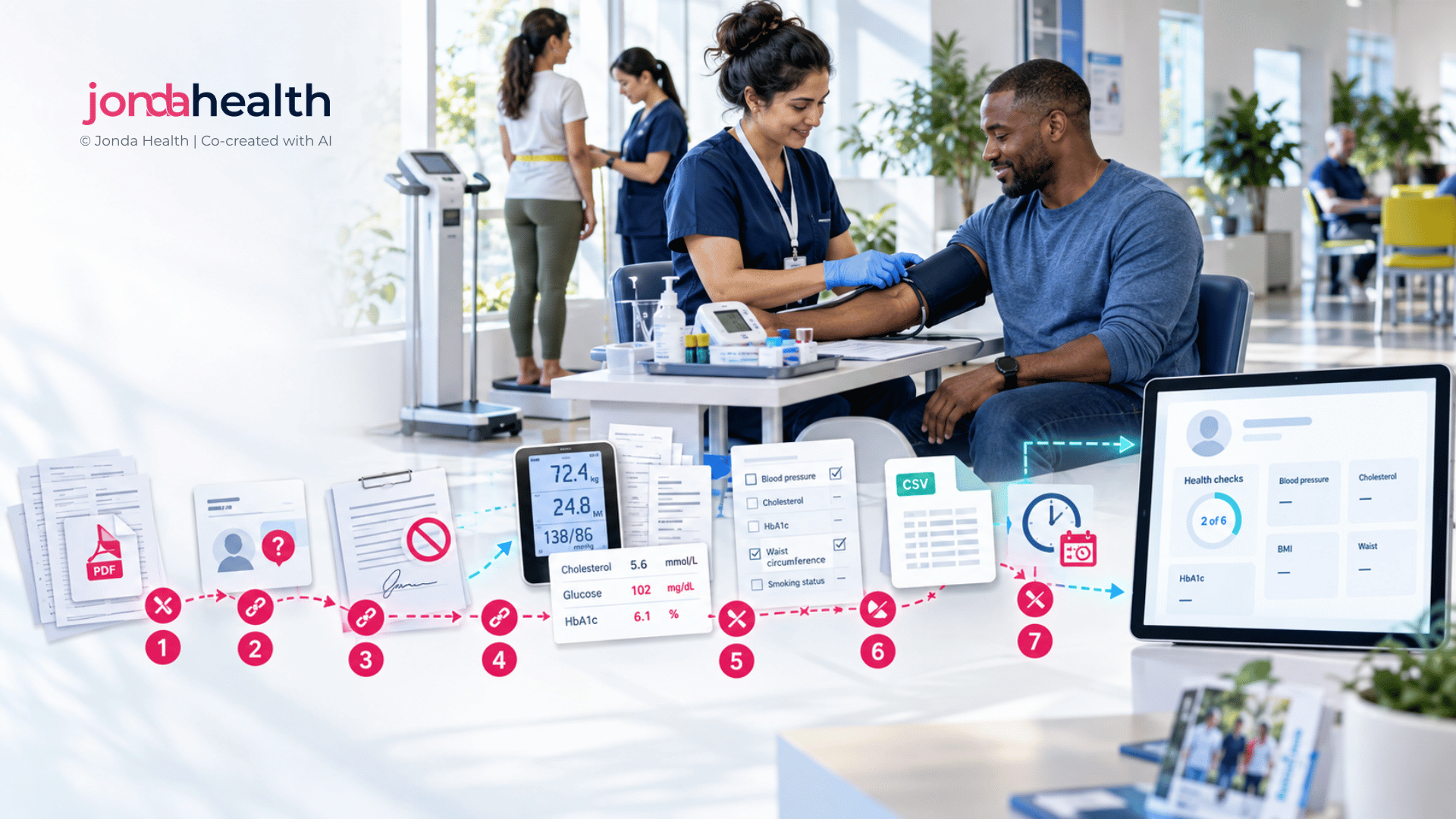
Figure 1. A health check reaches the programme as many separate pieces, each in its own format.
1. The health check arrives as a pile of PDFs, photos and paper
The member did their part. The programme cannot read it.
A member books a health check, takes a morning off, and receives a folder of results. To claim their wellness points, they upload what they were given: a PDF lab report, a photo of a handwritten vitals sheet, a scanned doctor's letter, perhaps a screenshot from the clinic's app. Every one of those files is meaningful to a person. Very little of it is meaningful to a system.
Programmes respond in one of three ways. Some count the upload itself, rewarding the act of attending rather than anything the results say. Some ask an operations team to read and key in a handful of values. Others simply store the files, where they sit unread. In all three cases, the most detailed health information the programme will receive all year is reduced to a tick box, or to a few numbers out of dozens.
Figure 2. The member hands over a full picture. The programme often keeps a tick box and a number or two.
Cost to the member and employer
The member's effort goes largely unrecognised. Guidance stays generic because the programme only knows that they attended, and the employer sees participation figures with nothing behind them.
Cost to the insurer
The programme pays for, or encourages, the most valuable data point of the year and then cannot use it. Any personalisation, risk insight or outcome reporting is built on a fraction of what was submitted.
What good looks like
Whatever the member submits, in whatever form, becomes structured data the programme can act on, without asking the member to retype anything and without a growing manual workload behind the scenes. The full health check counts, not just the fact that it happened.
Tip. Take twenty real member submissions and list every value they contain. Then compare that list with what your platform actually stores. The gap is the value you are leaving behind.
Common pitfall. Asking members to type their own results into a form. It feels like a quick fix, but it adds effort at the moment you want the least friction, and self-keyed values are hard to trust for rewards.
2. Early findings are buried in doctor's notes and imaging reports
The most useful sentence in the health check is often in free text.
Many of the findings that matter most for prevention never appear as a number in a results table. They are written in sentences. The doctor's summary might note a mildly raised fasting glucose and suggest repeating the test in three months. An imaging report might recommend a follow-up scan, or a borderline electrocardiogram (ECG) comment might be flagged for review. A dental or eye screening might recommend a follow-up visit.
These are exactly the moments a wellness programme exists for. A finding has surfaced early, while the member is well, and a timely prompt could make the difference between a lifestyle conversation now and a more serious problem later. But when the finding sits in a paragraph of a scanned report, no rule can fire, no nudge goes out, and no one on the programme team knows it is there.
Figure 3. The same finding, buried in a sentence versus captured in a form the programme can act on.
Cost to the member and employer
The member misses a timely prompt to act on something found early, which is the core benefit they were promised. For the employer, a preventable issue may later show up as absence or reduced wellbeing.
Cost to the insurer
The programme misses its best opportunity to intervene before a finding becomes a claim. Without these findings, it also cannot see which risks are common across its members or design support around them.
What good looks like
Findings written in doctor's summaries, imaging impressions and screening notes are captured alongside the numbers, reviewed by clinically trained people where the meaning matters, and routed into the programme's follow-up rules. A member hears about the right next step while it is still early.
Tip. Agree with your medical team which free-text findings should trigger a prompt, and how quickly. A short, clinically signed-off list is far more useful than trying to act on everything.
Common pitfall. Searching reports for keywords. Phrases such as "no evidence of" or "previously noted" change the meaning completely, and a keyword match can send a member the wrong message.
3. Results from different providers cannot be compared
The same measure, written three different ways.
Members rarely go back to the same clinic every year. One year they test at a panel clinic near the office, the next at a hospital screening centre, and the year after at a lab while travelling. Each provider names tests in its own way, sometimes in a local language, and many report in different units. One report says HbA1c 5.8%, another says glycated haemoglobin 41 mmol/mol, and a third says hemoglobin terglikasi with its own reference range. A cholesterol of 5.2 mmol/L and one of 201 mg/dL describe almost exactly the same result.
The same problem applies well beyond lab results. Blood pressure may be recorded seated or standing, once or as an average. Body mass index may be measured or self-reported. Questionnaires use different scales. Until these are brought into one consistent form, a programme cannot tell whether a member is improving, staying the same, or quietly drifting the wrong way.
Figure 4. Three providers, three ways of writing the same test. Only once they are made consistent does the upward drift become visible. Values are illustrative.
Cost to the member and employer
The member cannot see their own progress, which is one of the strongest reasons people keep engaging. For the employer, year-on-year change across the workforce simply cannot be reported.
Cost to the insurer
Gradual drift, the very signal a prevention programme exists to catch, stays hidden. Population trends cannot be trusted when the underlying values are not like for like, so programme design rests on guesswork.
What good looks like
Every result, whichever provider, language or unit it came from, is brought into one consistent form, with the original kept for reference. Test names are resolved to a single meaning, units are converted carefully, and anything ambiguous is checked by a clinically trained reviewer rather than guessed.
Tip. Pick the ten measures that matter most to your programme and decide, with your medical team, the one unit and definition you will hold each to. It is a short exercise that makes every later report more trustworthy.
Common pitfall. Comparing values against each provider's own reference range and treating "within range" as the result. Ranges differ between labs, so the same value can be flagged at one provider and not at another.
4. Device, wearable and questionnaire data sit apart from clinical results
Each source tells part of the story. None tells it alone.
Most wellness programmes collect far more than the annual check. Members log steps and sleep from a wearable, photograph readings from a home blood pressure monitor or glucometer, and complete a health risk questionnaire about diet, activity, smoking and stress. Each of these usually lives in its own place: the wearable feed in one system, device photos in an upload folder, questionnaire answers in the app, and health check results somewhere else entirely.
The real insight comes from reading them together. A borderline blood pressure at the health check means something different when home readings have been creeping up for months and the questionnaire shows the member has stopped exercising. Seen side by side, that is a clear, personal reason to reach out. Seen separately, each looks unremarkable, and the member receives the same generic advice as everyone else.
Figure 5. Four sources that each look unremarkable on their own add up to a clear, personal reason to reach out.
Cost to the member and employer
The member gets generic tips rather than guidance that reflects their life, so the programme feels like an app rather than support. Employers see a benefit that does not feel personal, which weakens uptake.
Cost to the insurer
The promise of personalisation, which is often central to how the programme is sold, falls flat. Coaching and support resources are spread evenly instead of directed to the members who would benefit most.
What good looks like
Clinical results, device readings, wearable data and questionnaire answers are linked to the same member and held in a consistent structure, so the programme can read them side by side and set rules that draw on more than one source.
Tip. Write down three member stories your programme should be able to spot, each needing at least two data sources. Then check whether your data, as it is stored today, could actually spot them.
Common pitfall. Treating every data source as equally reliable. A clinic-measured blood pressure, a home reading and a self-reported answer carry different weight, and the programme's rules should know which is which.
5. Manual keying, matching and verification create backlogs
The member earned the reward weeks ago. The queue has not caught up.
When results cannot be read automatically, someone has to do it by hand. An operations team opens each upload, types in the values that matter, works out which member it belongs to, and checks whether it qualifies for a reward. Matching alone is harder than it sounds: the name on the clinic report may be spelled differently, the identification number may be missing, and the date of birth may be written in another format.
Volumes are rarely steady. Submissions spike around the end of a programme year, after a corporate health day, or when a points campaign runs, which is exactly when members expect quick recognition. Backlogs grow, rewards are delayed, some submissions are rejected because they could not be verified, and the member who did everything right is left wondering whether it was worth the effort.
Figure 6. Manual handling puts a person at every step. A structured flow keeps people where their judgement matters.
Cost to the member and employer
Rewards arrive late, or not at all when a submission cannot be verified. Members lose trust in the programme, and employers hear the complaints from their own staff.
Cost to the insurer
Operations cost grows with every submission, peaks are hard to staff, and complaints rise. Errors in keying or matching can also mean the wrong member is rewarded, or the wrong result is attached to someone's record.
What good looks like
Submissions are read, linked to the right member and checked against the reward rules as they arrive. Only the items that genuinely need judgement, such as an unclear result or an uncertain match, go to a clinically trained reviewer, and members are rewarded while the effort is still fresh in their minds.
Tip. Measure the time from upload to reward for a recent month, and the share of submissions rejected. Those two numbers tell you more about member experience than most satisfaction surveys.
Common pitfall. Matching on name alone. Spelling and naming conventions vary widely across Asia and Africa, so matching should draw on several identifiers, with uncertain matches held for review rather than guessed.
6. Uncertainty about wellness versus underwriting use
When nobody is sure where the line is, everyone holds back.
Health data shared for a wellness programme is sensitive, and members know it. Many hesitate to upload a full health check because they are unsure whether it could affect their premiums or future cover. Inside the insurer, the same uncertainty plays out in a different way. Wellness, underwriting, claims and data teams may each be unclear on what the programme is allowed to do with the data, so the safest course appears to be doing very little with it.
Data protection laws in most markets expect personal data to be used only for the purposes people were told about. Singapore's Personal Data Protection Act (PDPA) sets this out as a purpose limitation obligation, and the European Union's General Data Protection Regulation (GDPR) treats purpose limitation as a core principle and health data as a special category.1,2 The rules differ in detail from market to market, and each programme should take its own advice. The practical point is the same everywhere: a programme can only use data confidently when it knows exactly where each piece came from, what the member agreed to, and who is allowed to see it.
Figure 7. Clear purpose, clear origin, clear access. When the line is visible, teams can use wellness data with confidence.
Cost to the member and employer
Members share less than they could, or nothing at all, and lose the benefit of a programme built around their results. Employers see lower participation from the very people who might benefit most.
Cost to the insurer
Data the programme is entitled to use for wellness sits idle out of caution. At the other extreme, unclear boundaries create real privacy and reputational risk if data is used beyond what members agreed to.
What good looks like
Every data point carries its origin and the purpose it may be used for. Wellness data is kept within that purpose, identifiers are pseudonymised wherever programme insight does not need them, and members are told plainly, in the app, how their data is and is not used.
Tip. Write one short paragraph, in plain language, explaining to members what happens to their health check. If your wellness, underwriting and legal teams cannot agree on that paragraph, the boundary is not yet clear enough.
Common pitfall. Assuming that removing names is enough. Dates, clinic names and rare findings can still point to a person, so pseudonymisation needs thought about what else in the record is identifying.
7. No credible evidence that the programme works
Renewal season arrives, and the report shows activity rather than outcomes.
Sooner or later, someone asks whether the programme is working. An employer's human resources lead wants to know before renewing group cover. A product committee inside the insurer wants to know before increasing the budget. Too often, the answer is a participation report: how many members registered, how many health checks were attended, how many points were issued. These numbers show activity, but they cannot show that anyone is healthier.
Credible evidence depends on everything that came before it in this guide. It needs results that were captured in full, findings that were acted on, values that can be compared over time and across providers, and data that was used within clear boundaries. When those foundations are missing, even a programme that is genuinely helping people cannot prove it.
Figure 8. Participation shows that people took part. Outcomes show that taking part made a difference.
Cost to the member and employer
Employers cannot see a return when cover comes up for renewal, so programmes are cut or reduced. Members lose a benefit that may have been genuinely helping them.
Cost to the insurer
The programme cannot prove its value internally or win renewals on outcomes, so it is treated as a cost rather than a reason members and employers stay. Decisions about where to invest next are made without evidence.
What good looks like
Outcome measures are agreed at the start of the programme year, and the data needed to report them is captured consistently from the first submission. Reports to employers and internal committees show change over time, not only activity, with clear notes on what the data can and cannot support.
Tip. Ask your largest corporate client what they would want to see at renewal, then work backwards to the data you would need to show it. The gaps you find are where to start.
Common pitfall. Promising outcome reporting before the data foundations exist. An outcome claim that cannot be backed up does more damage to trust than an honest participation report.
When every health check counts
The value was always there. The data decides whether it reaches anyone.
Taken together, these seven reasons explain why so many wellness programmes deliver less than they promise, even when members are doing their part. None of them is about a lack of effort from the people running the programme. Each is about data arriving in forms, places and meanings that the programme cannot use.
When the data is right, the programme starts to work the way it was designed to. Members see their own progress and hear about the right next step at the right time. Employers see a benefit their people use and outcomes they can weigh at renewal. Insurers see engaged members, earlier intervention and evidence that the programme is worth investing in. Each health check then feeds the next, because members who feel their effort counted are far more likely to come back.
Figure 9. When the data is usable, value reaches the member, and the member comes back.
Where to start
If you lead a wellness programme inside an insurer, start with reasons 1 and 7. Compare what members submit with what your platform keeps, and then compare what your reports show with what your largest clients want to see. The distance between those two pairs is the value waiting to be recovered.
If you run wellness programmes on an insurer's behalf, start with reasons 3 and 5. Consistent, comparable data and a fast, reliable path from upload to reward are what your insurer clients notice first, and they make every other improvement easier to deliver.
Frequently asked questions
Why do member health checks not count in wellness programmes?
Most health checks reach the programme as PDFs, photos and paper reports in different formats and languages. Programmes can often record only attendance or a few keyed values, so findings, comparable trends and much of the value to members and insurers are lost.
What does a corporate or insurance health check include?
A typical health check combines lab results, a doctor's summary, vitals such as blood pressure and body mass index, an electrocardiogram (ECG), imaging or screening reports, and vision, hearing or dental checks. Many programmes also collect home device readings, wearable data and lifestyle questionnaires.
How can a wellness programme verify health check results before issuing rewards?
Each value should be read from the source document, linked to the right member and checked against the reward rules, with uncertain values reviewed by clinically trained people. Keeping the source document allows every reward to be traced back to its evidence.
How do you compare health check results from different clinics and labs?
Results need to be brought into one consistent form: test names resolved to a single meaning, units converted carefully, and measurement differences recorded. Ambiguous cases should be reviewed rather than guessed, and the original values kept for reference.
Can insurers use wellness programme data for underwriting?
It depends on what members agreed to and on local law. Data protection rules in most markets expect personal data to be used only for the purposes people were told about, so wellness data is usually kept separate from individual underwriting. Insurers should take advice for each market.
Can JondaX read health check reports for wellness programmes?
Yes. JondaX is a single API that turns lab reports, doctor's summaries and other clinical documents, and photographed medical device readings into structured, consistent data, with clinically trained reviewers checking flagged values and 99% field-level accuracy with expert review.
How Jonda Health can help
Jonda Health works with programmes like these from two directions. Some teams need help understanding their data and designing how it should flow. Others already know what they need and want the health data layer handled for them. Many need a little of both.
Jonda Health Services
Understand and design your programme's data
Health data foundations: we map what members submit, where it goes, what is lost along the way, and what it would take to turn it into value for members, employers and your programme.
Privacy and data-flow design: we help you set clear boundaries between wellness and other uses, decide what to pseudonymise, and plan around local rules, including in-country processing.
Experience design: we help shape the submission journey so members can share their health check with less effort and see that it counted.
JondaX
Turn every submission into usable data
One API for every source: lab reports, doctor's summaries and other clinical documents, and photographed medical device readings, arriving as PDFs, scans or photos in many languages, returned as structured, consistent data.
Configured to the data types your programme needs, and to your own definitions and code sets where you have them.
Clinically trained reviewers check what the AI flags, and their corrections feed back into future mapping, reaching 99% field-level accuracy with expert review.
ISO 27001 certified, designed to comply with HIPAA, GDPR and PDPA, and able to process data within a client's own country where required.
Want every health check in your programme to count?
We would be glad to hear how your programme handles member submissions today and where the value is getting lost. There is no need to have it all worked out before you reach out.
Suhina Singh is Founder & CEO of Jonda Health. She has spent her career in healthcare, first as a doctor working in oncology, then in medical affairs and digital transformation roles across Asian markets, and as an investor in and builder of digital health products. She founded Jonda Health in 2021 to make health data usable for the people and systems that depend on it.
This guide offers general information, not legal advice. Data protection requirements vary by market, and programmes should seek advice for the markets they operate in.